
The polar bear (also known as the Ursus Maritimus or the “sea bear”) is the world’s largest terrestrial predator, and can be found in many locations including the Arctic, Alaska, Canada, Denmark, Norway and Russia. The polar bear lives in extreme cold climate conditions on the annual arctic sea ice, with temperatures dropping as low as -45 degrees Celsius. In fact, the polar bear needs sea ice to survive. The arctic sea ice allows the polar bear to hunt, live, travel and breed – sea ice is the basic foundation of the arctic marine ecosystem.
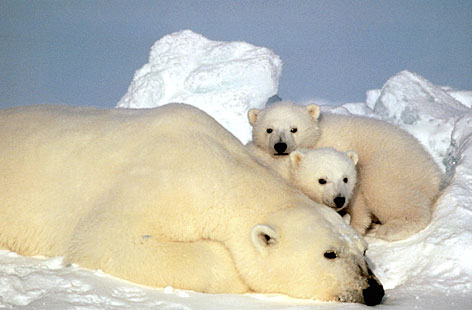
It is estimated that there are currently 20-25,000 polar bears worldwide; most of which live in Canada. With that being said, studies have shown that approximately two-thirds of the world’s polar bears could disappear by the year 2050. Why you ask? Because of global warming. As temperatures increase, the ice, that the polar bear depends so heavily upon, is melting away – destroying the polar bear’s natural habitat. Global warming is a growing ecological issue that is inflicting an abundance of negative effects upon the polar bear’s survival. As the severity of this situation increases, the possibility of the polar bear’s eventual extinction comes into play.
According to the NWF (National Wildlife Federation), rapid Arctic ice melting in 2007….
- Caused a record low for the surface area of summer sea ice in the Arctic Ocean, nearly 23 percent below the previous record low in 2005
- Melted an additional area equivalent to the size of Alaska and Texas, combined
- Exceeded the projections of most climate-ice models. Based on rapid melt, one NASA scientist projected summer ice could be essentially gone as early as 2012
**This data fortifies and illustrates the severity and intensity of rapid Arctic ice melting.
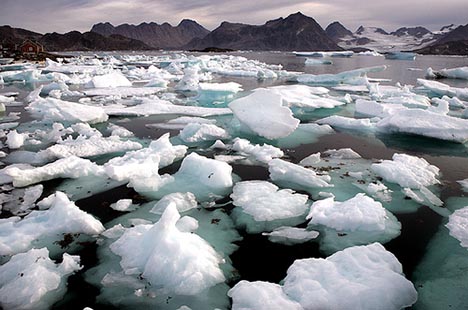
The polar bear is situated at the top of the Arctic marine ecosystem, and finds its primary food source from the seal. The sea ice functions as the polar bear’s mechanism for hunting and traveling — seals create ‘breathing holes’ in the ice, and the polar bears wait until the seals surface, to then consume the seals as their food source. As the excess heat melts away the sea ice, the polar bears are left wandering, unable to catch seal. The scarcity of their food supply is continuously increasing, and the polar bears are left with nothing to eat This reduced food availability is leading to the starvation and death of many polar bears. Scientists and researchers have found the bodies of multiple polar bears that had starved to death. Both their habitats and food supply are disappearing – which in turn poses a life-threatening concern upon the survival of this species.
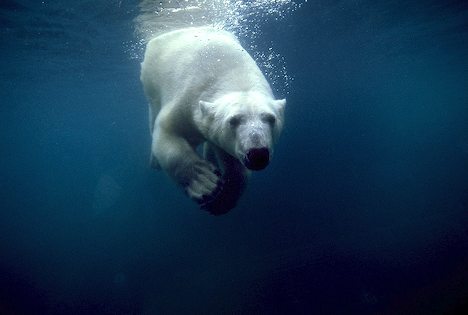
Although polar bears are recognized as rather strong swimmers, there have been multiple cases of polar bears drowning. Polar bears are being obligated to swim excessive distances across open sea (up to 60 miles!) to find food and habitat. These ‘sea voyages’ are becoming longer and essentially never-ending. The ‘ice floes’ from which they feed and rest are rapidly decreasing in size and drifting further away from one another. These ‘voyages’ are leaving them susceptible to extreme exhaustion and hypothermia which is causing them to drown as they desperately search for food and habitat. A study on bears in Canada’s Hudson Bay shows that for every week earlier that ice breaks up, bears become 10kg lighter than what they should be. It is also very important to keep in mind that the polar bears are swimming these unbelievably long distances, with a critical lack of ‘fuel’ (proper food source). Because of this shortage of food supply, the polar bear becomes progressively weaker — very little energy, along with decreased strength and power. This is a long and strenuous voyage for a healthy, fully-nourished polar bear to endure; never mind a weak, starving bear. “Last summer the ice cap receded about 200 miles further north than the average of two decades ago, forcing the bears to undertake far longer voyages between floes.” (From the Sunday Times — “Polar bears drown as ice shelf melts”)
“Our results have demonstrated that as the sea ice goes, so goes the polar bear,” – Steven Amstrup, a USGS wildlife research biologist. Global warming is currently the most powerful threat to polar bear extinction and if this issue is not addressed in the near future, the threat of extinction will become a reality.
Finally, I have included a link to a short video, “Polar Bears on Thin Ice” from CBS News to better illustrate the crisis of polar bears.