I’ve been following a heated discussion on twitter this past week about a planned protest on Sunday in the UK, in which environmentalists plan to destroy a crop of genetically modified wheat being grown as part of a scientific experiment at Rothamsted, in Hertfordshire (which is, incidentally, close to where I grew up). Many scientists I follow on twitter are incensed, calling the protest anti-science. And some worry that it’s part of a larger anti-science trend in which the science on issues such as climate change gets ignored too. In return, the protesters are adamant that the experiment should not be happening, no matter what potential benefits the research might bring.

I’m fascinated by the debate, because it seems to be a classic example of the principle of complementarity in action, with each group describing things in terms of different systems, and rejecting the others’ position because it makes no sense within their own worldview. So, it should make a great case study for applying boundary critique, in which we identify the system that each group is seeing, and then explore where they’ve chosen to draw the boundaries of that system, and why. I think this will make a great case study for my course next month.

I’ve identified eight different systems that people have talked about in the debate. This is still something of a work in progress (and I hope my students can extend the analysis). So here they are, and for each some initial comments towards a boundary critique:

  1. A system of scientists doing research. Many scientists see the protests as nothing more than irrational destruction of research. The system that motivates this view is a system of scientific experimentation, in which expert researchers choose problems to work on, based on their expectation that the results will be interesting and useful in some way. In this case, the GM trials are applied research – there is an expectation that the modified wheat might lead to agricultural improvements (e.g. through improved yield, or reduced need for fertilizer or pesticide). Within this system, science is seen as a neutral pursuit of knowledge, and therefore, attempts to disrupt experiments must be “anti-knowledge”, or “anti-science”. People who operate within this system tend to frame the discussion in terms of an attack on a particular group of researchers (on twitter, they’ve been using the hashtag #dontdestroyresearch), and they ask, pointedly, whether green politicians and groups condone or condemn the destruction. (The irony here is that the latter question itself is, itself, unscientific – it’s a rhetorical device used in wedge politics – but few of the people using it acknowledge this). Questions about whether certain kinds of research are ethical, or who might yield the benefits from this research lie outside the boundary of this system, and so are not considered. It is assumed that the researchers themselves, as experts, have made those judgments well, and that the research itself is not, and cannot be, a political act.
  2. A system of research ethics and risk management. If we expand the boundaries of system 1 a little, we see a system of processes by which scientific experiments are assessed for how they manage the risks they pose to be public. Scientific fields differ in their sophistication for how they arrange this system. In the physical sciences, the question often doesn’t arise, because the the research itself carries no risk. But in medical and social sciences, processes have arisen for making this judgement, sometimes in response to a disaster or a scandal. Most research institutions have set up Internal Review Boards (IRBs) who must approve (or prevent) research studies that poses a risk to people or ecosystems. My own research often strays into behavioural science, so I frequently have to go though our ethics approval process. The approvals process is usually frustrating, and I’m often surprised at some of the modifications the ethics board asks me to make, because my assessment of the risk is different to theirs. However, if I take a step back, I can see that both the process and the restrictions it places on me are necessary, and that I’m definitely not the right person to make judgements about the risks I might impose on others in my research. The central question is usually one of beneficence: does the value of the knowledge gained outweigh any potential risk to participants or others affected by the study? Some research clearly should not happen, because the argument for beneficence is too weak. In this view, the Rothamsted protest is really about democratic control of the risk assessment process. If all stakeholders aren’t included, and the potential impact on them is not taken seriously, they lose faith in the scientific enterprise itself. In the case of GMOs, there’s a widespread public perception (in the UK) that the interests of large corporations who stand to profit from this research are being allowed to drive the approvals process, and that the researchers themselves are unable to see this because they’re stuck in system 1. I’ve no idea how true this is for GMO research, but there’s plenty of evidence that’s it’s become a huge problem in pharmaceutical research. Medical research organizations have, in the last few years, taken significant steps to reduce the problem, e.g by creating registers of trials to ensure negative results don’t get hidden. The biotech research community appear to be way behind on this, and much research still gets done behind the veil of corporate secrecy. (The irony here is that the Rothamsted trials are publicly funded, and results will be publicly available, making it perhaps the least troublesome biotech research with respect to corporate control. However, that visibility makes it an easy target, and hence, within this system, the protest is really an objection to how the government ran the risk assessment and approval process for this experiment).
  3. A system of ecosystems and contaminants that weaken them. Some of the protesters are focused more specifically on the threat that this and similar experiments might pose on neighbouring ecosystems. In this view, GMOs are a potential contaminant, which, once released into the wild cannot ever be recalled. Ecosystems are complex systems, and we still don’t understand all the interactions that take place within them, and how changing conditions can damage them. Previous experimentation (e.g. the introduction of non-native species, culls of species regarded as pests, etc), have often been disastrous, because of unanticipated system interactions. Within this system, scientists releasing GMOs into the wild are potentially repeating these mistakes of the past, but on a grander scale, because a GMO represents a bigger step change within the system than, say, selective breeding. Because these ecosystems have non-linear dynamics, bigger step changes aren’t just a little more risky than small step changes; they risk hitting a threshold and causing ecosystem collapse. People who see this system tend to frame the discussion in terms of the likelihood of cross-contamination by the GMO, and hence worry that no set of safeguards by the researchers is sufficient to guarantee the GMO won’t escape. Hence, they object to the field trials on principle. This trial is therefore, potentially, the thin end of the wedge, a step towards lifting the wider ban on such trials. If this trial is allowed to go ahead, then others will surely follow, and sooner or later, various GMOs will escape with largely unpredictable consequences for ecosystems. As the GMOs are supposed to have a competitive advantage of other related species, once they’ve escaped, they’re likely to spread, in the same way that invasive species did. So, although the researchers in this experiment may have taken extensive precautions to prevent cross-contamination, such measures will never be sufficient to guarantee protection, and indeed, there’s already a systematic pattern of researchers underestimating the potential spread of GMO seeds (e.g. through birds and insects), and of course, they routinely underestimate the likelihood of human error. Part of the problem here is that the researchers themselves are biased in at least two ways: they designed the protection measures themselves, so they tend to overestimate their effectiveness, and they believe their GMOs are likely to be beneficial (otherwise they wouldn’t be working on them), so they downplay the risk to ecosystems if they do escape. Within this system, halting this trial is equivalent to protecting the ecosystems from risky contamination. (The irony here is that a bunch of protesters marching into the field to destroy the crop is likely to spread the contamination anyway. The protesters might rationalize it by saying this particular trial is more symbolic, because the risk from any one trial is rather low; instead the aim is to make it impossible for future trials to go ahead)
  4. A system of intellectual property rights and the corresponding privatization of public goods. Some see GMO research as part of a growing system of intellectual property rights, in which large corporations gain control of who can grow which seeds and when. In Canada, this issue became salient when Monsanto tried suing farmers who were found to have their genetically modified corn planted in their fields, despite the fact that those farmers had never planted them (it turned out the seeds were the result of cross-contamination from other fields, something that Monsanto officially denies is possible). By requiring farmers to pay a licence fee each year to re-plant their proprietary seeds, these companies create a financial dependency that didn’t exist when farmers were able to save seeds to be replanted. Across developing countries, there is growing concern that agribusiness is gaining too much control of local agriculture, creating a market in which only their proprietary seeds can be planted, and hence causing a net outflow of wealth from countries that can least afford it to large multi-national corporations. I don’t see this view playing a major role in the UK protests this week, although it does come up in the literature from the protest groups, and is implicit in the name of the protest group: Take The Flour Back.
  5. An economic system in which investment in R&D is expected to boost the economy. This is the basic capitalist system. Companies that have the capital invest in research into new technologies (GMOs) that can potentially bring big returns on investment for biotech corporations. This is almost certainly the UK government’s perspective on the trials at Rothamsted – the research should be good for the economy. It’s also perhaps the system that motivates some of the protesters, especially where they see this system exacerbating current inequalities (big corporations get richer, everyone else pays more for their food). Certainly, economic analysis of the winners and losers from GM technology demonstrate that large corporations gain, and small-scale farmers lose out.
  6. A system of global food supply and demand, in which a growing global population, and a fundamental limit on the land available for agriculture, place serious challenges on how to achieve a better match of food consumption to food production. In the past, we solved this problem through two means: expanding the amount of land under cultivation, and through the green revolution, in which agricultural yields were increased by industrialization of the agricultural system and the wide-scale use of artificial fertilizers. GMOs are (depending on who you ask) either the magic bullet that will allow us to feed 9 billion people by mid-century, or, more modestly, one of many possible solutions that we should investigate. In this system, the research at Rothamsted is seen as a valuable step towards solving world hunger, and so protesting against it is irrational. The irony here is that improving agricultural yields is probably the least important part of the challenge of feeding 9 billion people: there is much more leverage to be had in solving problems of food distribution, reducing wastage, and reducing the amount of agricultural land devoted to non-foods.
  7. A system of potential threats to human health and well-being. Some see GMOs as a health issue. Potential human health effects include allergies, and cross-species genetic transfer, although scientists dismiss both, citing a lack of evidence. While there is some (disputed) evidence of such health risks already occurring, on balance this is more a concern about unpredictable future impacts, rather than what has already happened, which means an insistence on providing evidence is irrelevant: a bad outcome doesn’t have to have already occurred for us to take the risk seriously. If we rely on ever more GMOs to drive the global agricultural system, sooner or later we will encounter such health problems, most likely through increased allergic reaction. Allergies themselves have interesting systemic properties – they arise when the body’s normal immune system, doing it’s normal thing, ends up over-reacting to a stimulus (e.g. new proteins) that is otherwise harmless. The concern here, then, is that the reinforcing feedback loop of ever more GM plant variants means that, sooner or later, we will cross a threshold where there is an impact on human health. People who worry about this system tend to frame the discussion using terms such as “Frankenfoods“, a term that is widely derided by biotech scientists. The irony here is that by dismissing such risks entirely, the scientists reduce their credibility in the eyes of the general public, and end up seeming even more like Dr Frankenstein, oblivious to their own folly.
  8. A system of sustainable agriculture, with long time horizons. In this system, short term improvements in agricultural yield are largely irrelevant, unless the improvement can be demonstrated to be sustainable indefinitely without further substantial inputs to the system. In general, most technological fixes fail this test. The green revolution was brought about by a massive reliance on artificial fertilizer, derived from fossil fuels. As we hit peak oil, this approach cannot be sustained. Additionally, the approach has brought its own problems, including a massive nitrogen pollution of lakes and coastal waters, and poorer quality soils, and of course, the resulting climate change from the heavy use of fossil fuels. In this sense, technological fixes provide short term gains in exchange for a long term debt that must be paid by future generations. In this view, GMOs are seen as an even bigger step in the wrong direction, as they replace an existing diversity in seed-stocks and farming methods with industrialized mono-cultures, and divert attention away from the need for soil conservation, and long-term sustainable farming practices. In this system, small scale organic farming is seen as the best way of improving the resilience of the global food production. While organic farming sometime (but not always!) means lower yields, it reduces dependency on external inputs (e.g. artificial fertilizers and pesticides), and increases diversity. Systems with more diverse structures tend to be more resilient in the face of new threats, and the changing climates over the next few decades will severely test the resilience of our farming methods in many regions of the world.  The people who worry about this system point to failures of GMOs to maintain their resistance to pests. Here, you get a reinforcing feedback loop in which you need ever more advances in GMO technology to keep pace with the growth of resistance within the ecosystem, and with each such advance, you make it harder for non-GMO food varieties to survive. So while most proponents of GMOs see them as technological saviours, in the long term it’s likely they actually reduce the ability of the global agricultural system to survive the shocks of climate change.

Systems theory leads us to expect that these systems will interact in interesting ways, and indeed they do. For example, systems 6 and 8 can easily be confused as having the same goal, but in fact, because the systems have very different temporal scales, they can end up being in conflict: short-term improvements to agricultural yield can lead to long term reduction of sustainability and resilience. Systems 6 and 7 can also interfere – it’s been argued that the green revolution reduced world starvation and replaced it with widespread malnutrition, as industrialization of food production gives us fewer healthy food choices. Systems 1 and 4 are often in conflict, and are leading to ever more heated debates over open access to research results. And of course, one of the biggest worries of some of the protest groups is the interaction between systems 2 and 5: the existence of a large profit motive tends to weaken good risk management practices in biotech research.

Perhaps the most telling interaction is the opportunity cost. While governments and corporations, focusing on systems 5 & 6, pour funding and effort into research into GMOs, other, better solutions to long term sustainability and resilience, required in system 8, become under-invested. More simply: if we’re asking the wrong question about the benefit of GMOs, we’ll make poor decisions about whether to pursue them. We should be asking different questions about how to feed the world, and resources put into publicly funded GMO research tend to push us even further in the wrong direction.

So where does that leave the proposed protests? Should the trials at Rothamsted be allowed to continue, or do the protesters have the right to force an end to the experiment, by wilful destruction if necessary? My personal take is that the experiment should be halted immediately, preferably by Rothamsted itself, on the basis that it hasn’t yet passed the test for beneficence in a number of systems. The knowledge gain from this one trial is too small to justify creating this level of societal conflict. I’m sure some of my colleague will label me anti-science for this position, but in fact, I would argue that my position here is strongly pro-science: an act of humility by scientists is far more likely to improve the level of trust that the public has in the scientific community. Proceeding with the trial puts public trust in scientists further at risk.

Let’s return to that question of whether there’s an analogy between people attacking the biotech scientists and people attacking climate scientists. If you operate purely within system 1, the analogy seems compelling. However, it breaks down as soon as you move to system 2, because the risks have opposite signs. In the case of GMO food trials, the research itself creates a risk; choosing not to do the research at all (or destroying it if someone else tries it) is an attempt to reduce risk. In the case of climate science, the biggest risks are on the business-as-usual scenario. Choosing to do the research itself poses no additional risk, and indeed reduces it, because we come to understand more about how the climate system works.

The closest analogy in climate science I can think of is the debate over geo-engineering. Many climate scientists objected to any research being done on geo-engineering for many years, for exactly the reason many people object to GMO research – because it diverts attention away from more important things we should be doing, such as reducing greenhouse gas emissions. A few years back, the climate science community seems to have shifted perspective, towards the view that geo-engineering is a desperate measure that might buy us more time  to get emissions under control, and hence research is necessary to find out how well it works. A few geo-engineering field trials have already happened. As these start to gain more public attention, I would expect the protests to start in earnest, along with threats to destroy the research. And it will be for all the same reasons that people want to destroy the GM wheat trials at Rothamsted. And, unless we all become better systems thinkers, we’ll have all the same misunderstandings.

Update (May 29, 2012): I ought to collect links to thought provoking articles on this. Here are some:
There’s a fascinating piece up this week on The Grid on how to make Toronto a better city. They asked a whole bunch of prominent people for ideas, each to be no longer than 200 words. The ideas didn’t necessarily have to be practical, but would be things to make us think. Some of them are wacky, some are brilliant, and some are both. My favourites are:

  • Give people alternative ways to pay their dues, e.g. instead of taxes, struggling artists donate public art, etc. (Seema Jethalal);
  • Hold a blackout holiday twice a year, to mimic the sense of connectness we all got when the power grid went down in 2003 (Carlyle Jansen)
  • Use ranked ballots for all municipal elections (Dave Meslin)
  • Banish all outdoor commercial ads (Sean Martindale)
  • Ban parking on all main streets (Chris Hume)
  • Build a free wireless internet via decentralized network sharing (Jesse Hirsh)
  • Make the TTC (our public transit) free (David Mirvish)

Better yet, they asked for more suggestions from readers. Here are mine:

Safe bike routes to schools. Every school should be connected to a network of safe bike paths for kids. Unlike the city’s current bike network, these bike baths should avoid main roads as much as possible: bike lanes on main roads are not safe for kids. Instead they should go via residential streets, parks, and marginal spaces, and physically separate the bikes from all vehicle traffic. These routes should provide uninterrupted links from sheltered bike parking at each school all the way through the  residential neighbourhoods that each school serves. They should also provide a larger network, linking each school with neighbouring schools, for families where the kids go to different local schools, and where kids use services (e.g. pools) in other local schools.

Advantages: kids get exercise biking to school, gain some independence from parents, and become better connected with their environment. Traffic congestion and pollution at school drop-off and pickup times would drop. To build such a network, we would have to sacrifice some on-street parking in residential streets. However, a complete network of such bike paths could become a safer alternative to the current bike lanes on main streets, thus freeing up space on main streets.

and:

Car-free blocks on streetcar routes. On each streetcar route through the city, select individual blocks (i.e. stretches between adjacent cross-streets) at several points along each route, and close these stretches to all other motorized vehicle traffic. Such blocks would only allow pedestrians, bikes and streetcars. The sidewalks would then be extended for use as patios by cafes and restaurants. Delivery vehicles would still be permitted, perhaps only at certain times of day.

The aim is to discourage other traffic from using the streets that our streetcars run on as major commuting corridors through the city, and to speed up the flow of streetcars. The blocks selected to pedestrianize would be those where there is already a lively street life, with existing cafes, etc. Such blocks would become desirable destinations for shoppers, diners and tourists.

I’ve been working for the past couple of months with the Cities Centre and the U of T Sustainability Office to put together a symposium on sustainability, where we pose the question “What role should the University of Toronto play in the broader challenge of building a sustainable city?”. We now finally have all the details in place:

  • An Evening Lecture, on the evening of June 13, 6pm to 9pm, at Innis Town Hall, featuring Bob Willard, author of “The Sustainability Advantage”, Tanzeel Merchant, of the Ontario Growth Secretariat and Heritage Toronto, and John Robinson, Director of the UBC Sustainability initiative and the Royal Canadian Geographical Society’s Canadian Environmental Scientist of the Year.
  • A full day visioning workshop on June 14, 9am to 5pm, at the Debates Room, Hart House. With a mix of speakers and working group sessions, the goal will be to map out a vision for sustainability at U of T, that brings together research, teaching and operations at the University, and explores how we can use the University as a “living lab” to investigate challenges in urban sustainability.

And it’s free. Register here!

On my trip to Queens University last week, I participated in a panel session on the role of social media in research. I pointed out that tools like twitter provide a natural extension to the kinds of conversations we usually only get to have at conferences – the casual interactions with other researchers that sometimes lead to new research questions and collaborations.

So, with a little help from Storify, here’s an example…

In which we see and example of how Twitter can enable interesting science, and understand a little about the role of existing social networks in getting science done.

http://storify.com/SMEasterbrook/science-via-twitter

I was talking to the folks at our campus sustainability office recently, and they were extolling the virtues of Green Revolving Funds. The idea is ridiculously simple, but turns out to be an important weapon in making sure that the savings from  energy efficiency don’t just disappear back into the black hole of University operational budgets. Once the fund is set up, it provides money for the capital costs of energy efficiency projects, so that they don’t have to compete with other kinds of projects for scarce capital. The money saved from reduced utility bills is then ploughed back into the fund to support more such projects. And the beauty of the arrangement is that you don’t then have to go through endless bureaucracy to get new projects going. According to wikipedia, this arrangement is increasingly common across university campuses in the US and Canada.

So I’m delighted to see the Toronto District School Board (TDSB) is proposing a revolving fund for this too. Here’s the motion to be put to the TDSB’s Operations and Facilities Management Committee next week. Note the numbers in there about savings already realised:

Motion – Environmental Legacy Fund

Whereas in February 2010, the Board approved the Go Green: Climate Change Action Plan that includes the establishment of an Environmental Advisory Committee and the Environmental Legacy Fund;

Whereas the current balance of the Environmental Legacy Fund includes revenues from the sale of carbon credits accrued through energy efficiency projects and from Feed-in-Tariff payments accruing from nine Ministry-funded solar electricity projects;

Whereas energy efficiency retrofit projects completed since 1990/91 have resulted in an estimated 33.9% reduction in greenhouse gas emissions to date and lowered the TDSB’s annual operating costs significantly, saving the Board a $22.43 million in 2010/11 alone; and

Whereas significant energy efficiency and renewable energy opportunities remain available to the TDSB which can provide robust annual operational savings, new revenue streams as well as other benefits including increasing the comfort and health of the Board’s learning spaces;

Therefore, the Environmental Advisory Committee recommends that:

  1. The Environmental Legacy Fund be utilized in a manner that advances projects that directly and indirectly reduce the Board’s greenhouse gas (GHG) emissions and lower the TDSB’s long-term operating costs;
  2. The Environmental Legacy Fund be structured and operated as a revolving fund;
  3. The Environmental Legacy Fund be replenished and  augmented from energy cost savings achieved, incentives and grant revenues secured for energy retrofit projects and renewable energy projects, and an appropriate level of renewable energy revenue as determined by the Board.,
  4. The TDSB establish criteria for how and how much of the Environmental Legacy Fund can be used to advance environmental initiatives that have demonstrated GHG reduction benefits but may not provide a short-term financial return and opportunity for replenishing the Fund.
  5. To ensure transparency and document success, the Board issue an annual financial statement, on the Environmental Legacy Fund along with a report on the energy and GHG savings attributable to projects financed by the Fund.

The 12th Annual Weblog (Bloggies) awards shortlists are out. This year, they have merged the old categories of “Best Science weblog” and “Best Computer or Technology Weblog” into a single category, “Best Science or Technology Weblog“. And the five candidates on the shortlist? Four technology blogs and one rabid anti-science blog.

Not that this award ever had any track record for being able to distinguish science from pseudo-science; the award is legendary for vote-stuffing. But this year it has really stooped to new depths.

This term, I’m running my first year seminar course, “Climate Change: Software Science and Society” again. The outline has changed a little since last year, but the overall goals of the course are the same: to take a small, cross-disciplinary group of first year undergrads through some of the key ideas in climate modeling.

As last year, we’re running a course blog, and the first assignment is to write a blog post for it. Please feel free to comment on the students’ posts, but remember to keep your comments constructive!

Update (Aug 15, 2013): After a discussion on Twitter with Gavin Schmidt, I realised I did the calculation wrong. The reason is interesting: I’d confused radiative forcing with the current energy imbalance at the top of the atmosphere. A rookie mistake, but it shows that climate science can be tricky to understand, and it *really* helps to be able to talk to experts when you’re learning it… [I’ve marked the edits in green]

I’ve been meaning to do this calculation for ages, and finally had an excuse today, as I need it for the first year course I’m teaching on climate change. The question is: how much energy are we currently adding to the earth system due to all those greenhouse gases we’ve added to the atmosphere?

In the literature, the key concept is anthropogenic forcing, by which is meant the extent to which human activities are affecting the energy balance of the earth. When the Earth’s climate is stable, it’s because the planet is in radiative balance, meaning the incoming radiation from the sun and the outgoing radiation from the earth back into space are equal. A planet that’s in radiative balance will generally stay at the same (average) temperature because it’s not gaining or losing energy. If we force it out of balance, then the global average temperature will change.

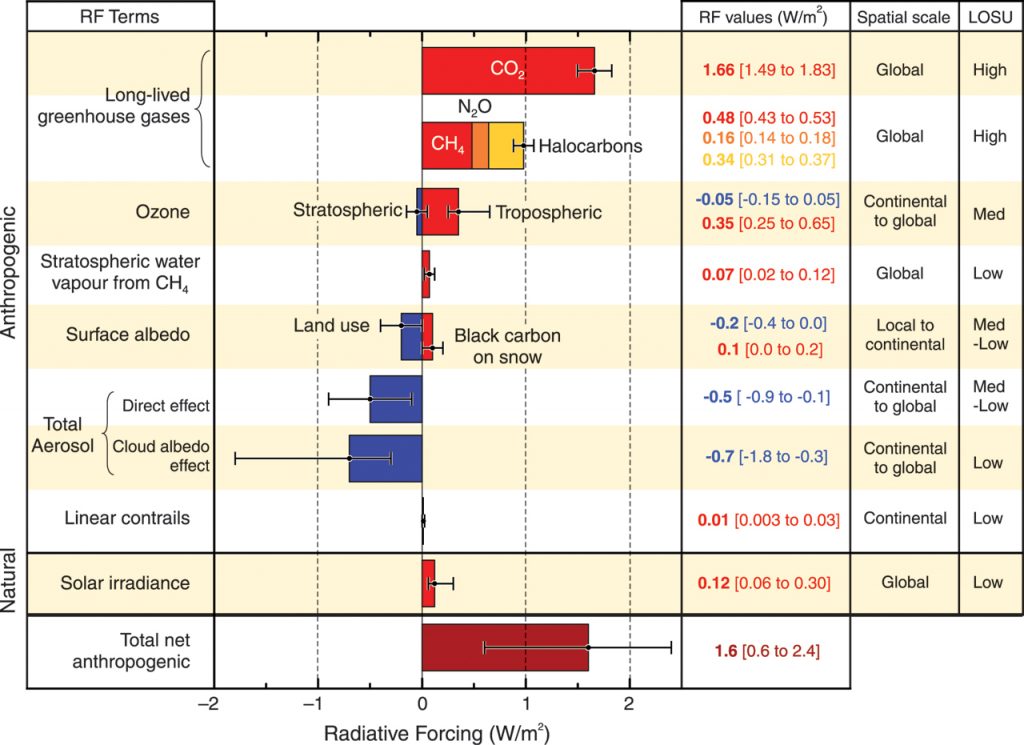
Physicists express radiative forcing in watts per square meter (W/m2), meaning the number of extra watts of power that the earth is receiving, for each square meter of the earth’s surface. Figure 2.4 from the last IPCC report summarizes the various radiative forcings from different sources. The numbers show best estimates of the overall change from 1750 to 2005 (note the whiskers, which express uncertainty – some of these values are known much better than others):

If you add up the radiative forcing from greenhouse gases, you get a little over 2.5 W/m2. Of course, you also have to subtract the negative forcings from clouds and aerosols (tiny particles of pollution, such as sulpur dioxide), as these have a cooling effect because they block some of the incoming radiation from the sun. So we can look at the forcing that’s just due to greenhouse gases (about 2.5 W/m2), or we can look at the total net anthropogenic forcing that takes into account all the different effects (which is about 1.6 W/m2).

Over the period covered by the chart, 1750-2005, the earth warmed somewhat in response to this radiative forcing. The total incoming energy has increased by about +1.6W/m2, but the total outgoing energy lost to space has also risen – a warmer planet loses energy faster. The current imbalance between incoming and outgoing energy at the top of the atmosphere is therefore smaller than the total change in forcing over time. Hansen et. al. give an estimate of the energy imbalance of 0.58 ± 0.15 W/m2 for the period from 2005-2010.

The problem I have with these numbers is that they don’t mean much to most people. Some people try to explain it by asking people to imagine adding a 2 watt light bulb (the kind you get in Christmas lights) over each square meter of the planet, which is on continuously day and night. But I don’t think this really helps much, as most people (including me) do not have a good intuition for how many square meters the surface of Earth has, and anyway, we tend to think of a Christmas tree light bulb as using a trivially small amount of power. According to wikipedia, the Earth’s surface is 510 million square kilometers, which is 510 trillion square meters.

So, do the maths, that gives us a change in incoming energy of about 1,200 trillion watts (1.2 petawatts) for just the anthropogenic greenhouse gases, or about 0.8 petawatts overall when we subtract the cooling effect of changes in clouds and aerosols. But some of this extra energy is being lost back into space. From the current energy imbalance, the planet is gaining 0.3 petawatts at the moment.

But how big is a petawatt? A petawatt is 1015 watts. Wikipedia tells us that the average total global power consumption of the human world in 2010 was about 16 terawatts (1 petawatt = 1000 terawatts). So, human energy consumption is dwarfed by the extra energy currently being absorbed by the planet due to climate change: the planet is currently gaining about 18 watts of extra power for each 1 watt of power humans actually use.

Note: Before anyone complains, I’ve deliberately conflated energy and power above, because the difference doesn’t really matter for my main point. Power is work per unit of time, and is measured in watts; Energy is better expressed in joules, calories, or kilowatt hours (kWh). To be technically correct, I should say that the earth is getting about 300 terawatt hours of energy per hour due to anthropogenic climate change, and humans use about 16 terawatt hours of energy per hour. The ratio is still approximately 18.

Out of interest, you can also convert it to calories. 1kWh is about 0.8 million calories. So, we’re force-feeding the earth about 2 x 10¹⁷ (200,000,000,000,000,000) calories every hour. Yikes.

We’re running a new weekly lecture series this term to explore different disciplinary perspectives on climate change, entitled “Collaborative Challenges for the Climate Change Research Community“, sponsored by the department of Computer Science and the Centre for Environment. Our aim is to use this as an exploration of the range of research related to climate change across the University of Toronto, and to inspire new collaborations. A central theme of the series is the role of computational climate models: how researchers share models, verify models, create models, and share results. But we also want to explore beyond models, so we’ll be looking at ethics, policy, education, and community-based responses to climate change.

The lectures will be on Monday afternoons, at 3pm, starting on January 16th, in the Bahen Centre, 40 St George Street, Toronto, room BA1220. The lectures are public and free to attend.

The first four speakers have been announced (I’ll be giving the opening talk):

  • Jan 16th: Computing the Climate: the Evolution of Climate Models – Steve Easterbrook, Dept of Computer Science
  • Jan 23rd: Building Community Resilience: A Viable Response to Climate Change and Other Emerging Challenges to Health Equity? – Blake Poland, Dalla Lana School of Public Health
  • Jan 30th: Constraining fast and slow climate feedbacks with computer models – Danny Harvey, Dept of Geography
  • Feb 6th: Urban GHG Modelling Using Agent-Based Microsimulation – Eric Miller, Dept of Civil Engineering & Cities Centre

For more details, see the C4RC website.

One of the things that strikes me about discussions of climate change, especially from those who dismiss it as relatively harmless, is a widespread lack of understanding on how non-linear systems behave. Indeed, this seems to be one of the key characteristics that separate those who are alarmed at the prospect of a warming climate from those who are not.

At the AGU meeting this month, Kerry Emanuel presented a great example of this in his talk on “Hurricanes in a Warming Climate”. I only caught his talk by chance, as I was slipping out of the session in the next room, but I’m glad I did, because he made an important point about how we think about the impacts of climate change, and in particular, showed two graphs that illustrate the point beautifully.

Kerry’s talk was an overview of a new study that estimates changes in damage from tropical cyclones with climate change, using a new integrated assessment model. The results are reported in detail in a working paper at the World Bank. The report points out that the link between hurricanes and climate change remains controversial. So, while Atlantic hurricane power has more than doubled over the last 30 years, and model forecasts show an increase in the average intensity of hurricanes in a warmer world, there is still no clear statistical evidence of a trend in damages caused by these storms, and hence a great deal of uncertainty about future trends.

The analysis is complicated by several factors:

  • Increasing insurance claims from hurricane damage in the US have a lot to do with growing economic activity in vulnerable regions. Indeed, expected economic development in the regions subject to tropical storm damage means that there’s certain to be big increases in damage even if there were no warming at all.
  • The damage is determined more by when and where each storm makes landfall than it is by the intensity of the storm.
  • There simply isn’t enough data to detect trends. More than half of the economic damage due to hurricanes in the US since 1870 was caused by just 8 storms.

The new study by Emanuel and colleagues overcomes some of these difficulties by simulating large numbers of storms. They took the outputs of four different Global Climate Models, using the A1B emissions scenario, and fed them into a cyclone generator model to simulate thousands of storms, comparing the characteristics of these storms with those that have caused damage in the US in the last few decades, and then adjusting the damage estimates according to anticipated changes in population and economic activity in the areas impacted (for details, see the report).

The first thing to note is that the models forecast only a small change in hurricanes, typically a slight decrease in medium-strength storms and a slight increase in more intense storms. For example, at first sight, the MIROC model indicates almost no difference:

Probability density for storm damage on the US East Coast, generated from the MIROC model for current vs. year 2100, under the A1B scenario, for which this model forecasts a global average temperature increase of around 4.5C. Note that x axis is a logarithmic scale: 8 means $100 million, 9 means $1 billion, 10 means $10 billion, etc (source: Figure 9 in Mendelsohn et al, 2011)

Note particularly that at the peak of the graph, the model shows a very slight reduction in the number of storms (consistent with a slight decrease in the overall frequency of hurricanes), while on the upper tail, the model shows a very slight increase (consistent with a forecast that there’ll be more of the most intense storms). The other three models show slightly bigger changes by the year 2100, but overall, the graphs seem very comforting. It looks like we don’t have much to worry about (at least as far as hurricane damage from climate change is concerned). Right?

The problem is that the long tail is where all the action is. The good news is that there appears to be a fundamental limit on storm intensity, so the tail doesn’t really get much longer. But the problem is that it only takes a few more of these very intense storms to make a big difference in the amount of damage caused. Here’s what you get if you multiply the probability by the damage in the above graph:

Changing risk of hurricane damage due to climate change. Calculated as probability times impact. (Source: courtesy of K. Emanuel, from his AGU 2011 talk)

That tiny change in the long tail generates a massive change in the risk, because the system is non-linear. If most of the damage is done by a few very intense storms, then you only need a few more of them to greatly increase the damage. Note in particular, what happens at 12 on the damage scale – these are trillion dollar storms. [Update: Kerry points out that the total hurricane damage is proportional to the area under the curves of the second graph].

The key observation here is that the things that matter most to people (e.g. storm damage) do not change linearly as the climate changes. That’s why people who understand non-linear systems tend to worry much more about climate change than people who do not.

Here’s the call for papers for a workshop we’re organizing at ICSE next May:

The First International Workshop on Green and Sustainable Software (GREENS’2012)

(In conjunction with the 34th International Conference on Software Engineering (ICSE 2012), Zurich, Switzerland, June 2-9, 2012

Important Dates:

  • 17th February 2012 – paper submission
  • 19th March 2012 – notification of acceptance
  • 29th March 2012 – camera-ready
  • 3rd June 2011 – workshop

Workshop theme and goals: The Focus of the GREENS workshop is the engineering of green and sustainable software. Our goal is to bring together academics and practitioners to discuss research initiatives, challenges, ideas, and results in this critically important area of the software industry. To this end GREENS will both discuss the state of the practice, especially at the industrial level, and define a roadmap, both for academic research and for technology transfer to industry. GREENS seeks contributions addressing, but not limited to, the following list of topics:

Concepts and foundations:

  • Definition of sustainability properties (e.g. energy and power consumption, green-house gases emissions, waste and pollutants production), their relationships, their units of measure, their measurement procedures in the context of software-intensive systems, their relationships with other properties (e.g. response time, latency, cost, maintainability);
  • Green architectural knowledge, green IT strategies and design patterns;

Greening domain-specific software systems:

  • Energy-awareness in mobile software development;
  • Mobile software systems scalability in low-power situations;
  • Energy-efficient techniques aimed at optimizing battery consumption;
  • Large and ultra-large scale green information systems design and development (including inter-organizational effects)

Greening of IT systems, data and web centers:

  • Methods and approaches to improve sustainability of existing software systems;
  • Customer co-creation strategies to motivate behavior changes;
  • Virtualization and offloading;
  • Green policies, green labels, green metrics, key indicators for sustainability and energy efficiency;
  • Data center and storage optimization;
  • Analysis, assessment, and refactoring of source code to improve energy efficiency;
  • Workload balancing;
  • Lifecycle Extension

Greening the process:

  • Methods to design and develop greener software systems;
  • Managerial and technical risks for a sustainable modernization;
  • Quality & risk assessments, tradeoff analyses between energy efficiency, sustainability and traditional quality requirements;

Case studies, industry experience reports and empirical studies:

  • Empirical data and analysis about sustainability properties, at various granularity levels: complete infrastructure, or nodes of the infrastructure (PCs, servers, and mobile devices);
  • Studies to define technical and economic models of green aspects;
  • Return on investment of greening projects, reasoning about the triple bottom line of people, planet and profits;
  • Models of energy and power consumption, at various granularity levels;
  • Benchmarking of power consumption in software applications;

Guidelines for Submission: We are soliciting papers in two distinct categories:

  1. Research papers describing innovative and significant original research in the field (maximum 8 pages);
  2. Industrial papers describing industrial experience, case studies, challenges, problems and solutions (maximum 8 pages).

Please submit your paper online through EasyChair (see the GREENS website). Submissions should be original and unpublished work. Each submitted paper will undergo a rigorous review process by three members of the Program Committee. All types of papers must conform to the ICSE submission format and guidelines. All accepted papers will appear in the ACM Digital Library.

Workshop Organizers:

  • Patricia Lago (VU University Amsterdam, The Netherlands)
  • Rick Kazman (University of Hawaii, USA)
  • Niklaus Meyer (Green IT SIG, Swiss Informatics Society, Switzerland)
  • Maurizio Morisio (Politecnico di Torino, Italy)
  • Hausi A. Mueller (University of Victoria, Canada)
  • Frances Paulisch (Siemens Corporate Technology, Germany)
  • Giuseppe Scanniello (Università della Basilicata, Italy)
  • Olaf Zimmermann (IBM Research, Zurich, Switzerland)

Program committee:

  • Marco Aiello, University of Groningen, Netherlands
  • Luca Ardito, Politecnico di Torino, Italy
  • Ioannis Athanasiadis, Democritus Univ. of Thrace, Greece
  • Rami Bahsoon, University College London, UK
  • Ivica Crnkovic, Malardalen University, Sweden
  • Steve Easterbrook, University of Toronto, Canada
  • Hakan Erdogmus, Things Software
  • Anthony Finkelstein, University College London, UK
  • Matthias Galster, University of Groningen, Netherlands
  • Ian Gorton, Pacific Northwest National Laboratory, USA
  • Qing Gu, VU University Amsterdam, Netherlands
  • Wolfgang Lohmann, Informatics and Sustainability Research, Swiss Federal Laboratories for Materials Science and Technology, Switzerland
  • Lin Liu, School of Software, Tsinghua University, China
  • Alessandro Marchetto, Fondazione Bruno Kessler, Italy
  • Henry Muccini, University of L’Aquila, Italy
  • Stefan Naumann, Trier University of Applied Sciences, Environmental Campus, Germany
  • Cesare Pautasso, University of Lugano, Switzerland
  • Barbara Pernici, Politecnico di Milano, Italy
  • Giuseppe Procaccianti, Politecnico di Torino, Italy
  • Filippo Ricca, University of Genova
  • Antony Tang, Swinburne University of Tech., Australia
  • Antonio Vetro’, Fraunhofer IESE, USA
  • Joost Visser, Software Improvement Group and Knowledge Network Green Software, Netherlands
  • Andrea Zisman, City University London, UK

A number of sessions at the AGU meeting this week discussed projects to improve climate literacy among different audiences:

  • The Climate Literacy and Energy Awareness Network (CLEANET), are developing concept maps for use in middle school and high school, along with a large set of pointers to educational resources on climate and energy for use in the classroom.
  • The Climate Literacy Zoo Education Network (CliZEN). Michael Mann (of Hockey Stick Fame) talked about this project, which was a rather nice uplifting change from hearing about his experiences with political attacks on his work. This is a pilot effort, currently involving ten zoos, mainly in the north east US. So far, they have completed a visitor survey across a network of zoos, plus some aquaria, exploring the views of visitors on climate change, using the categories of the Six Americas report. The data they have collected show that zoo visitors tend to be more skewed towards the “alarmed” category compared to the general US population. [Incidentally, I’m impressed with their sample size: 3,558 responses. The original Six Americas study only had 981, and most surveys in my field have much smaller sample sizes]. The next steps in the project are to build on this audience analysis to put together targeted information and education material that links what we know about climate climate with it’s impact on specific animals at the zoos (especially polar animals).
  • The Climate Interpreter Project. Bill Spitzer from the New England Aquarium talked about this project. Bill points out that aquaria (and museums, zoos etc) are have an important role to play, because people come for the experience, which must be enjoyable, but they do expect to learn something, and they do trust museums and zoos to provide them accurate information. This project focusses on the role of interpreters and volunteers, who are important because they tend to be more passionate, more knowledgeable, and come into contact with many people. But many interpreters are not yet comfortable in talking about issues around climate change. They need help, and training. Interpretation isn’t just transmission of information. It’s about translating science in a way that’s meaningful and resonates with an audience. It requires a systems perspective. The strategy adopted by this project is to begin with audience research, to understand people’s interests and passions; connect this with the cognitive and social sciences on how people learn, and how they make sense of what they’re hearing; and finally to make use of strategic framing, which gets away from the ‘crisis’ frame that dominates most news reporting (on crime, disasters, fires), but which tends to leave people feeling overwhelmed, which leads them to treat it as someone else’s problem. Thinking explicitly about framing allows you to connect information about climate change with people’s values, with what they’re passionate about, and even with their sense of self-identity. The website climateinterpreter.org describes what they’ve learnt so far
    (As an aside, Bill points out that it can’t just be about training the interpreters – you need institutional support and leadership, if they are to focus on a controversial issue. Which got me thinking about why science museums tend to avoid talking much about climate change – it’s easy for the boards of directors to avoid the issue, because of worries about whether it’s politically sensitive, and hence might affect fundraising.)
  • The WorldViews Network. Rachel Connolly from Nova/WGBH presented this collaboration between museums, scientists and TV networks. Partners include planetariums and groups interested in data visualization, GIS data, mapping, many from an astronomy background. Their 3-pronged approach, called TPACK, identifies three types of knowledge: technological, pedagogical, and content knowledge.  The aim is to take people from seeing, to knowing, to doing. For example, they might start with a dome presentation, but bring into it live and interactive web resources, and then move on to community dialogues. Storylines use visualizations that move seamlessly across scale: cosmic, global, bioregional. They draw a lot on the ideas from Rockstrom’s planetary boundaries, within which they’r focussing on three: climate, biodiversity loss and ocean acidification. A recent example from Denver, in May, focussed on water. On the cosmic scale, they look at where water comes from as planets are formed. They eventually bring this down to the bioregional scale, looking at the rivershed for Denver, and the pressures on the Colorado River. Good visual design is a crucial part of the project (Rachel showed a neat example of a visualization of the size of water on the planet: comparing all water, with fresh water and frozen water. Another fascinating example was a satellite picture of the border of Egypt and Israel, where the different water management strategies either side of the border produce a starkly visible difference either side of the border. (Rachel also recommended Sciencecafes.org and the Buckminster Fuller Challenge).
  • ClimateCommunication.org. There was a lot of talk through the week about this project, led by Susan Hassol and Richard Somerville, especially their recent paper in Physics Today, which explores the use of jargon, and how it can mislead the general public. The paper went viral on the internet shortly after it was published, and and they used an open google doc to collect many more examples. Scientists are often completely unaware the non-specialists have different meaning for jargon terms, which can  then become a barrier for communication. My favourite examples from Susan’s list are “aerosol”, which to the public means a spray can (leading to a quip by Glenn Beck who had heard that aerosols cool the planet); ‘enhanced’, which the public understands as ‘made better’ so the ‘enhanced greenhouse effect’ sounds like a good thing, and ‘positive feedback’ which also sounds like a good thing, as it suggests a reward for doing something good.
  • Finally, slightly off topic, but I was amused by the Union of Concerned Scientists’ periodic table of political interferences in science.

On Thursday, Kaitlin presented her poster at the AGU meeting, which shows the results of the study she did with us in the summer. Her poster generated a lot of interest, especially the visualizations she has of the different model architectures. Click on thumbnail to see the full poster at the AGU site:

A few things to note when looking at the diagrams:

  • Each diagram shows the components of a model, scale to their relative size by lines of code. However, the models are not to scale with one another, as the smallest, UVic’s, is only a tenth of the size of the biggest, CESM. Someone asked what accounts for that size. Well, the UVic model is an EMIC rather than a GCM. It has a very simplified atmosphere model that does not include atmospheric dynamics, which makes it easier to run for very long simulations (e.g. to study paleoclimate). On the other hand, CESM is a community model, with a large number of contributors across the scientific community. (See Randall and Held’s point/counterpoint article in last months IEEE Software for a discussion of how these fit into different model development strategies).
  • The diagrams show the couplers (in grey), again sized according to number of lines of code. A coupler handles data re-gridding (when the scientific components use different grids), temporal aggregation (when the scientific components run on different time steps) along with other data handling. These are often invisible in diagrams the scientists create of their models, because they are part of the infrastructure code; however Kaitlin’s diagrams show how substantial they are in comparison with the scientific modules. The European models all use the same coupler, following a decade-long effort to develop this as a shared code resource.
  • Note that there are many different choices associated with the use of a coupler, as sometimes it’s easier to connect components directly rather through the coupler, and the choice may be driven by performance impact, flexibility (e.g. ‘plug-and-play’ compatibility) and legacy code issues. Sea ice presents an interesting example, because its extent varies over the course of a model run. So somewhere there must be code that keeps track of which grid cells have ice, and then routes the fluxes from ocean and atmosphere to the sea ice component for these grid cells. This could be done in the coupler, or in any of the three scientific modules. In the GFDL model, sea ice is treated as an interface to the ocean, so all atmosphere-ocean fluxes pass through it, whether there’s ice in a particular cell or not.
  • The relative size of the scientific components is a reasonable proxy for functionality (or, if you like, scientific complexity/maturity). Hence, the diagrams give clues about where each lab has placed its emphasis in terms of scientific development, whether by deliberate choice, or because of availability (or unavailability) of different areas of expertise. The differences between the models from different labs show some strikingly different choices here, for example between models that are clearly atmosphere-centric, versus models that have a more balanced set of earth system components.
  • One comment we received in discussions around the poster was about the places where we have shown sub-components in some of the models. Some modeling groups are more explicit about naming the sub-components, and indicating them in the code. Hence, our ability to identify these might be more dependent on naming practices rather than any fundamental architectural differences.

I’m sure Kaitlin will blog more of her reflections on the poster (and AGU in general) once she’s back home.

I’m at the AGU meeting in San Francisco this week. The internet connections in the meeting rooms suck, so I won’t be twittering much, but will try and blog any interesting talks. But first things first! I presented my poster in the session on “Methodologies of Climate Model Evaluation, Confirmation, and Interpretation” yesterday morning. Nice to get my presentation out of the way early, so I can enjoy the rest of the conference.

Here’s my poster, and the abstract is below (click for the full sized version at the AGU ePoster site):

A Hierarchical Systems Approach to Model Validation

Introduction

Discussions of how climate models should be evaluated tend to rely on either philosophical arguments about the status of models as scientific tools, or on empirical arguments about how well runs from a given model match observational data. These lead to quantitative measures expressed in terms of model bias or forecast skill, and ensemble approaches where models are assessed according to the extent to which the ensemble brackets the observational data.

Such approaches focus the evaluation on models per se (or more specifically, on the simulation runs they produce), as if the models can be isolated from their context. Such approaches may overlook a number of important aspects of the use of climate models:

  • the process by which models are selected and configured for a given scientific question.
  • the process by which model outputs are selected, aggregated and interpreted by a community of expertise in climatology.
  • the software fidelity of the models (i.e. whether the running code is actually doing what the modellers think it’s doing).
  • the (often convoluted) history that begat a given model, along with the modelling choices long embedded in the code.
  • variability in the scientific maturity of different components within a coupled earth system model.

These omissions mean that quantitative approaches cannot assess whether a model produces the right results for the wrong reasons, or conversely, the wrong results for the right reasons (where, say the observational data is problematic, or the model is configured to be unlike the earth system for a specific reason).

Furthermore, quantitative skill scores only assess specific versions of models, configured for specific ensembles of runs; they cannot reliably make any statements about other configurations built from the same code.

Quality as Fitness for Purpose

The problem is that there is no such thing as “the model”. The body of code that constitutes a modern climate model actually represents an enormous number of possible models, each corresponding to a different way of configuring that code for a particular run. Furthermore, this body of code isn’t a static thing. The code is changed on a daily basis, through a continual process of experimentation and model improvement. This applies even to any specific “official release”, which again is just a body of code that can be configured to run as any of a huge number of different models, and again, is not unchanging – as with all software, there will be occasional bugfix releases applied to it, along with improvements to the ancillary datasets.

Evaluation of climate models should not be about “the model”, but about the relationship between a modelling system and the purposes to which it is put. More precisely, it’s about the relationship between particular ways of building and configuring models and the ways in which the runs produced by those models are used.

What are the uses of a climate model? They vary tremendously:

  • To provide inputs to assessments of the current state of climate science;
  • To explore the consequences of a current theory;
  • To test a hypothesis about the observational system (e.g. forward modeling);
  • To test a hypothesis about the calculational system (e.g. to explore known weaknesses);
  • To provide homogenized datasets (e.g. re-analysis);
  • To conduct thought experiments about different climates;
  • To act as a comparator when debugging another model;

In general, we can distinguish three separate systems: the calculational system (the model code); the theoretical system (current understandings of climate processes) and the observational system. In the most general sense, climate models are developed to explore how well our current understanding (i.e. our theories) of climate explain the available observations. And of course the inverse: what additional observations might we make to help test our theories.

We’re dealing with relationships between three different systems

Validation of the Entire Modeling System

When we ask questions about likely future climate change, we don’t ask the question of the calculational system, we ask it of the theoretical system; the models are just a convenient way of probing the theory to provide answers.
When society asks climate scientists for future projections, the question is directed at climate scientists, not their models. Modellers apply their judgment to select appropriate versions & configurations of the models to use, set up the runs, and interpret the results in the light of what is known about the models’ strengths and weaknesses and about any gaps between the computational models and the current theoretical understanding. And they add all sorts of caveats to the conclusions they draw from the model runs when they present their results.

Validation is not a post-hoc process to be applied to an individual “finished” model, to ensure it meets some criteria for fidelity to the real world. In reality, there is no such thing as a finished model, just many different snapshots of a large set of model configurations, steadily evolving as the science progresses. Knowing something about the fidelity of a given model configuration to the real world is useful, but not sufficient to address fitness for purpose. For this, we have to assess the extent to which climate models match our current theories, and the extent to which the process of improving the models keeps up with theoretical advances.

Summary

Our approach to model validation extends current approaches:

  • down into the detailed codebase to explore the processes by which the code is built and tested. Thus, we build up a picture of the day-to-day practices by which modellers make small changes to the model and test the effect of such changes (both in isolated sections of code, and on the climatology of a full model). The extent to which these practices improve the confidence and understanding of the model depends on how systematically this testing process is applied, and how many of the broad range of possible types of testing are applied. We also look beyond testing to other software practices that improve trust in the code, including automated checking for conservation of mass across the coupled system, and various approaches to spin-up and restart testing.
  • up into the broader scientific context in which models are selected and used to explore theories and test hypotheses. Thus, we examine how features of the entire scientific enterprise improve (or impede) model validity, from the collection of observational data, creation of theories, use of these theories to develop models, choices for which model and which model configuration to use, choices for how to set up the runs, and interpretation of the results. We also look at how model inter-comparison projects provide a de facto benchmarking process, leading in turn to exchanges of ideas between modelling labs, and hence advances in the scientific maturity of the models.

This layered approach does not attempt to quantify model validity, but it can provide a systematic account of how the detailed practices involved in the development and use of climate models contribute to the quality of modelling systems and the scientific enterprise that they support. By making the relationships between these practices and model quality more explicit, we expect to identify specific strengths and weaknesses the modelling systems, particularly with respect to structural uncertainty in the models, and better characterize the “unknown unknowns”.

I’ve spent much of the last month preparing a major research proposal for the Ontario Research Fund (ORF), entitled “Integrated Decision Support for Sustainable Communities”. We’ve assembled a great research team, with professors from a number of different departments, across the schools of engineering, information, architecture, and arts and science. We’ve held meetings with a number of industrial companies involved in software for data analytics and 3D modeling, consultancy companies involved in urban planning and design, and people from both provincial and city government. We started putting this together in September, and were working to a proposal deadline at the end of January.

And then this week, out of the blue, the province announced that it was cancelling the funding program entirely, “in light of current fiscal challenges”. The best bit in the letter I received was:

The work being done by researchers in this province is recognized and valued. This announcement is not a reflection of the government’s continued commitment through other programs that provides support to the important work being done by researchers.

I’ve searched hard for the “other programs” they mention, but there don’t appear to be any. It’s increasingly hard to get any finding for research, especially trans-disciplinary research. Here’s the abstract from our proposal:

Our goal is to establish Ontario as a world leader in building sustainable communities, through the use of data analytics tools that provide decision-makers with a more complete understanding of how cities work. We will bring together existing expertise in data integration, systems analysis, modeling, and visualization to address the information needs of citizens and policy-makers who must come together to re-invent towns and cities as the basis for a liveable, resilient, carbon-neutral society. The program integrates the work of a team of world-class researchers, and builds on the advantages Ontario enjoys as an early adopter of smart grid technologies and open data initiatives.

The long-term sustainability of Ontario’s quality of life and economic prosperity depends on our ability to adopt new, transformative approaches to urban design and energy management. The transition to clean energy and the renewal of urban infrastructure must go hand-in-hand, to deliver improvements across a wide range of indicators, including design quality, innovation, lifestyle, transportation, energy efficiency and social justice. Design, planning and decision-making must incorporate a systems-of-systems view, to encompass the many processes that shape modern cities, and the complex interactions between them.

Our research program integrates emerging techniques in five theme areas that bridge the gap between decision-making processes for building sustainable cities and the vast sources of data on social demographics, energy, buildings, transport, food, water and waste:

  • Decision-Support and Public Engagement: We begin by analyzing the needs of different participants, and develop strategies for active engagement;
  • Visualization: We will create collaborative and immersive visualizations to enhance participatory decision-making;
  • Modelling and Simulation: We will develop a model integration framework to bring together models of different systems that define the spatio-temporal and socio-economic dynamics of cities, to drive our visualizations;
  • Data Privacy: We will assess the threats to privacy of all citizens that arise when detailed data about everyday activities is mined for patterns and identify appropriate techniques for protecting privacy when such data is used in the modeling and analysis process;
  • Data Integration and Management: We will identify access paths to the data sources needed to drive our simulations and visualizations, and incorporate techniques for managing and combining very large datasets.

These themes combine to provide an integrated approach to intelligent, data-driven planning and decision-making. We will apply the technologies we develop in a series of community-based design case studies, chosen to demonstrate how our approach would apply to increasingly complex problems such as energy efficiency, urban intensification, and transportation. Our goal is to show how an integrated approach can improve the quality and openness of the decision-making process, while taking into account the needs of diverse stakeholders, and the inter-dependencies between policy, governance, finance and sustainability in city planning.

Because urban regions throughout the world face many of the same challenges, this research will allow Ontario to develop a technological advantage in areas such as energy management and urban change, and enabling a new set of creative knowledge-based services address the needs of communities and governments. Ontario is well placed to develop this as a competitive advantage, due to its leadership in the collection and maintenance of large datasets in areas such as energy management, social well-being, and urban infrastructure. We will leverage this investment and create a world-class capability not available in any other jurisdiction.

Incidentally, we spent much of last fall preparing a similar proposal for the previous funding round. That was rejected on the basis that we weren’t clear enough what the project outcomes would be, and what the pathways to commercialization were. For our second crack at it, we were planning to focus much more specifically on the model integration part, by developing a software framework for coupling urban system models, based on a detailed requirements analysis of the stakeholders involved in urban design and planning, with case studies on neighbourhood re-design and building energy retro-fits. Our industrial partners have identified a number of routes to commercial services that would make use of such software. Everything was coming together beautifully. *Sigh*.

Now we have to find some other source of funding for this. Contributions welcome!