We’re taking the kids to see their favourite band: Muse are playing in Toronto tonight. I’m hoping they play my favourite track:

I find this song fascinating, partly because of the weird mix of progressive rock and dubstep. But more for the lyrics:

All natural and technological processes proceed in such a way that the availability of the remaining energy decreases. In all energy exchanges, if no energy enters or leaves an isolated system, the entropy of that system increases. Energy continuously flows from being concentrated to becoming dispersed, spread out, wasted and useless. New energy cannot be created and high grade energy is destroyed. An economy based on endless growth is unsustainable. The fundamental laws of thermodynamics will place fixed limits on technological innovation and human advancement. In an isolated system, the entropy can only increase. A species set on endless growth is unsustainable.

This summarizes, perhaps a little too succinctly, the core of the critique of our current economy, first articulated clearly in 1972 by the Club of Rome in the Limits to Growth Study. Unfortunately, that study was widely dismissed by economists and policymakers. As Jorgen Randers points out in a 2012 paper, the criticism of the Limits to Growth study was largely based on misunderstandings, and the key lessons are absolutely crucial to understanding the state of the global economy today, and the trends that are likely over the next few decades. In a nutshell, humans exceeded the carrying capacity of the planet sometime in the latter part of the 20th century. We’re now in the overshoot portion, where it’s only possible to feed the world and provide energy for economic growth by consuming irreplaceable resources and using up environmental capital. This cannot be sustained.

In general systems terms, there are three conditions for sustainability (I believe it was Herman Daly who first set them out in this way):

  1. We cannot use renewable resources faster than they can be replenished.
  2. We cannot generate wastes faster than they can be absorbed by the environment.
  3. We cannot use up any non-renewable resource.

We can and do violate all of these conditions all the time. Indeed, modern economic growth is based on systematically violating all three of them, but especially #3, as we rely on cheap fossil fuel energy. But any system that violates these rules cannot be sustained indefinitely, unless it is also able to import resources and export wastes to other (external) systems. The key problem for the 21st century is that we’re now violating all three conditions on a global scale, and there are no longer other systems that we can rely on to provide a cushion – the planet as a whole is an isolated system. There are really only two paths forward: either we figure out how to re-structure the global economy to meet Daly’s three conditions, or we face a global collapse (for an understanding of the latter, see GrahamTurner’s 2012 paper).

A species set on endless growth is unsustainable.

We now have a fourth paper added to our special issue of the journal Geoscientific Model Development, on Community software to support the delivery of CMIP5. All papers are open access:

  • M. Stockhause, H. Höck, F. Toussaint, and M. Lautenschlager, Quality assessment concept of the World Data Center for Climate and its application to CMIP5 data, Geosci. Model Dev., 5, 1023-1032, 2012.
    Describes the distributed quality control concept that was developed for handling the terabytes of data generated from CMIP5, and the challenges in ensuring data integrity (also includes a useful glossary in an appendix).
  • B. N. Lawrence, V. Balaji, P. Bentley, S. Callaghan, C. DeLuca, S. Denvil, G. Devine, M. Elkington, R. W. Ford, E. Guilyardi, M. Lautenschlager, M. Morgan, M.-P. Moine, S. Murphy, C. Pascoe, H. Ramthun, P. Slavin, L. Steenman-Clark, F. Toussaint, A. Treshansky, and S. Valcke, Describing Earth system simulations with the Metafor CIM, Geosci. Model Dev., 5, 1493-1500, 2012.
    Explains the Common Information Model, which was developed to describe climate model experiments in a uniform way, including the model used, the experimental setup and the resulting simulation.
  • S. Valcke, V. Balaji, A. Craig, C. DeLuca, R. Dunlap, R. W. Ford, R. Jacob, J. Larson, R. O’Kuinghttons, G. D. Riley, and M. Vertenstein, Coupling technologies for Earth System Modelling, Geosci. Model Dev., 5, 1589-1596, 2012.
    An overview paper that compares different approaches to model coupling used by different earth system models in the CMIP5 ensemble.
  • S. Valcke, The OASIS3 coupler: a European climate modelling community software, Geosci. Model Dev., 6, 373-388, 2013 (See also the Supplement)
    A detailed description of the OASIS3 coupler, which is used in all the European models contributing to CMIP5. The OASIS User Guide is included as a supplement to this paper.

(Note: technically speaking, the call for papers for this issue is still open – if there are more software aspects of CMIP5 that you want to write about, feel free to submit them!)

Last week, Damon Matthews from Concordia visited, and gave a guest CGCS lecture, “Cumulative Carbon and the Climate Mitigation Challenge”. The key idea he addressed in his talk is the question of “committed warming” – i.e. how much warming are we “owed” because of carbon emissions in the past (irrespective of what we do with emissions in the future). But before I get into the content of Damon’s talk, here’s a little background.

The question of ‘owed’ or ‘committed’ warming arises because we know it takes some time for the planet to warm up in response to an increase in greenhouse gases in the atmosphere. You can calculate a first approximation of how much it will warm up from a simple energy balance model (like the ones I posted about last month). However, to calculate how long it takes to warm up you need to account for the thermal mass of the oceans, which absorb most of the extra energy and hence slow the rate of warming of surface temperatures. For this you need more than a simple energy balance model.

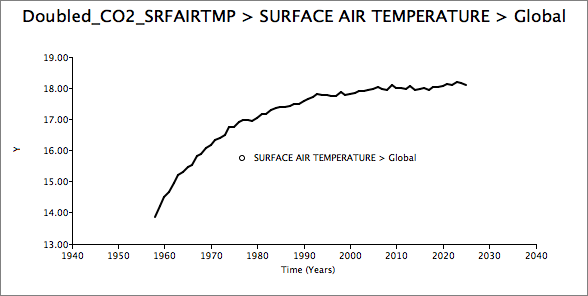
You can do a very simple experiment with a Global Circulation Model, by setting CO2 concentrations at double their pre-industrial levels, and then leave them constant at this level, to see how long the earth takes to reach a new equilibrium temperature. Typically, this takes several decades, although the models differ on exactly how long. Here’s what it looks like if you try this with EdGCM (I ran it with doubled CO2 concentrations starting in 1958):
EVA_time

Of course, the concentrations would never instantaneously double like that, so a more common model experiment is to increase CO2 levels gradually, say by 1% per year (that’s a little faster than how they have risen in the last few decades) until they reach double the pre-industrial concentrations (which takes approx 70 years), and then leave them constant at that level. This particular experiment is a standard way of estimating the Transient Climate Response – the expected warming at the moment we first reach a doubling of CO2 – and is included in the CMIP5 experiments. In these model experiments, it typically takes a few decades more of warming until a new equilibrium point is reached, and the models indicate that the transient response is expected to be a little over half of the eventual equilibrium warming.

This leads to a (very rough) heuristic that as the planet warms, we’re always ‘owed’ almost as much warming again as we’ve already seen at any point, irrespective of future emissions, and it will take a few decades for all that ‘owed’ warming to materialize. But, as Damon argued in his talk, there are two problems with this heuristic. First, it confuses the issue when discussing the need for an immediate reduction in carbon emissions, because it suggests that no matter how fast we reduce them, the ‘owed’ warming means such reductions will make little difference to the expected warming in the next two decades. Second, and more importantly, the heuristic is wrong! How so? Read on!

For an initial analysis, we can view the climate problem just in terms of carbon dioxide, as the most important greenhouse gas. Increasing CO2 emissions leads to increasing CO2 concentrations in the atmosphere, which leads to temperature increases, which lead to climate impacts. And of course, there’s a feedback in the sense that our perceptions of the impacts (whether now or in the future) lead to changed climate policies that constrain CO2 emissions.

So, what happens if we were to stop all CO2 emissions instantly? The naive view is that temperatures would continue to rise, because of the ‘climate commitment’  – the ‘owed’ warming that I described above. However, most models show that the temperature stabilizes almost immediately. To understand why, we need to realize there are different ways of defining ‘climate commitment’:

  • Zero emissions commitment – How much warming do we get if we set CO2 emissions from human activities to be zero?
  • Constant composition commitment – How much warming do we get if we hold atmospheric concentrations constant? (in this case, we can still have some future CO2 emissions, as long as they balance the natural processes that remove CO2 from the atmosphere).

The difference between these two definition is shown here. Note that in the zero emissions case, concentrations drop from an initial peak, and then settle down at a lower level:

Committed-concentrations

CommittedWarming

The model experiments most people are familiar with are the constant composition experiments, in which there is continued warming. But in the zero emissions scenarios, there is almost no further warming. Why is this?

The relationship between carbon emissions and temperature change (the “Carbon Climate Response”) is complicated, because it depends two factors, each of which is complicated by (different types of) inertia in the system:

  • Climate Sensitivity – how much temperature changes in response to difference levels of CO2 in the atmosphere. The temperature response is slowed down by the thermal inertia of the oceans, which means it takes several decades for the earth’s surface temperatures to respond fully to a change in CO2 concentrations.
  • Carbon sensitivity – how much concentrations of CO2 in the atmosphere change in response to different levels of carbon emissions. A significant fraction (roughly half) of our CO2 emissions are absorbed by the oceans, but this also takes time. We can think of this as “carbon cycle inertia” – the delay in uptake of the extra CO2, which also takes several decades. [Note: there is a second kind of carbon system inertia, by which it takes tens of thousands of years for the rest of the CO2 to be removed, via very slow geological processes such as rock weathering.]

Carbon-Response

It turns out that the two forms of inertia roughly balance out. The thermal inertia of the oceans slows the rate of warming, while the carbon cycle inertia accelerates it. Our naive view of the “owed” warming is based on an understanding of only one of these, the thermal inertia of the ocean, because much of the literature talks only about climate sensitivity, and ignores the question of carbon sensitivity.

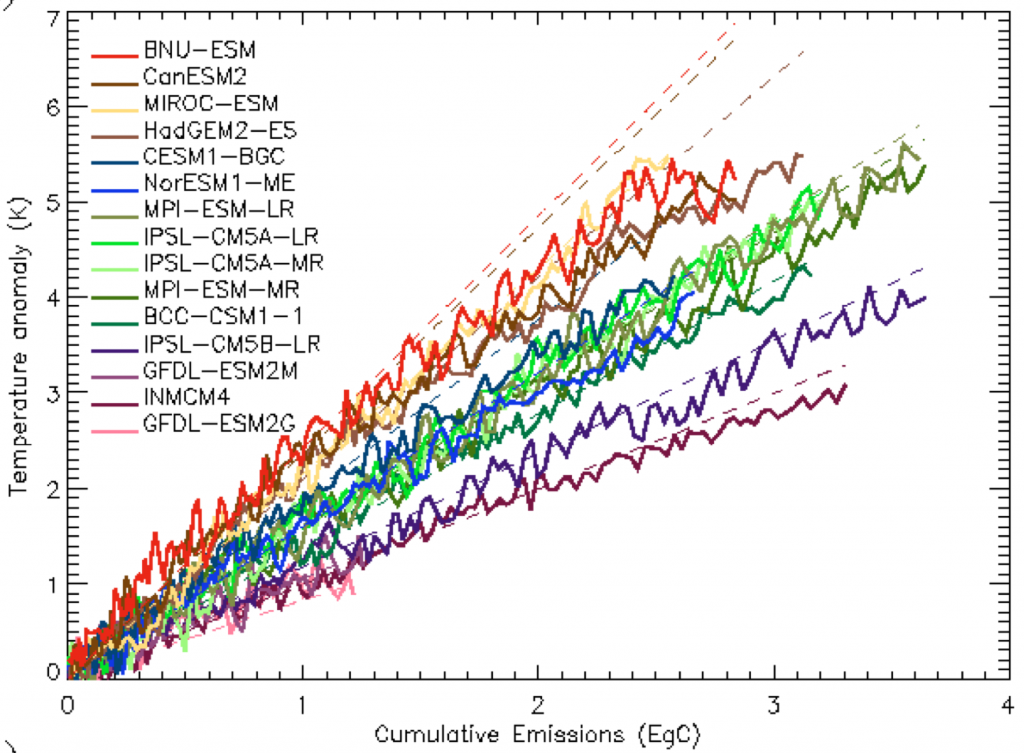
The fact that these two forms of inertia tend to balance leads to another interesting observation. The models all show an approximately linear response to cumulative emissions. For example, here are the CMIP3 models, used in the IPCC AR4 report (the average of the models, indicated by the arrow, is around 1.6C of warming per 1,000 gigatonnes of carbon):

Temp-Against-Cum-Emissions

The same relationship seems to hold for the CMIP5 models, many of which now include a dynamic carbon cycle:
Temp-against-cum-emissions-CMIP5

This linear relationship isn’t determined by any physical properties of the climate system, and probably won’t hold in much warmer or cooler climates, nor when other feedback processes kick in. So we could say it’s a coincidental property of our current climate. However, it’s rather fortuitous for policy discussions.

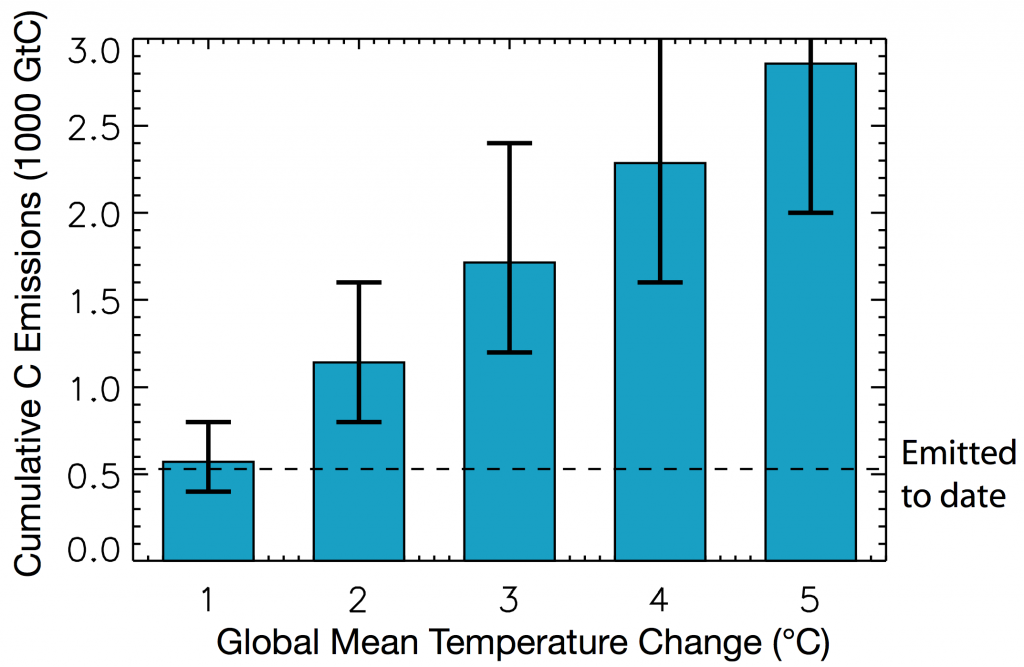
Historically, we have emitted around 550 billion tonnes since the beginning of the industrial era, which gives us an expected temperature response of around 0.9°C. If we want to hold temperature rises to be no more than 2°C of warming, total future emissions should not exceed a further 700 billion tonnes of Carbon. In effect, this gives us a total worldwide carbon budget for the future. The hard policy question, of course, is then how to allocate this budget among the nations (or people) of the world in an equitable way.

[A few years ago, I blogged about a similar analysis, which says that cumulative carbon emissions should not exceed 1 trillion tonnes in total, ever. That calculation gives us a smaller future budget of less then 500 billion tonnes. That result came from analysis using the Hadley model, which has one of the higher slopes on the graphs above. Which number we use for a global target then might depend on which model we believe gives the most accurate projections, and perhaps how we also factor in the uncertainties. If the uncertainty range across models is accurate, then picking the average would give us a 50:50 chance of staying within the temperature threshold of 2°C. We might want better odds than this, and hence a smaller budget.]

In the National Academies report in 2011, the cumulative carbon budgets for each temperature threshold were given as follows (note the size of the uncertainty whiskers on each bar):
emissions-targets-NAS2011

[For a more detailed analysis see: Matthews, H. D., Solomon, S., & Pierrehumbert, R. (2012). Cumulative carbon as a policy framework for achieving climate stabilization. Philosophical transactions. Series A, Mathematical, physical, and engineering sciences, 370(1974), 4365–79. doi:10.1098/rsta.2012.0064]

So, this allows us to clear up some popular misconceptions:

The idea that there is some additional warming owed, no matter what emissions pathway we follow is incorrect. Zero future emissions means little to no future warming, so future warming depends entirely on future emissions. And while the idea of zero future emissions isn’t policy-relevant (because zero emissions is impossible, at least in the near future), it does have implications for how we discuss policy choices. In particular, it means the idea that CO2 emissions cuts will not have an effect on temperature change for several decades is also incorrect. Every tonne of CO2 emissions avoided has an immediate effect on reducing the temperature response.

Another source of confusion is the emissions scenarios used in the IPCC report. They don’t diverge significantly for the first few decades, largely because we’re unlikely (and to some extent unable) to make massive emissions reductions in the next 1-2 decades, because society is very slow to respond to the threat of climate change, and even when we do respond, the amount of existing energy infrastructure that has to be rebuilt is huge. In this sense, there is some inevitable future warming, but it comes from future emissions that we cannot or will not avoid. In other words, political, socio-economic and technological inertia are the primary causes of future climate warming, rather than any properties of the physical climate system.

Like most universities, U of T had a hiring freeze for new faculty for the last few years, as we struggled with budget cuts. Now, we’re starting to look at hiring again, to replace faculty we lost over that time, and to meet the needs of rapidly growing student enrolments. Our department (Computer Science) is just beginning the process of deciding what new faculty positions we wish to argue for, for next year. This means we get to engage in a fascinating process of exploring what we expect to be the future of our field, and where there are opportunities to build exciting new research and education programs. To get a new faculty position, our department has to make a compelling case to the Dean, and the Dean has to balance our request with those from 28 other departments and 46 interdisciplinary groups. So the pitch has to be good.

So here’s my draft pitch:

(1) Create a joint faculty position between the Department of Computer Science and the new School of Environment.

Last summer U of T’s Centre for Environment was relaunched as a School of Environment, housed wholly within the Faculty of Arts and Science. As a school, it can now make up to 49% faculty appointments. [The idea is that to do interdisciplinary research, you need a base in a home department/discipline, where your tenure and promotion will be evaluated, but would spend half your time engaged in inter-disciplinary research and teaching at the School. Hence, a joint position for us would be 51% CS and 49% in the School of Environment.]

A strong relationship between Computer Science and the School of Environment makes sense for a number of reasons. Most environmental science research makes extensive use of computational modelling as a core research tool, and the environmental sciences are one of the greatest producers of big data. As an example, the Earth System Grid currently stores more than 3 petabytes of data from climate models, and this is expected to grow to the point where by the end of the decade a single experiment with a climate model would generate an exabyte of data. This creates a number of exciting opportunities for application of CS tools and algorithms, in a domain that will challenge our capabilities. At the same time, this research is increasingly important to society, as we seek to find ways to feed 9 billion people, protect vital ecosystems, and develop strategies to combat climate change.

There are a number of directions we could go with such a collaboration. My suggestion is to pick one of:

  • Climate informatics. A small but growing community is applying machine learning and data mining techniques to climate datasets. Two international workshops have been held in the last two years, and the field has had a number of successes in knowledge discovery that have established its importance to climate science. For a taste of what the field covers, see the agenda of the last CI Workshop.
  • Computational Sustainability. Focuses on the decision-support needed for resource allocation to develop sustainable solutions in large-scale complex adaptive systems. This could be viewed as a field of applied artificial intelligence, but to do it properly requires strong interdisciplinary links with ecologists, economists, statisticians, and policy makers. This growing community has run run an annual conference, CompSust, since 2009, as well as tracks at major AI conferences for the last few years.
  • Green Computing. Focuses on the large environmental footprint of computing technology, and how to reduce it. Energy efficient computing is a central concern, although I believe an even more interesting approach is when we take a systems approach to understand how and why we consume energy (whether in IT equipment directly, or in devices that IT can monitor and optimize). Again, a series of workshops in the last few years has brought together an active research community (see for example, Greens’2013),

(2) Hire more software engineering professors!

Our software engineering group is now half the size it was a decade ago, as several of our colleagues retired. Here’s where we used to be, but that list of topics and faculty is now hopelessly out of date. A decade ago we had five faculty and plans to grow this to eight by now. Instead, because of the hiring freeze and the retirements, we’re down to three. There were a number of reasons we expected to grow the group, not least because for many years, software engineering was our most popular undergraduate specialist program and we had difficulty covering all the teaching, and also because the SE group had proved to be very successful in bringing in research funding, research prizes, and supervising large numbers of grad students.

Where do we go from here? Deans generally ignore arguments that we should just hire more faculty to replace losses, largely because when faculty retire or leave, that’s the only point at which a university can re-think its priorities. Furthermore, some of our arguments for a bigger software engineering group at U of T went away. Our department withdrew the specialist degree in software engineering, and reduced the number of SE undergrad courses, largely because we didn’t have the faculty to teach them, and finding qualified sessional instructors was always a struggle. In effect, our department has gradually walked away from having a strong software engineering group, due to resource constraints.

I believe very firmly that our department *does* need a strong software engineering group, for a number of reasons. First, it’s an important part of an undergrad CS education. The majority of our students go on to work in the software industry, and for this, it is vital that they have a thorough understanding of the engineering principles of software construction. Many of our competitors in N America run majors and/or specialist programs in software engineering, to feed the enormous demand from the software industry for more graduates. One could argue that this should be left to the engineering schools, but these schools tend to lack sufficient expertise in discrete math and computing theory. I believe that software engineering is rooted intellectually in computer science and that a strong software engineering program needs the participation (and probably the leadership) of a strong computer science department. This argument suggests we should be re-building the strength in software engineering that we used to have in our undergrad program, rather than quietly letting it whither.

Secondly, the complexity of modern software systems makes software engineering research ever more relevant to society. Our ability to invent new software technology continues to outpace our ability to understand the principles by which that software can be made safe and reliable. Software companies regularly come to us seeking to partner with us in joint research and to engage with our grad students. Currently, we have to walk away from most of these opportunities. That means research funding we’re missing out on.

I’ve been collecting examples of different types of climate model that students can use in the classroom to explore different aspects of climate science and climate policy. In the long run, I’d like to use these to make the teaching of climate literacy much more hands-on and discovery-based. My goal is to foster more critical thinking, by having students analyze the kinds of questions people ask about climate, figure out how to put together good answers using a combination of existing data, data analysis tools, simple computational models, and more sophisticated simulations. And of course, learn how to critique the answers based on the uncertainties in the lines of evidence they have used.

Anyway, as a start, here’s a collection of runnable and not-so-runnable models, some of which I’ve used in the classroom:

Simple Energy Balance Models (for exploring the basic physics)

General Circulation Models (for studying earth system interactions)

  • EdGCM – an educational version of the NASA GISS general circulation model (well, an older version of it). EdGCM provides a simplified user interface for setting up model runs, but allows for some fairly sophisticated experiments. You typically need to let the model run overnight for a century-long simulation.
  • Portable University Model of the Atmosphere (PUMA) – a planet Simulator designed by folks at the University of Hamburg for use in the classroom to help train students interested in becoming climate scientists.

Integrated Assessment Models (for policy analysis)

  • C-Learn, a simple policy analysis tool from Climate Interactive. Allows you to specify emissions trajectories for three groups of nations, and explore the impact on global temperature. This is a simplified version of the C-ROADS model, which is used to analyze proposals during international climate treaty negotiations.
  • Java Climate Model (JVM) – a detailed desktop assessment model that offers detailed controls over different emissions scenarios and regional responses.

Systems Dynamics Models (to foster systems thinking)

  • Bathtub Dynamics and Climate Change from John Sterman at MIT. This simulation is intended to get students thinking about the relationship between emissions and concentrations, using the bathtub metaphor. It’s based on Sterman’s work on mental models of climate change.
  • The Climate Challenge: Our Choices, also from Sterman’s team at MIT. This one looks fancier, but gives you less control over the simulation – you can just pick one of three emissions paths: increasing, stabilized or reducing. On the other hand, it’s very effective at demonstrating the point about emissions vs. concentrations.
  • Carbon Cycle Model from Shodor, originally developed using Stella by folks at Cornell.
  • And while we’re on systems dynamics, I ought to mention toolkits for building your own systems dynamics models, such as Stella from ISEE Systems (here’s an example of it used to teach the global carbon cycle).

Other Related Models

  • A Kaya Identity Calculator, from David Archer at U Chicago. The Kaya identity is a way of expressing the interaction between the key drivers of carbon emissions: population growth, economic growth, energy efficiency, and the carbon intensity of our energy supply. Archer’s model allows you to play with these numbers.
  • An Orbital Forcing Calculator, also from David Archer. This allows you to calculate what the effect changes in the earth’s orbit and the wobble on its axis have on the solar energy that the earth receives, in any year in the past of future.

Useful readings on the hierarchy of climate models

A high school student in Ottawa, Jin, writes to ask me for help with a theme on the question of whether global warming is caused by human activities. Here’s my answer:

The simple answer is ‘yes’, global warming is caused by human activities. In fact we’ve known this for over 100 years. Scientists in the 19th Century realized that some gases in the atmosphere help to keep the planet warm by stopping the earth losing heat to outer space, just like a blanket keeps you warm by trapping heat near your body. The most important of these gases is Carbon Dioxide (CO2). If there were no CO2 in the atmosphere, the entire earth would be a frozen ball of ice. Luckily, that CO2 keeps the planet at the temperatures that are suitable for human life. But as we dig up coal and oil and natural gas, and burn them for energy, we increase the amount of CO2 in the atmosphere and hence we increase the temperature of the planet. Now, while scientists have known this since the 19th century, it’s only in the last 30 years that scientists were able to calculate precisely how fast the earth would warm up, and which parts of the planet would be affected the most.

Here are three really good explanations, which might help you for your theme:

  1. NASA’s Climate Kids website:
    http://climatekids.nasa.gov/big-questions/
    It’s probably written for kids younger than you, but has really simple explanations, in case anything isn’t clear.
  2. Climate Change in a Nutshell – a set of short videos that I really like:
    http://www.planetnutshell.com/climate
  3. The IPCC’s frequently asked question list. The IPCC is the international panel on climate change, whose job is to summarize what scientists know, so that politicians can make good decisions. Their reports can be a bit technical, but have a lot more detail than most other material:
    http://www.ipcc.ch/publications_and_data/ar4/wg1/en/faqs.html

Also, you might find this interesting. It’s a list of successful predictions by climate scientists. One of the best ways we know that science is right about something is that we are able to use our theories to predict what while happen in the future. When those predictions turn out to be correct, it gives us a lot more confidence that the theories are right: http://www.easterbrook.ca/steve/?p=3031

By the way, if you use google to search for information about global warming or climate change, you’ll find lots of confusing information, and different opinions. You might wonder why that is, if scientists are so sure about the causes of climate change. There’s a simple reason. Climate change is a really big problem, one that’s very hard to deal with. Most of our energy supply comes from fossil fuels, in one way or another. To prevent dangerous levels of warming, we have to stop using them. How we do that is hard for many people to think about. We really don’t want to stop using them, because the cheap energy from fossil fuels powers our cars, heats our homes, gives us cheap flights, powers our factories, and so on.

For many people it’s easier to choose not to believe in global warming than it is to think about how we would give up fossil fuels. Unfortunately, our climate doesn’t care what we believe – it’s changing anyway, and the warming is accelerating. Luckily, humans are very intelligent, and good at inventing things. If we can understand the problem, then we should be able to solve it. But it will require people to think clearly about it, and not to fool themselves by wishing the problem away.

A few weeks back, Randall Munroe (of XKCD fame) attempted to explain the parts of a Saturn V rocket (“Up Goer Five”) using only the most common one thousand words of English. I like the idea, but found many of his phrasings awkward, and some were far harder to understand than if he’d used the usual word.

Now there’s a web-based editor that let’s everyone try their hand at this, and a tumblr of scientists trying to explain their work this way. Some of them are brilliant, but many almost unreadable. It turns out this is much harder than it looks.

Here’s mine. I cheated once, by introducing one new word that’s not on the list, although it’s not really cheating because the whole point of science education is to equip people the right words and concepts to talk about important stuff:

If the world gets hotter or colder, we call that ‘climate’ change. I study how people use computers to understand such change, and to help them decide what we should do about it. The computers they use are very big and fast, but they are hard to work with. My job is to help them check that the computers are working right, and that the answers they get from the computers make sense. I also study what other things people want to know about how the world will change as it gets hotter, and how we can make the answers to their questions easier to understand.

[Update] And here’s a few others that I think are brilliant:

Emily S. Cassidy, Environmental Scientist at University of Minnesota:

In 50 years the world will need to grow two times as much food as we grow today. Meeting these growing needs for food will be hard because we need to make sure meeting these needs doesn’t lead to cutting down more trees or hurting living things. In the past when we wanted more food we cut down a lot of trees, so we could use the land. So how are we going to grow more food without cutting down more trees? One answer to this problem is looking at how we use the food we grow today. People eat food, but food is also used to make animals and run cars. In fact, animals eat over one-third of the food we grow. In some places, animals eat over two-thirds of the food grown! If the world used all of the food we grow for people, instead of animals and cars, we could have 70% more food and that would be enough food for a lot of people!

Anthony Finkelstein, at University College London, explaining requirements analysis:

I am interested in computers and how we can get them to do what we want. Sometimes they do not do what we expect because we got something wrong. I would like to know this before we use the computer to do something important and before we spend too much time and money. Sometimes they do something wrong because we did not ask the people who will be using them what they wanted the computer to do. This is not as easy as it sounds! Often these people do not agree with each other and do not understand what it is possible for the computer to do. When we know what they want the computer to do we must write it down in a way that people building the computer can also understand it.

This week, I start teaching a new grad course on computational models of climate change, aimed at computer science grad students with no prior background in climate science or meteorology. Here’s my brief blurb:

Detailed projections of future climate change are created using sophisticated computational models that simulate the physical dynamics of the atmosphere and oceans and their interaction with chemical and biological processes around the globe. These models have evolved over the last 60 years, along with scientists’ understanding of the climate system. This course provides an introduction to the computational techniques used in constructing global climate models, the engineering challenges in coupling and testing models of disparate earth system processes, and the scaling challenges involved in exploiting peta-scale computing architectures. The course will also provide a historical perspective on climate modelling, from the early ENIAC weather simulations created by von Neumann and Charney, through to today’s Earth System Models, and the role that these models play in the scientific assessments of the UN’s Intergovernmental Panel on Climate Change (IPCC). The course will also address the philosophical issues raised by the role of computational modelling in the discovery of scientific knowledge, the measurement of uncertainty, and a variety of techniques for model validation. Additional topics, based on interest, may include the use of multi-model ensembles for probabilistic forecasting, data assimilation techniques, and the use of models for re-analysis.

I’ve come up with a draft outline for the course, and some possible readings for each topic. Comments are very welcome:

  1. History of climate and weather modelling. Early climate science. Quick tour of range of current models. Overview of what we knew about climate change before computational modeling was possible.
  2. Calculating the weather. Bjerknes’ equations. ENIAC runs. What does a modern dynamical core do? [Includes basic introduction to thermodynamics of atmosphere and ocean]
  3. Chaos and complexity science. Key ideas: forcings, feedbacks, dynamic equilibrium, tipping points, regime shifts, systems thinking. Planetary boundaries. Potential for runaway feedbacks. Resilience & sustainability. (way too many readings this week. Have to think about how to address this – maybe this is two weeks worth of material?)
    • Liepert, B. G. (2010). The physical concept of climate forcing. Wiley Interdisciplinary Reviews: Climate Change, 1(6), 786-802.
    • Manson, S. M. (2001). Simplifying complexity: a review of complexity theory. Geoforum, 32(3), 405-414.
    • Rind, D. (1999). Complexity and Climate. Science, 284(5411), 105-107.
    • Randall, D. A. (2011). The Evolution of Complexity In General Circulation Models. In L. Donner, W. Schubert, & R. Somerville (Eds.), The Development of Atmospheric General Circulation Models: Complexity, Synthesis, and Computation. Cambridge University Press.
    • Meadows, D. H. (2008). Chapter One: The Basics. Thinking In Systems: A Primer (pp. 11-34). Chelsea Green Publishing.
    • Randers, J. (2012). The Real Message of Limits to Growth: A Plea for Forward-Looking Global Policy, 2, 102-105.
    • Rockström, J., Steffen, W., Noone, K., Persson, Å., Chapin, F. S., Lambin, E., Lenton, T. M., et al. (2009). Planetary boundaries: exploring the safe operating space for humanity. Ecology and Society, 14(2), 32.
    • Lenton, T. M., Held, H., Kriegler, E., Hall, J. W., Lucht, W., Rahmstorf, S., & Schellnhuber, H. J. (2008). Tipping elements in the Earth’s climate system. Proceedings of the National Academy of Sciences of the United States of America, 105(6), 1786-93.
  4. Typology of climate Models. Basic energy balance models. Adding a layered atmosphere. 3-D models. Coupling in other earth systems. Exploring dynamics of the socio-economic system. Other types of model: EMICS; IAMS.
  5. Earth System Modeling. Using models to study interactions in the earth system. Overview of key systems (carbon cycle, hydrology, ice dynamics, biogeochemistry).
  6. Overcoming computational limits. Choice of grid resolution; grid geometry, online versus offline; regional models; ensembles of simpler models; perturbed ensembles. The challenge of very long simulations (e.g. for studying paleoclimate).
  7. Epistemic status of climate models. E.g. what does a future forecast actually mean? How are model runs interpreted? Relationship between model and theory. Reproducibility and open science.
    • Shackley, S. (2001). Epistemic Lifestyles in Climate Change Modeling. In P. N. Edwards (Ed.), Changing the Atmosphere: Expert Knowledge and Environmental Government (pp. 107-133). MIT Press.
    • Sterman, J. D., Jr, E. R., & Oreskes, N. (1994). The Meaning of Models. Science, 264(5157), 329-331.
    • Randall, D. A., & Wielicki, B. A. (1997). Measurement, Models, and Hypotheses in the Atmospheric Sciences. Bulletin of the American Meteorological Society, 78(3), 399-406.
    • Smith, L. a. (2002). What might we learn from climate forecasts? Proceedings of the National Academy of Sciences of the United States of America, 99 Suppl 1, 2487-92.
  8. Assessing model skill – comparing models against observations, forecast validation, hindcasting. Validation of the entire modelling system. Problems of uncertainty in the data. Re-analysis, data assimilation. Model intercomparison projects.
  9. Uncertainty. Three different types: initial state uncertainty, scenario uncertainty and structural uncertainty. How well are we doing? Assessing structural uncertainty in the models. How different are the models anyway?
  10. Current Research Challenges. Eg: Non-standard grids – e.g. non-rectangular, adaptive, etc; Probabilistic modelling – both fine grain (e.g. ECMWF work) and use of ensembles; Petascale datasets; Reusable couplers and software frameworks. (need some more readings on different research challenges for this topic)
  11. The future. Projecting future climates. Role of modelling in the IPCC assessments. What policymakers want versus what they get. Demands for actionable science and regional, decadal forecasting. The idea of climate services.
  12. Knowledge and wisdom. What the models tell us. Climate ethics. The politics of doubt. The understanding gap. Disconnect between our understanding of climate and our policy choices.
14. November 2012 · 2 comments · Categories: cities

Well here’s an interesting example of how much power a newspaper editor has to change the political discourse. And how powerless actual expertise and evidence is when stacked up against emotive newspaper headlines.

This week, Toronto is removing the bike lanes on Jarvis Street. The removal will a cost around $275,000. These bike lanes were only installed three years ago, after an extensive consultation exercise and environmental assessment that cost $950,000, and a construction cost of $86,000. According to analysis by city staff, the bike lanes are working well, with minimal impact on motor traffic travel times, and a significant reduction of accidents. Why would a city council that claims it’s desperately short of funding, and a mayor who vowed to slash unnecessary spending, suddenly decide to spend this much money removing a successful exercise in urban redesign, against the advice of city staff, against the recommendations of their environmental assessment, and against the wishes of local residents?

The answer is that the bike lanes on Jarvis have become a symbol of an ideological battle.

Up until 2009, Jarvis street had five lanes for motor traffic, with the middle lane working as a ‘tidal’ lane – north in the morning, to accommodate cars entering the city from the Gardiner expressway, and south in the evening when they were leaving. The design never worked very well, was confusing to motorists, and dangerous to cyclists and pedestrians. There was widespread agreement that the fifth lane had to be removed, as part of a much larger initiative to rejuvenate the downtown neighbourhoods along Jarvis Street. The main issue in the public consultation was the question of whether the new design should go for wider sidewalks or bike lanes. After an extensive consultation the city settled on bike lanes, and the vote sailed through council by a large majority.

A few days before the vote, the Toronto Sun, a rightwing and rather trashy tabloid newspaper printed a story under the front page headline “Toronto’s War on the Car“, picking up on a framing for discussions of urban transport that seems to have started with a rather silly rant two years previously in the National Post. The original piece in the National Post was a masterpiece of junk journalism: a story of about a local resident who refuses to take the subway and thinks his commute by car takes too long. Add a clever soundbite headline, avoid any attempt to address the issues seriously, and you’ve manufactured a shock horror story to sell more papers.

The timing of the article in the Toronto Sun was unfortunate – a handful of rightwing councillors picked up the soundbite to and made it a key talking point  in the debate on the Jarvis bike lanes in May 2009. The rhetoric on this supposed ‘war’ quickly replaced any rational discussion of how we accommodate multiple modes of transport, and how we solve urban congestion, and the debate descended into a nasty slanging match about cyclists, with our current mayor (then a councillor), even going so far as to say “bikers are a pain in the ass”.

The National Post upped the rhetoric in its news report the next day:

What started out five years ago as a local plan to beautify Jarvis Street yesterday became the front line in Toronto’s war on the car, with Mayor David Miller leading the charge…

The article never explains what’s wrong with building more bike lanes, but that really doesn’t matter when you have such a great soundbite at your disposal. The idea of a war on the car seems to be a peculiar ‘made in Toronto’ phenomenon, designed to get suburban drivers all fired up and ready to vote for firebrand rightwing politicians, who would then defend their rights to drive whereever and whenever they want. This rhetoric shuts down any sensible discussion about urban planning, transit, and sustainability.

Having seen how well the message played to suburban voters, our current mayor picked up the phrase as a major part of his election campaign, making a pledge to “end Toronto’s war on the car” a key part of his election platform. Nobody was ever clear what that meant, but to the voters in the suburbs, frustrated by their long commutes, it sounded good. Ford evidently believed that it meant cancelling every above-ground transit project currently underway, no matter how much such projects might help to reduce congestion. After his successful election, he declared “We will not build any more rail tracks down the middle of our streets.” Never mind that cities all over the world are turning to surface light rail to reduce congestion and pollution and to improve mobility and liveability. For Ford and his suburban voters, anything that threatens the supremacy of the car as his transport of choice must be stopped.

For a while, the argument transmuted into a debate over subways versus surface-level light rail. Subways, of course, have the benefit that they’re hidden away, so people who dislike mass transit never have to see them, and they don’t take precious street-level space away from cars. Unfortunately, subways are dramatically more expensive to build, and are only cost effective in very dense downtown environments, where they can be justified by a high ridership. Street-level light rail can move many more people at a small fraction of the price, and have the added benefit of integrating transit more tightly with existing streetscapes, making shops and restaurants much more accessible. Luckily for Toronto, sense prevailed, and Mayor Ford’s attempts to cancel Toronto’s plan to build an extensive network of light rail failed earlier this year.

Unfortunately, the price of that embarrassing defeat for Mayor Ford was that something else had to be sacrificed. Politicians need to be able to argue that they delivered on their promises. Having failed to kill Transit City, what else could Ford do but look for an easier win? And so the bike lanes on Jarvis had to go. Their removal will make no noticeable difference to drivers using Jarvis for their commute, and will make the street dramatically less safe for bikes. But Ford gets his symbolic victory. Removing a couple of urban bike lanes is now all that’s left of his promise to end the war on cars.

As Eric de Place points out:

“There’s something almost laughably overheated about the ‘war on cars’ rhetoric. It’s almost as if the purveyors of the phrase have either lost their cool entirely, or else they’re trying desperately to avoid a level-headed discussion of transportation policy.”

Removing downtown bike lanes certainly smacks of a vindictiveness born of desperation.

For a talk earlier this year, I put together a timeline of the history of climate modelling. I just updated it for my course, and now it’s up on Prezi, as a presentation you can watch and play with. Click the play button to follow the story, or just drag and zoom within the viewing pane to explore your own path.

Consider this a first draft though – if there are key milestones I’ve missed out (or misrepresented!) let me know!

”]

We spent some time in my climate change class this week talking about Hurricane Sandy – it’s a fascinating case study of how climate change alters things in complex ways. Some useful links I collected:

In class we looked in detail about the factors that meteorologists look at as a hurricane approaches to forecast likely damage:

  • When will it make landfall? If it coincides with a high tide, that’s far worse than it it comes ashore during low tide.
  • Where exactly will it come ashore? Infrastructure to the north of the storm takes far more damage than infrastructure to the south, because the winds drive the storm surge in an anti-clockwise direction. For Sandy, New York was north of the landfall.
  • What about astronomical conditions? There was a full moon on Monday, which means extra high tides because of the alignment of the moon, earth and sun. That adds inches to the storm surge.

All these factors, combined with the rising sea levels, affected the amount of damage from Sandy. I already wrote about the non-linearity of hurricane damage back in December. After hurricane Sandy, I started thinking about another kind of non-linearity, this time in the impacts of sea level rise. We know that as the ocean warms it expands, and as glaciers around the world melt, the water ends up in the ocean. And sea level sea level rise is usually expressed in measures like: “From 1993 to 2009, the mean rate of SLR amounts to 3.3 ± 0.4 mm/year“. Such measures conjure up images of the sea slowly creeping up the beach, giving us plenty of time to move out of the way. But that’s not how it happens.

We’re used to the idea that an earthquake is a sudden release of the pressure that slowly builds up over a long period of time. Maybe that’s a good metaphor for sea level rise too – it is non-linear in the same way. What really matters about sea level rise isn’t its effects on average low and high tides. What matters is its effect on the height of storm surges. For example, the extra foot added to sea level in New York over the last century was enough to make the difference between the storm surge from Hurricane Sandy staying below the sea walls or washing into the subway tunnels. If you keep adding to sea level rise year after year, what you should expect is, sooner or later, a tipping point where a storm that you could survive previously suddenly become disastrous. Of course, it doesn’t help that Sandy was supersized by warmer oceans, fed by the extra moisture in a warmer atmosphere, and pushed in directions that it wouldn’t normally go by unusual weather conditions over Greenland. But still, it was the exact height of the storm surge that made all the difference, when you look at the bulk of the damage.

”]

I’ve been using the term Climate Informatics informally for a few years to capture the kind of research I do, at the intersection of computer science and climate science. So I was delighted to be asked to give a talk at the second annual workshop on Climate Informatics at NCAR, in Boulder this week. The workshop has been fascinating – an interesting mix of folks doing various kinds of analysis on (often huge) climate datasets, mixing up techniques from Machine Learning and Data Mining with the more traditional statistical techniques used by field researchers, and the physics-based simulations used in climate modeling.

I was curious to see how this growing community defines itself – i.e. what does the term “climate informatics” really mean? Several of the speakers offered definitions, largely drawing on the idea of the Fourth Paradigm, a term coined by Jim Gray, who explained it as follows. Originally, science was purely empirical. In the last few centuries, theoretical science came along, using models and generalizations, and in the latter half of the twentieth century, computational simulations. Now, with the advent of big data, we can see a fourth scientific research paradigm emerging, sometimes called eScience, focussed on extracting new insights from vast collections of data. By this view, climate informatics could be defined as data-driven inquiry, and hence offers a complement to existing approaches to climate science.

However, there’s still some confusion, in part because the term is new, and crosses disciplinary boundaries. For example, some people expected that Climate Informatics would encompass the problems of managing and storing big data (e.g. the 3 petabytes generated by the CMIP5 project, or the exabytes of observational data that is now taxing the resources of climate data archivists). However, that’s not what this community does. So, I came up with my own attempt to define the term:

I like this definition for three reasons. First, by bringing Information Science into the mix, we can draw a distinction between climate informatics and other parts of computer science that are relevant to climate science (e.g. the work of building the technical infrastructure for exascale computing, designing massively parallel machines, data management, etc). Secondly, information science brings with it a concern for the broader societal and philosophical questions of the nature of information and why people need it, a concern that’s often missing from computer science. Oh, and I also like this definition because I also work at the intersection of the three fields, even though I don’t really do data-driven inquiry (although I did, many years ago, write an undergraduate thesis on machine learning). Hence, it creates a slightly broader definition than just associating the term with the ‘fourth paradigm’.

Having defined the field this way, it immediately suggests that climate informatics should also concern itself with the big picture of how we get get beyond mere information, and start to produce knowledge and (hopefully) wisdom:

This diagram is adapted from a classic paper by Russ Ackoff “From Data to Wisdom”, Journal of Applied Systems Analysis, Volume 16, 1989 p 3-9. Ackoff originally had Understanding as one of the circles, but subsequent authors have pointed out that it makes more sense as one of two dimensions you move along as you make sense of the data, the other being ‘context’ or ‘connectedness’.

The machine learning community offers a number of tools primarily directed at moving from Data towards Knowledge, by finding patterns in complex datasets. The output of a machine learner is a model, but it’s a very different kind of model from the computational models used in climate science: it’s a mathematical model that describes the discovered relationships in the data. In contrast, the physics-based computational models that climate scientists build are more geared towards moving in the opposite direction, from knowledge (in the form of physical theories of climactic processes) towards data, as a way of exploring how well current theory explains the data. Of course, you can also run a climate model to project the future (and, presumably, help society choose a wise path into the future), but only once you’ve demonstrated it really does explain the data we already have about the past. Clearly the two approaches are complementary, and ought to be used together to build a strong bridge between data and wisdom.

Note: You can see all the other invited talks (including mine), at the workshop archive. You can also explore the visuals I used (with no audio) at Prezi (hint: use full screen for best viewing).

It’s AGU abstract submission day, and I’ve just submitted one to a fascinating track organised by John Cook, entitled “Social Media and Blogging as a Communication Tool for Scientists”. The session looks like it will be interesting, as there are submissions from several prominent climate bloggers. I decided to submit an abstract on moderation policies for climate blogs:

Don’t Feed the Trolls: An analysis of strategies for moderating discussions on climate blogs
A perennial problem in any online discussion is the tendency for discussions to get swamped with non-constructive (and sometimes abusive) comments. Many bloggers use some form of moderation policy to filter these out, to improve the signal to noise ratio in the discussion, and to encourage constructive participation. Unfortunately, moderation policies have disadvantages too: they are time-consuming to implement, introduce a delay in posting contributions, and can lead to accusations of censorship and anger from people whose comments are removed.

In climate blogging, the problem is particularly acute because of the politicization of the discourse. The nature of comments on climate blogs vary widely. For example, on a blog focussed on the physical science of climate, comments on posts might include personal abuse, accusations of misconduct and conspiracy, repetition of political talking points, dogged pursuit of obscure technical points (whether related or not to the original post), naive questions, concern trolling (negative reactions posing as naive questions), polemics, talk of impending doom and catastrophe, as well as some honest and constructive questions about the scientific topic being discussed. How does one decide which of these comments to allow? And if some comments are to be removed, what should be done with them?

In this presentation, I will survey a number of different moderation strategies used on climate blogs (along with a few notable examples from other kinds of blogs), and identify the advantages and disadvantages of each. The nature of the moderation strategy has an impact on the size and kind of audience a blog attracts. Hence, the choice of moderation strategy should depend on the overall goals for the blog, the nature of the intended audience, and the resources (particularly time) available to implement the strategy.

05. June 2012 · 3 comments · Categories: philosophy

There’s been plenty of reaction across the net this week in response to a daft NYT article that begins “Men invented the internet”. At BoingBoing, Xeni is rightly outraged at the way the article is written, and in response comes up with plenty of examples of the contributions women have made to the development of computing. Throughout the resulting thread, many commentators chip in with more examples. Occasionally a (male) commentator shows up and tries to narrow down the definition of “invented the internet” to show that, yes, it was a man who invented some crucial piece of technology that makes it work. These comments are very revealing of a particular (male!) mindset towards technology and invention.

The central problem in the discussion seems to have been missed entirely. The real problem word in that opening sentence isn’t the word “men”, it’s the word “invented”. The internet is an incredibly complex socio-technical system. The notion that any one person (or any small group of people) invented it is ludicrous. Over a period of decades, the various technologies, protocols and conventions that make the internet work gradually evolved, through the efforts of a huge number of people (men and women), through a remarkable open design process. The people engaged in this endeavour had to invent new social processes for sharing and testing design ideas and getting feedback (for example, the RFC). It was these social processes, as much as any piece of technology, that made the internet possible.

But we should go further, because the concept of “invented” is even more problematic. If you study how any modern device came to be, the idea that there is a unique point in space and time that can be called its “invention” is really just a fiction. Henry Petroski does a great job of demonstrating this, through his histories of every day objects such as pencils, cutlery, and so on. The technologies we rely on today all passed though a long history of evolution in the same way. Each new form is a variant of ones that have gone before, created to respond to a perceived flaw in its predecessors. Some of these new variants are barely different from others, others represent larger modifications. Many of these modifications are worse than the original, some are better for specific purposes (and hence may start a new niche), and occasionally a more generally useful improvement is made.

The act of pointing to these occasional, larger modifications, and choosing to label them as “the birth of the modern X”, or the “first X”, or “the invention of X”, is a purely a social construct. We do it because we’re anchored in the present, seeing only the outcomes of these evolutionary processes, and we make the same mistake that creationists make, of being unable to conceive of the huge variety of intermediate forms that came before, and the massive process of trial and error that selected a particular form to survive and prosper. And, through continued operation of that bias, we’ve been conditioned to think in terms of unique moments of “invention” (often accompanied by a caricature of the lonely inventor working late at night in the lab).

And one of the biggest differences between men and women, in terms of social behaviour, is that men tend to boast about their successes and identify winners, while women tend to acknowledge group contributions and downplay their own efforts. So it’s hardly surprising that our history books are more full of male “inventors” than female inventors – the very idea of looking for a unique person to call the “inventor” is largely a male concept. Not only that, but it’s overwhelmingly a rich white guys’ way of looking at the world. The rich and powerful get to make decisions about who gets the credit for stuff. Not surprisingly, rich and powerful white men tend to pick other white men to designate as the “inventor”, and marginalize the contributions of others, no matter who else contributed to the idea during its gestation.

Update: Jan 9, 2014: Thanks to my student, Elizabeth, I now know the term for this: it’s the Matthew Effect. The wikipedia page has lots of examples.

29. May 2012 · 5 comments · Categories: education

A few people today have pointed me at the new paper by Dan Kahan & colleagues (1), which explores competing explanations for why lots of people don’t regard climate change as a serious problem. I’ve blogged about Dan’s work before – their earlier studies are well designed, and address important questions. If you’re familiar with their work, the new study isn’t surprising. They find that people’s level of concern over climate change doesn’t correlate with their level of science literacy, but does correlate with their cultural philosophies. In this experiment, there was no difference in science literacy between people who are concerned about climate change and those who are not. They use this to build a conclusion that giving people more facts is not likely to change their minds:

A communication strategy that focuses only on transmission of sound scientific information, our results suggest, is unlikely to do that.

Which is reasonable advice, because science communication must address how different people see the world, and how people filter information based on their existing worldview:

Effective strategies include use of culturally diverse communicators, whose affinity with different communities enhances their credibility, and information-framing techniques that invest policy solutions with resonances congenial to diverse groups

Naturally, some disreputable newsites spun the basic finding as a “Global warming skeptics as knowledgeable about science as climate change believers, study says“. Which is not what the study says at all, because it didn’t measure what people know about the science.

The problem is that there’s an unacknowledged construct validity problem in the study. At the beginning of the paper, the authors talk about “the science comprehension thesis (SCT)”:

As members of the public do not know what scientists know, or think the way scientists think, they predictably fail to take climate change as seriously as scientists believe they should.

…which they then claim their study disproves. But when you get into the actual study design, they quickly switch to talking about science literacy:

We measured respondents’ science literacy with National Science Foundation’s (NSF) Science and Engineering Indicators. Focused on physics and biology (for example, ‘Electrons are smaller than atoms [true/false]’; ‘Antibiotics kill viruses as well as bacteria [true/false]’), the NSF Indicators are widely used as an index of public comprehension of basic science.

But the problem is, science comprehension cannot be measured by asking a whole bunch of true/false questions about scientific “facts”! All that measures is the ability to do well in a pub trivia quizzes.

Unfortunately, this mistake is widespread, and leads to an education strategy that fills students’ heads with a whole bunch of disconnected science trivia, and no appreciation for what science is really all about. When high school students learn chemistry, for example, they have to follow recipes from a textbook, and get the “right” results. If their results don’t match the textbooks, they get poor marks. When they’re given science tests (like the NSF one used in this study), they’re given the message that there’s a right and wrong answer to each question, and you just gotta know it. But that’s about as far from real science as you can get! It’s when the experiment gives surprising results that the real scientific process kicks in. Science isn’t about getting the textbook answer, it’s about asking interesting questions, and finding sound methods for answering them. The myths about science are ground into kids from an early age by people who teach science as a bunch of facts (3).

At the core of the problem is a failure to make the distinction that Maienschein points out between science literacy and scientific literacy (2). The NSF instrument measures the former. But science comprehension is about the latter – it…

…emphasizes scientific ways of knowing and the process of thinking critically and creatively about the natural world.

So, to Kahan’s interpretation of the results, I would add another hypothesis: we should actually start teaching people about what scientists do, how they work, and what it means to collect and analyze large bodies of evidence. How results (yes, even published ones) often turn out to be wrong, and what matters is the accumulation of evidence over time, rather than any individual result. After all, with Google, you can now quickly find a published result to support just about any crazy claim. We need to teach people why that’s not science.

Update (May 30, 2012): Several people suggested I should also point out that the science literacy test they used is for basic science questions across physics and biology; they did not attempt to test in any way people’s knowledge of climate science. So that seriously dents their conclusion: The study says nothing about whether giving people more facts about climate science is likely to make a difference.

Update2 (May 31, 2012): Some folks on Twitter argued with my statement “concern over climate change doesn’t correlate with … level of science literacy”. Apparently none of them have a clue how to interpret statistical analysis in the behavioural sciences. Here’s Dan Kahan on the topic. (h/t to Tamsin).

References:

(1) Kahan, D., Peters, E., Wittlin, M., Slovic, P., Ouellette, L., Braman, D., & Mandel, G. (2012). The polarizing impact of science literacy and numeracy on perceived climate change risks Nature Climate Change DOI: 10.1038/nclimate1547
(2) Maienschein, J. (1998). Scientific Literacy Science, 281 (5379), 917-917 DOI: 10.1126/science.281.5379.917
(3) William F. McComas (1998). The Principle Elements of the Nature of Science: Dispelling the Myths The Nature of Science in Science Education