I was doing some research on Canada’s climate targets recently, and came across this chart, presented as part of Canada’s Intended Nationally Determined Contribution (INDC) under the Paris Agreement:

canada-indc-pledge

Looks good right? Certainly it conveys a message that Canada’s well on track, and that the target for 2030 is ambitious (compared to a business as usual pathway). Climate change solved, eh?

But the chart is an epic example of misdirection. Here’s another chart that pulls the same trick, this time from the Government’s Climate Change website, and apparently designed to make the 2030 target look bravely ambitious:

ghg_emissions_trends_2016_en

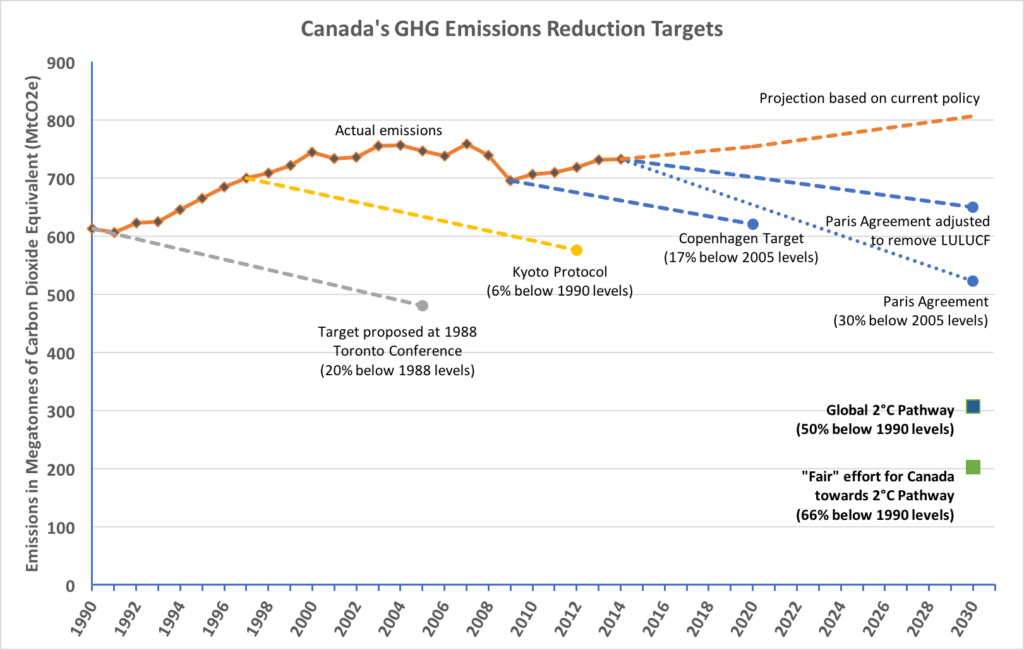
So I downloaded the data and produced my own chart, with a little more perspective added. I wanted to address several ways in which the above charts represent propaganda, rather than evidence:

  • By cutting off the Y axis at 500 Mt, the chart hides the real long-term evidence-based goal for climate policy: zero emissions;
  • Canada has consistently failed to meet any of it’s climate targets in the past, while the chart seems to imply we’re doing rather well;
  • The chart conflates two different measures. The curves showing actual emissions exclude net removal from forestry (officially known as Land Use, Land Use Change, and Forestry LULUCF), while Canada fully intends to include this in its accounting for achieving the 2030 target. So if you plot the target on the same chart with emissions, honesty dictates you should adjust the target accordingly.

Here’s my “full perspective” chart. Note that the first target shown here in grey was once Liberal party policy in the early 1990s; the remainder were official federal government targets. Each is linked to the year they were first proposed. The “fair effort” for Canada comes from ClimateActionTracker’s analysis:

canada-climate-targets2

The correct long term target for carbon emissions is, of course zero. Every tonne of CO2 emitted makes the problem worse, and there’s no magic fairy that removes these greenhouse gases from the atmosphere once we’ve emitted them. So until we get to zero emissions, we’re making the problem worse, and the planet keeps warming. Worse still, the only plausible pathways to keep us below the UN’s upper limit of 2°C of warming requires us to do even better than this: we have to go carbon negative before the end of the century.

Misleading charts from the government of Canada won’t help us get on the right track.

This is an excerpt from the draft manuscript of my forthcoming book, Computing the Climate.

While models are used throughout the sciences, the word ‘model’ can mean something very different to scientists from different fields. This can cause great confusion. I often encounter scientists from outside of climate science who think climate models are statistical models of observed data, and that future projections from these models must be just extrapolations of past trends. And just to confuse things further, some of the models used in climate policy analysis are like this. But the physical climate models that underpin our knowledge of why climate change occurs are fundamentally different from statistical models.

A useful distinction made by philosophers of science is between models of phenomena, and models of data. The former include models developed by physicists and engineers to capture cause-and-effect relationships. Such models are derived from theory and experimentation, and have explanatory power: the model captures the reasons why things happen. Models of data, on the other hand, describe patterns in observed data, such as correlations and trends over time, without reference to why they occur. Statistical models, for example, describe common patterns (distributions) in data, without saying anything about what caused them. This simplifies the job of describing and analyzing patterns: if you can find a statistical model that matches your data, you can reduce the data to a few parameters (sometimes just two: a mean and a standard deviation). For example, the heights of any large group of people tend to follow a normal distribution—the bell-shaped curve—but this model doesn’t explain why heights vary in that way, nor whether they always will in the future. New techniques from machine learning have extended the power of these kinds of models in recent years, allowing more complex patterns to be discovered by “training” an algorithm to find more complex kinds of pattern.

Statistical techniques and machine learning algorithms are good at discovering patterns in data (eg “A and B always seems to change together”), but hopeless at explaining why those patterns occur. To get over this, many branches of science use statistical methods together with controlled experiments, so that if we find a pattern in the data after we’ve carefully manipulated the conditions, we can argue that the changes we introduced in the experiment caused that pattern. The ability to identify a causal relationship in a controlled experiment has nothing to do with the statistical model used—it comes from the logic of the experimental design. Only if the experiment is designed properly will statistical analysis of the results provide any insights into cause and effect.

Unfortunately, for some scientific questions, experimentation is hard, or even impossible. Climate change is a good example. Even though it’s possible to manipulate the climate (as indeed we are currently doing, by adding more greenhouse gases), we can’t set up a carefully controlled experiment, because we only have one planet to work with. Instead, we use numerical models, which simulate the causal factors—a kind of virtual experiment. An experiment conducted in a causal model won’t necessarily tell us what will happen in the real world, but it often gives a very useful clue. If we run the virtual experiment many times in our causal model, under slightly varied conditions, we can then turn back to a statistical model to help analyze the results. But without the causal model to set up the experiment, a statistical analysis won’t tell us much.

Both traditional statistical models and modern machine learning techniques are brittle, in the sense that they struggle when confronted with new situations not captured in the data from which the models were derived. An observed statistical trend projected into the future is only useful as a predictor if the future is like the past; it will be a very poor predictor if the conditions that cause the trend change. Climate change in particular is likely to make a mess of all of our statistical models, because the future will be very unlike the past. In contrast, a causal model based on the laws of physics will continue to give good predictions, as long as the laws of physics still hold.

Modern climate models contain elements of both types of model. The core elements of a climate model capture cause-and-effect relationships from basic physics, such as the thermodynamics and radiative properties of the atmosphere. But these elements are supplemented by statistical models of phenomena such as clouds, which are less well understood. To a large degree, our confidence in future predictions from climate models comes from the parts that are causal models based on physical laws, and the uncertainties in these predictions derive from the parts that are statistical summaries of less well-understood phenomena. Over the years, many of the improvements in climate models have come from removing a component that was based on a statistical model, and replacing it with a causal model. And our confidence in the causal components in these models comes from our knowledge of the laws of physics, and from running a very large number of virtual experiments in the model to check whether we’ve captured these laws correctly in the model, and whether they really do explain climate patterns that have been observed in the past.

Today I’ve been tracking down the origin of the term “Greenhouse Effect”. The term itself is problematic, because it only works as a weak metaphor: both the atmosphere and a greenhouse let the sun’s rays through, and then trap some of the resulting heat. But the mechanisms are different. A greenhouse stays warm by preventing warm air from escaping. In other words, it blocks convection. The atmosphere keeps the planet warm by preventing (some wavelengths of) infra-red radiation from escaping. The “greenhouse effect” is really the result of many layers of air, each absorbing infra-red from the layer below, and then re-emitting it both up and down. The rate at which the planet then loses heat is determined by the average temperature of the topmost layer of air, where this infra-red finally escapes to space. So not really like a greenhouse at all.

So how did the effect acquire this name? The 19th century French mathematician Joseph Fourier is usually credited as the originator of the idea in the 1820’s. However, it turns out he never used the term, and as James Fleming (1999) points out, most authors writing about the history of the greenhouse effect cite only secondary sources on this, without actually reading any of Fourier’s work. Fourier does mention greenhouses in his 1822 classic “Analytical Theory of Heat”, but not in connection with planetary temperatures. The book was published in French, so he uses the french “les serres”, but it appears only once, in a passage on properties of heat in enclosed spaces. The relevant paragraph translates as:

In general the theorems concerning the heating of air in closed spaces extend to a great variety of problems. It would be useful to revert to them when we wish to foresee and regulate the temperature with precision, as in the case of green-houses, drying-houses, sheep-folds, work-shops, or in many civil establishments, such as hospitals, barracks, places of assembly” [Fourier, 1822; appears on p73 of the edition translated by Alexander Freeman, published 1878, Cambridge University Press]

In his other writings, Fourier did hypothesize that the atmosphere plays a role in slowing the rate of heat loss from the surface of the planet to space, hence keeping the ground warmer than it might otherwise be. However, he never identified a mechanism, as the properties of what we now call greenhouse gases weren’t established until John Tyndall‘s experiments in the 1850’s. In explaining his hypothesis, Fourier refers to a “hotbox”, a device invented by the explorer de Saussure, to measure the intensity of the sun’s rays. The hotbox had several layers of glass in the lid which allowed the sun’s rays to enter, but blocked the escape of the heated air via convection. But it was only a metaphor. Fourier understood that whatever the heat trapping mechanism in the atmosphere was, it didn’t actually block convection.

Svante Arrhenius was the first to attempt a detailed calculation of the effect of changing levels of carbon dioxide in the atmosphere, in 1896, in his quest to test a hypothesis that the ice ages were caused by a drop in CO2. Accordingly, he’s also sometime credited with inventing the term. However, he also didn’t use the term “greenhouse” in his papers, although he did invoke a metaphor similar to Fourier’s, using the Swedish word “drivbänk”, which translates as hotbed (Update: or possibly “hothouse” – see comments).

So the term “greenhouse effect” wasn’t coined until the 20th Century. Several of the papers I’ve come across suggest that the first use of the term “greenhouse” in this connection in print was in 1909, in a paper by Wood. This seems rather implausible though, because the paper in question is really only a brief commentary explaining that the idea of a “greenhouse effect” makes no sense, as a simple experiment shows that greenhouses don’t work by trapping outgoing infra-red radiation. The paper is clearly reacting to something previously published on the greenhouse effect, and which Wood appears to take way too literally.

A little digging produces a 1901 paper by Nils Ekholm, a Swedish meteorologist who was a close colleague of Arrhenius, which does indeed use the term ‘greenhouse’. At first sight, he seems to use the term more literally than is warranted, although in subsequent paragraphs, he explains the key mechanism fairly clearly:

The atmosphere plays a very important part of a double character as to the temperature at the earth’s surface, of which the one was first pointed out by Fourier, the other by Tyndall. Firstly, the atmosphere may act like the glass of a green-house, letting through the light rays of the sun relatively easily, and absorbing a great part of the dark rays emitted from the ground, and it thereby may raise the mean temperature of the earth’s surface. Secondly, the atmosphere acts as a heat store placed between the relatively warm ground and the cold space, and thereby lessens in a high degree the annual, diurnal, and local variations of the temperature.

There are two qualities of the atmosphere that produce these effects. The one is that the temperature of the atmosphere generally decreases with the height above the ground or the sea-level, owing partly to the dynamical heating of descending air currents and the dynamical cooling of ascending ones, as is explained in the mechanical theory of heat. The other is that the atmosphere, absorbing but little of the insolation and the most of the radiation from the ground, receives a considerable part of its heat store from the ground by means of radiation, contact, convection, and conduction, whereas the earth’s surface is heated principally by direct radiation from the sun through the transparent air.

It follows from this that the radiation from the earth into space does not go on directly from the ground, but on the average from a layer of the atmosphere having a considerable height above sea-level. The height of that layer depends on the thermal quality of the atmosphere, and will vary with that quality. The greater is the absorbing power of the air for heat rays emitted from the ground, the higher will that layer be, But the higher the layer, the lower is its temperature relatively to that of the ground ; and as the radiation from the layer into space is the less the lower its temperature is, it follows that the ground will be hotter the higher the radiating layer is.” [Ekholm, 1901, p19-20]

At this point, it’s still not called the “greenhouse effect”, but this metaphor does appear to have become a standard way of introducing the concept. But in 1907, the English scientist, John Henry Poynting confidently introduces the term “greenhouse effect”, in his criticism of Percival Lowell‘s analysis of the temperature of the planets. He uses it in scare quotes throughout the paper, which suggests the term is newly minted:

Prof. Lowell’s paper in the July number of the Philosophical Magazine marks an important advance in the evaluation of planetary temperatures, inasmuch as he takes into account the effect of planetary atmospheres in a much more detailed way than any previous wrlter. But he pays hardly any attention to the “blanketing effect,” or, as I prefer to call it, the “greenhouse effect” of the atmosphere.” [Poynting, 1907, p749]

And he goes on:

The ” greenhouse effect” of the atmosphere may perhaps be understood more easily if we first consider the case of a greenhouse with horizontal roof of extent so large compared with its height above the ground that the effect of the edges may be neglected. Let us suppose that it is exposed to a vertical sun, and that the ground under the glass is “black” or a full absorber. We shall neglect the conduction and convection by the air in the greenhouse. [Poynting, 1907, p750]

He then goes on to explore the mathematics of heat transfer in this idealized greenhouse. Unfortunately, he ignores Ekholm’s crucial observation that it is the rate of heat loss at the upper atmosphere that matters, so his calculations are mostly useless. But his description of the mechanism does appear to have taken hold as the dominant explanation. The following year, Frank Very published a response (in the same journal), using the term “Greenhouse Theory” in the title of the paper. He criticizes Poynting’s idealised greenhouse as way too simplistic, but suggests a slightly better metaphor is a set of greenhouses stacked one above another, each of which traps a little of the heat from the one below:

It is true that Professor Lowell does not consider the greenhouse effect analytically and obviously, but it is nevertheless implicitly contained in his deduction of the heat retained, obtained by the method of day and night averages. The method does not specify whether the heat is lost by radiation or by some more circuitous process; and thus it would not be precise to label the retaining power of the atmosphere a “greenhouse effect” without giving a somewhat wider interpretation to this name. If it be permitted to extend the meaning of the term to cover a variety of processes which lead to identical results, the deduction of the loss of surface heat by comparison of day and night temperatures is directly concerned with this wider “greenhouse effect.” [Very, 1908, p477]

Between them, Poynting and Very are attempting to pin down whether the “greenhouse effect” is a useful metaphor, and how the heat transfer mechanisms of planetary atmospheres actually work. But in so doing, they help establish the name. Wood’s 1909 comment is clearly a reaction to this discussion, but one that fails to understand what is being discussed. It’s eerily reminiscent of any modern discussion of the greenhouse effect: whenever any two scientists discuss the details of how the greenhouse effect works, you can be sure someone will come along sooner or later claiming to debunk the idea by completely misunderstanding it.

In summary, I think it’s fair to credit Poynting as the originator of the term “greenhouse effect”, but with a special mention to Ekholm for both his prior use of the word “greenhouse”, and his much better explanation of the effect. (Unless I missed some others?)

References

Arrhenius, S. (1896). On the Influence of Carbonic Acid in the Air upon the Temperature of the Ground. Philosophical Magazine and Journal of Science, 41(251). doi:10.1080/14786449608620846

Ekholm, N. (1901). On The Variations Of The Climate Of The Geological And Historical Past And Their Causes. Quarterly Journal of the Royal Meteorological Society, 27(117), 1–62. doi:10.1002/qj.49702711702

Fleming, J. R. (1999). Joseph Fourier, the “greenhouse effect”, and the quest for a universal theory of terrestrial temperatures. Endeavour, 23(2), 72–75. doi:10.1016/S0160-9327(99)01210-7

Fourier, J. (1822). Théorie Analytique de la Chaleur (“Analytical Theory of Heat”). Paris: Chez Firmin Didot, Pere et Fils.

Fourier, J. (1827). On the Temperatures of the Terrestrial Sphere and Interplanetary Space. Mémoires de l’Académie Royale Des Sciences, 7, 569–604. (translation by Ray Pierrehumbert)

Poynting, J. H. (1907). On Prof. Lowell’s Method for Evaluating the Surface-temperatures of the Planets; with an Attempt to Represent the Effect of Day and Night on the Temperature of the Earth. Philosophical Magazine, 14(84), 749–760.

Very, F. W. (1908). The Greenhouse Theory and Planetary Temperatures. Philosophical Magazine, 16(93), 462–480.

Wood, R. W. (1909). Note on the Theory of the Greenhouse. Philosophical Magazine, 17, 319–320. Retrieved from http://scienceblogs.com/stoat/2011/01/07/r-w-wood-note-on-the-theory-of/

This week I’m reading my way through three biographies, which neatly capture the work of three key scientists who laid the foundation for modern climate modeling: Arrhenius, Bjerknes and Callendar.

Arrhenius-bookAppropriatingWeatherCallFullJacket#3.indd

Crawford, E. (1996). Arrhenius: From Ionic Theory to the Greenhouse Effect. Science History Publications.
A biography of Svante Arrhenius, the Swedish scientist who, in 1895, created the first computational climate model, and spent almost a full year calculating by hand the likely temperature changes across the planet for increased and decreased levels of carbon dioxide. The term “greenhouse effect” hadn’t been coined back then, and Arrhenius was more interested in the question of whether the ice ages might have been caused by reduced levels of CO2. But nevertheless, his model was a remarkably good first attempt, and produced the first quantitative estimate of the warming expected from human’s ongoing use of fossil fuels.
Friedman, R. M. (1993). Appropriating the Weather: Vilhelm Bjerknes and the Construction of a Modern Meteorology. Cornell University Press.
A biography of Vilhelm Bjerknes, the Norwegian scientist, who, in 1904, identified the primitive equations, a set of differential equations that form the basis of modern computational weather forecasting and climate models. The equations are, in essence, an adaption of the equations of fluid flow and thermodynamics, adapted to represent the atmosphere as a fluid on a rotating sphere in a gravitational field. At the time, the equations were little more than a theoretical exercise, and we had to wait half a century for the early digital computers, before it became possible to use them for quantitative weather forecasting.
Fleming, J. R. (2009). The Callendar Effect: The Life and Work of Guy Stewart Callendar (1898-1964). University of Chicago Press.
A biography of Guy S. Callendar, the British scientist, who, in 1938, first compared long term observations of temperatures with measurements of rising carbon dioxide in the atmosphere, to demonstrate a warming trend as predicted by Arrhenius’ theory. It was several decades before his work was taken seriously by the scientific community. Some now argue that we should use the term “Callendar Effect” to describe the warming from increased emissions of carbon dioxide, because the term “greenhouse effect” is too confusing – greenhouse gases were keeping the planet warm long before we started adding more, and anyway, the analogy with the way that glass traps heat in a greenhouse is a little inaccurate.

Not only do the three form a neat ABC, they also represent the three crucial elements you need for modern climate modelling: a theoretical framework to determine which physical processes are likely to matter, a set of detailed equations that allow you to quantify the effects, and comparison with observations as a first step in validating the calculations.

I’m heading off to Florence this week for the International Conference on Software Engineering (ICSE). The highlight of the week will be a panel session I’m chairing, on the Karlskrona Manifesto. The manifesto itself is something we’ve been working on since last summer – a group of us wrote the first draft at the Requirements Engineering conference in Karlskrona, Sweden, last summer (hence the name). This week we’re launching a website for the manifesto, and we’ve published a longer technical paper about it at ICSE.

The idea of the manifesto is to inspire deeper analysis of the roles and responsibilities of technology designers (and especially software designers), given that software systems now shape so much of modern life. We rarely stop to think about the unintended consequences of very large numbers of people using our technologies, nor do we ask whether, on balance, an idea that looks cool on paper will merely help push us even further into unsustainable behaviours. The position we take in the manifesto is that, as designers, our responsibility for the consequences of our designs are much broader than most of us acknowledge, and it’s time to do something about it.

For the manifesto, we ended up thinking about sustainability in terms of five dimensions:

  • Environmental sustainability: the long term viability of natural systems, including ecosystems, resource consumption, climate, pollution food, water, and waste.
  • Social sustainability: the quality of social relationships and the factors that tend to improve or erode trust in society, such as social equity, democracy, and justice.
  • Individual sustainability: the health and well-being of people as individuals, including mental and physical well-being, education, self-respect, skills, and mobility.
  • Economic sustainability: the long term viability of economic activities, such as businesses and nations, including issues such as investment, wealth creation and prosperity.
  • Technical sustainability: the ability to sustain technical systems and their infrastructures, including software maintenance, innovation, obsolescence, and data integrity.

There are of course, plenty of other ways of defining sustainability (which we discuss in the paper), and some hard constraints in some dimensions – e.g. we cannot live beyond the resource limits of the planet, no matter how much progress we make towards sustainability in other other dimensions. But a key insight is that all five dimensions matter, and none of them can be treated in isolation. For example, we might think we’re doing fine in one dimension – economic, say, as we launch a software company with a sound business plan that can make a steady profit – but often we do so only by incurring a debt in other dimensions, perhaps harming the environment by contributing to the mountains of e-waste, or harming social sustainability by replacing skilled jobs with subsistence labour.

The manifesto characterizes a set of problems in how technologists normally think about sustainability (if they do), and ends with a set of principles for sustainability design:

  • Sustainability is systemic. Sustainability is never an isolated property. Systems thinking has to be the starting point for the transdisciplinary common ground of sustainability.
  • Sustainability has multiple dimensions. We have to include those dimensions into our analysis if we are to understand the nature of sustainability in any given situation.
  • Sustainability transcends multiple disciplines. Working in sustainability means working with people from across many disciplines, addressing the challenges from multiple perspectives.
  • Sustainability is a concern independent of the purpose of the system. Sustainability has to be considered even if the primary focus of the system under design is not sustainability.
  • Sustainability applies to both a system and its wider contexts. There are at least two spheres to consider in system design: the sustainability of the system itself and how it affects sustainability of the wider system of which it will be part.
  • Sustainability requires action on multiple levels. Some interventions have more leverage on a system than others. Whenever we take action towards sustainability, we should consider opportunity costs: action at other levels may offer more effective forms of intervention.
  • System visibility is a necessary precondition and enabler for sustainability design. The status of the system and its context should be visible at different levels of abstraction and perspectives to enable participation and informed responsible choice.
  • Sustainability requires long-term thinking. We should assess benefits and impacts on multiple timescales, and include longer-term indicators in assessment and decisions.
  • It is possible to meet the needs of future generations without sacrificing the prosperity of the current generation. Innovation in sustainability can play out as decoupling present and future needs. By moving away from the language of conflict and the trade-off mindset, we can identify and enact choices that benefit both present and future.

You can read the full manifesto at sustainabilitydesign.org, and watch for the twitter tags  and .  I’m looking forward to lots of constructive discussions this week.

Last week I was at the 2012 AGU Fall Meeting. I plan to blog about many of the talks, but let me start with the Tyndall lecture given by Ray Pierrehumbert, on “Successful Predictions”. You can see the whole talk on youtube, so here I’ll try and give a shorter summary.

Ray’s talk spanned 120 years of research on climate change. The key message is that science is a long, slow process of discovery, in which theories (and their predictions) tend to emerge long before they can be tested. We often learn just as much from the predictions that turned out to be wrong as we do from those that were right. But successful predictions eventually form the body of knowledge that we can be sure about, not just because they were successful, but because they build up into a coherent explanation of multiple lines of evidence.

Here are the sucessful predictions:

1896: Svante Arrhenius correctly predicts that increases in fossil fuel emissions would cause the earth to warm. At that time, much of the theory of how atmospheric heat transfer works was missing, but nevertheless, he got a lot of the process right. He was right that surface temperature is determined by the balance between incoming solar energy and outgoing infrared radiation, and that the balance that matters is the radiation budget at the top of the atmosphere. He knew that the absorption of infrared radiation was due to CO2 and water vapour, and he also knew that CO2 is a forcing while water vapour is a feedback. He understood the logarithmic relationship between CO2 concentrations in the atmosphere and surface temperature. However, he got a few things wrong too. His attempt to quantify the enhanced greenhouse effect was incorrect, because he worked with a 1-layer model of the atmosphere, which cannot capture the competition between water vapour and CO2, and doesn’t account for the role of convection in determining air temperatures. His calculations were incorrect because he had the wrong absorption characteristics of greenhouse gases. And he thought the problem would be centuries away, because he didn’t imagine an exponential growth in use of fossil fuels.

Arrhenius, as we now know, was way ahead of his time. Nobody really considered his work again for nearly 50 years, a period we might think of as the dark ages of climate science. The story perfectly illustrates Paul Hoffman’s tongue-in-cheek depiction of how scientific discoveries work: someone formulates the theory, other scientists then reject it, ignore it for years, eventually rediscover it, and finally accept it. These “dark ages” weren’t really dark, of course – much good work was done in this period. For example:

  • 1900: Frank Very worked out the radiation balance, and hence the temperature, of the moon. His results were confirmed by Pettit and Nicholson in 1930.
  • 1902-14: Arthur Schuster and Karl Schwarzschild used a 2-layer radiative-convective model to explain the structure of the sun.
  • 1907: Robert Emden realized that a similar radiative-convective model could be applied to planets, and Gerard Kuiper and others applied this to astronomical observations of planetary atmospheres.

This work established the standard radiative-convective model of atmospheric heat transfer. This treats the atmosphere as two layers; in the lower layer, convection is the main heat transport, while in the upper layer, it is radiation. A planet’s outgoing radiation comes from this upper layer. However, up until the early 1930’s, there was no discussion in the literature of the role of carbon dioxide, despite occasional discussion of climate cycles. In 1928, George Simpson published a memoir on atmospheric radiation, which assumed water vapour was the only greenhouse gas, even though, as Richardson pointed out in a comment, there was evidence that even dry air absorbed infrared radiation.

1938: Guy Callendar is the first to link observed rises in CO2 concentrations with observed rises in surface temperatures. But Callendar failed to revive interest in Arrhenius’s work, and made a number of mistakes in things that Arrhenius had gotten right. Callendar’s calculations focused on the radiation balance at the surface, whereas Arrhenius had (correctly) focussed on the balance at the top of the atmosphere. Also, he neglected convective processes, which astrophysicists had already resolved using the radiative-convective model. In the end, Callendar’s work was ignored for another two decades.

1956: Gilbert Plass correctly predicts a depletion of outgoing radiation in the 15 micron band, due to CO2 absorption. This depletion was eventually confirmed by satellite measurements. Plass was one of the first to revisit Arrhenius’s work since Callendar, however his calculations of climate sensitivity to CO2 were also wrong, because, like Callendar, he focussed on the surface radiation budget, rather than the top of the atmosphere.

1961-2: Carl Sagan correctly predicts very thick greenhouse gases in the atmosphere of Venus, as the only way to explain the very high observed temperatures. His calculations showed that greenhouse gasses must absorb around 99.5% of the outgoing surface radiation. The composition of Venus’s atmosphere was confirmed by NASA’s Venus probes in 1967-70.

1959: Burt Bolin and Erik Eriksson correctly predict the exponential increase in CO2 concentrations in the atmosphere as a result of rising fossil fuel use. At that time they did not have good data for atmospheric concentrations prior to 1958, hence their hindcast back to 1900 was wrong, but despite this, their projection for changes forward to 2000 were remarkably good.

1967: Suki Manabe and Dick Wetherald correctly predict that warming in the lower atmosphere would be accompanied by stratospheric cooling. They had built the first completely correct radiative-convective implementation of the standard model applied to Earth, and used it to calculate a +2C equilibrium warming for doubling CO2, including the water vapour feedback, assuming constant relative humidity. The stratospheric cooling was confirmed in 2011 by Gillett et al.

1975: Suki Manabe and Dick Wetherald correctly predict that the surface warming would be much greater in the polar regions, and that there would be some upper troposphere amplification in the tropics. This was the first coupled general circulation model (GCM), with an idealized geography. This model computed changes in humidity, rather than assuming it, as had been the case in earlier models. It showed polar amplification, and some vertical amplification in the tropics. The polar amplification was measured, and confirmed by Serreze et al in 2009. However, the height gradient in the tropics hasn’t yet been confirmed (nor has it yet been falsified – see Thorne 2008 for an analysis)

1989: Ron Stouffer et. al. correctly predict that the land surface will warm more than the ocean surface, and that the southern ocean warming would be temporarily suppressed due to the slower ocean heat uptake. These predictions are correct, although these models failed to predict the strong warming we’ve seen over the antarctic peninsula.

Of course, scientists often get it wrong:

1900: Knut Angström incorrectly predicts that increasing levels of CO2 would have no effect on climate, because he thought the effect was already saturated. His laboratory experiments weren’t accurate enough to detect the actual absorption properties, and even if they were, the vertical structure of the atmosphere would still allow the greenhouse effect to grow as CO2 is added.

1971: Rasool and Schneider incorrectly predict that atmospheric cooling due to aerosols would outweigh the warming from CO2. However, their model had some important weaknesses, and was shown to be wrong by 1975. Rasool and Schneider fixed their model and moved on. Good scientists acknowledge their mistakes.

1993: Richard Lindzen incorrectly predicts that warming will dry the troposphere, according to his theory that a negative water vapour feedback keeps climate sensitivity to CO2 really low. Lindzen’s work attempted to resolve a long standing conundrum in climate science. In 1981, the CLIMAP project reconstructed temperatures at the last Glacial maximum, and showed very little tropical cooling. This was inconsistent the general circulation models (GCMs), which predicted substantial cooling in the tropics (e.g. see Broccoli & Manabe 1987). So everyone thought the models must be wrong. Lindzen attempted to explain the CLIMAP results via a negative water vapour feedback. But then the CLIMAP results started to unravel, and newer proxies demonstrated that it was the CLIMAP data that was wrong, rather than the models. It eventually turns out the models were getting it right, and it was the CLIMAP data and Lindzen’s theories that were wrong. Unfortunately, bad scientists don’t acknowledge their mistakes; Lindzen keeps inventing ever more arcane theories to avoid admitting he was wrong.

1995: John Christy and Roy Spencer incorrectly calculate that the lower troposphere is cooling, rather than warming. Again, this turned out to be wrong, once errors in satellite data were corrected.

In science, it’s okay to be wrong, because exploring why something is wrong usually advances the science. But sometimes, theories are published that are so bad, they are not even wrong:

2007: Courtillot et. al. predicted a connection between cosmic rays and climate change. But they couldn’t even get the sign of the effect consistent across the paper. You can’t falsify a theory that’s incoherent! Scientists label this kind of thing as “Not even wrong”.

Finally, there are, of course, some things that scientists didn’t predict. The most important of these is probably the multi-decadal fluctuations in the warming signal. If you calculate the radiative effect of all greenhouse gases, and the delay due to ocean heating, you still can’t reproduce the flat period in the temperature trend in that was observed in 1950-1970. While this wasn’t predicted, we ought to be able to explain it after the fact. Currently, there are two competing explanations. The first is that the ocean heat uptake itself has decadal fluctuations, although models don’t show this. However, it’s possible that climate sensitivity is at the low end of the likely range (say 2°C per doubling of CO2), it’s possible we’re seeing a decadal fluctuation around a warming signal. The other explanation is that aerosols took some of the warming away from GHGs. This explanation requires a higher value for climate sensitivity (say around 3°C), but with a significant fraction of the warming counteracted by an aerosol cooling effect. If this explanation is correct, it’s a much more frightening world, because it implies much greater warming as CO2 levels continue to increase. The truth is probably somewhere between these two. (See Armour & Roe, 2011 for a discussion)

To conclude, climate scientist have made many predictions about the effect of increasing greenhouse gases that have proven to be correct. They have earned a right to be listened to, but is anyone actually listening? If we fail to act upon the science, will future archaeologists wade through AGU abstracts and try to figure out what went wrong? There are signs of hope – in his re-election acceptance speech, President Obama revived his pledge to take action, saying “We want our children to live in an America that …isn’t threatened by the destructive power of a warming planet.”

The second speaker at our Workshop on City Science was Andrew Wisdom from Arup, talking about Cities as Systems of Systems. Andrew began with the observation that cities are increasingly under pressure, as the urban population continues to grow, and cities struggle to provide adequate infrastructure for their populations to thrive. But a central part of his message is that the way we think about things tends to create the way they are, and this is especially so with how we think about our cities.

As an exercise, he first presented a continuum of worldviews, from Technocentric at one end, to Ecocentric at the other end:

  • In the Techno-centric view, humans are dissociated from the earth. Nature has no inherent value, and we can solve everything with ingenuity and technology. This worldview tends to view the earth as an inert machine to be exploited.
  • In the Eco-centric view, the earth is alive and central to the web of life. Humans are an intrinsic part of nature, but human activity is already exceeding the limits of what the planet can support, to the point that environmental problems are potentially catastrophic. Hence, we need to get rid of materialism, eliminate growth, and work to restore balance.
  • Somewhere in the middle is a Sustain-centric view, which accepts that the earth provides an essential life support system, and that nature has some intrinsic value. This view accepts that limits are being reached, that environmental problems tend to take decades to solve, and that more growth is not automatically good. Humans can replace some but not all natural processes, and we have to focus more on quality of life as a measure of success.

As an exercise, Andrew asked the audience to imagine this continuum spread along one wall of the room, and asked us each to go and stand where we felt we fit on the spectrum. Many of the workshop participants positioned themselves somewhere between the eco-centric and sustain-centric views, with a small cluster at the extreme eco-centric end, and another cluster just to the techno-centric side of sustain-centric. Nobody stood at the extreme techno-centric end of the room!

Then, he asked us to move to where we think the city of Toronto sits, and then where we think Canada sits, and finally where we feel the world sits. For the first two of these, everyone shifted a long way towards the technocentric end of the spectrum (and some discussion ensued to the effect that both our mayor and our prime minister are a long way off the chart altogether – they are both well known for strong anti-environmentalist views). For the whole world, people didn’t move much from the “Canada” perspective. An immediate insight was that we (workshop attendees) are far more towards the ecocentric end of the spectrum than either our current city or federal governments, and perhaps the world in general. So if our governments (and by extension the voters who elect them) are out of step with our own worldviews, what are the implications? Should we, as researchers, be aiming to shift people’s perspectives?

One problem that arises from one’s worldview is how people understand messages about environmental problems. For example, people with a technocentric perspective tend to view discussions of sustainability as being about sacrifice – ‘wearing a hair shirt’, consume less, etc. Which then leads to a waning interest in these topics. For example, analysis of google trends on terms like global warming and climate change show spikes in 2007 around the release of Al Gore’s movie and the IPCC assessment, but declining interest since then.

Jeb Brugmann, the previous speaker, talked about the idea of a Consumptive city versus a Generative city, which is a change in perspective that alters how we view cities, changes what we choose to measure, and hence affects the way our cities evolve.

Changes in the indices we pay attention to can have a dramatic impact. For example, a study in Melbourne created that VAMPIRE index (Vulnerability Assessment for Mortgage, Petroleum and Inflation Risks and Expenses), which shows the relative degree of socio-economic stress in suburbs in Brisbane, Sydney, Melbourne, Adelaide and Perth. The pattern that emerges is that in the Western suburbs of Melbourne, there are few jobs, and many people paying off mortgages, all having to commute and hour and a half to the east of the city for work.

Our view of a city tend to create structures that compartmentalize different systems into silos, and then we attempt to optimize within these silos. For example, zoning laws create chunks of land with particular prescribed purposes, and then we end up trying to optimize within each zone. When zoning laws create the kind of problem indicated by the Melbourne VAMPIRE index, there’s little the city can do about it if they continue to think in terms of zoning. The structure of these silos has become fossilized into the organizational structure of government. Take transport, for example. We tend to look at existing roads, and ask how to widen them to handle growth in traffic; we rarely attempt to solve traffic issues by asking bigger questions about why people choose to drive. Hence, we miss the opportunity to solve traffic problems by changing the relationship between where people live and where they work. Re-designing a city to provide more employment opportunities in neighbourhoods that are suffering socio-economic stress is far more likely to help than improving the transport corridors between those neighbourhoods and other parts of the city.

Healthcare is another example. The outcome metrics typically used for hospital use include average length of stay, 30-day unplanned readmission rate, cost of readmission, etc. Again, these metrics create a narrow view of the system – a silo – that we then try to optimize within. However, if you compare European and American healthcare systems, there are major structural difference. The US system is based on formula funding, in which ‘clients’ are classified in terms of type of illness, standard interventions for that illness, and associated costs. Funding is then allocated to service providers based on this classification scheme. In Europe, service provides are funded directly, and are able to decide at the local level how best to allocate that funding to serve the needs of the population they care for. The European model is a much more flexible system that treats patients real needs, rather than trying to fit each patient into a pre-defined category. In the US, the medical catalogue of disorders becomes an accounting scheme for allocating funds, and the result is that in the US, medical care costs going up faster than any other country. If you plot life expectancy against health spending, the US is falling far behind:

The problem is that the US health system views illness as a problem to be solved. If you think in terms of wellbeing rather than illness, you broaden the set of approaches you can use. For example, there are significant health benefits to pet ownership, providing green space within cities, and so on, but these are not fundable with the US system. There are obvious connections between body mass index and the availability of healthy foods, the walkability of neighbourhoods, and so on, but these don’t fit into a healthcare paradigm that allocates resources according to disease diagnosis.

Andrew then illustrated the power of re-thinking cities as systems-of-systems through several Arup case studies:

  • Dongtan eco-city. This city was designed from the ground up to be food positive, and energy positive (ie. intended to generate more food and more clean energy than it uses). The design makes it more preferable to walk or bike than to drive a car. A key design tool was the use of an integrated model that captures the interactions of different systems within the city. [Dongtan is, incidentally, a classic example of how the media alternately overhypes and then trashtalks major sustainability initiatives, when the real story is so much more interesting].
  • Low2No, Helsinki, a more modest project that aims to work within the existing city to create carbon negative buildings and energy efficient neighbourhoods step by step.
  • Werribee, a suburb of Melbourne, which is mainly an agricultural town, particularly known for its broccoli farming. But with fluctuating prices, farmers have had difficulty selling their broccoli. In an innovative solution that turns this problem into an opportunity, Arup developed a new vision that uses local renewable energy, water and waste re-processing to build a self-sufficient hothouse food production and research facility that provides employment and education along with food and energy.

In conclusion, we have to understand how our views of these systems constrain us to particular pathways, and we have to understand the connections between multiple systems if we want to understand the important issues. In many cases, we don’t do well at recognizing good outcomes, because our worldviews lead us to the wrong measures of success, and then we use these measures to create silos, attempting to optimize within them, rather than seeing the big picture. Understanding the systems, and understanding how these systems shape our thinking is crucial. However, the real challenges then lie in using this understanding to frame effective policy and create effective action.

After Andrew’s talk, we moved into a hands-on workshop activity, using a set of cards developed by Arup called Drivers of Change. The cards are fascinating – there are 189 cards in the deck, each of which summarizes a key issue (e.g. urban migration, homelessness, clean water, climate change, etc), and on the back, distills some key facts and figures. Our exercise was to find connections between the cards – each person had to pick one card that interested him or her, and then team up with two other people to identify how their three cards are related. It was a fascinating and thought-provoking exercise, that really got us thinking about systems-of-systems. I’m now a big fan of the cards and plan to use them in the classroom. (I bought a deck at Indigo for $45, although I note that, bizarrely, Amazon has them selling for over $1000!).

We held a 2-day workshop at U of T last week entitled “Finding Connections – Towards a Holistic View of City Systems“. The workshop brought together a multi-disciplinary group of people from academia, industry, government, and the non-profit sector, all of whom share a common interest in understanding how cities work as systems-of-systems, and how to make our cities more sustainable and more liveable. A key theme throughout the workshop was how to make sure the kinds of research we do in universities does actually end up being useful to decision-makers – i.e. can we strengthen evidence-based policymaking (and avoid, as one of the participants phrased it, “policy-based evidence-making”).

I plan to blog some of the highlights of the workshop, starting with the first keynote speaker.

The workshop kicked off with an inspiring talk by Jeb Brugmann, entitled “The Productive City”. Jeb is an expert in urban sustainability and climate change mitigation, and has a book out called “Welcome to the Urban Revolution: How Cities are Changing the World“. (I should admit the book’s been sitting on the ‘to read’ pile on my desk for a while – now I have to read it!).

Jeb’s central message was that we need to look at cities and sustainability in a radically different way. Instead of thinking of sustainability as about saving energy, living more frugally, and making sacrifices, we should be looking out how we re-invent cities as places that produce resources rather than consume them. And he offered a number of case studies that demonstrate how this is already possible.

Jeb started his talk with the question: How will 9 billion people thrive on Earth? He then took us back to a UN meeting in 1990, the World Congress of Local Governments for a Sustainable Future. This meeting was the first time that city governments around the world came together to grapple with the question of sustainable development. To emphasis how new this was, Jeb recollected lengthy discussions at the meeting on basic questions such as how to translate the term ‘sustainable development’ into French, German, etc.

The meeting had two main outcomes:

  • Initial work on Agenda 21, getting communities engaged in collaborative sustainable decision making. [Note: Agenda 21 was subsequently adopted by 178 countries at the Rio Summit in 1992. More interestingly, if you google for Agenda 21 these days, you’re likely to find a whole bunch of nutball right-wing conspiracy theories about it being an agenda to destroy American freedom.]
  • A network of city governments dedicated to developing action on climate change [This network became ICLEI – Local Governments for Sustainability]. Jeb noted how the ambitions of the cities participating in ICLEI have grown over the years. Initially, many of these cities set targets around 20% reduction in greenhouse gas emissions. Over the years since, these target have grown. For example, Chicago now has a target of 80% reduction. This is significant because these targets have been through city councils, and have been discussed and agreed on by those councils.

An important idea arising out of these agreements is the concept of the ecological footprint – sometimes expressed as how many earths are needed to support us if everyone had the same resource consumption as you. The problem is that you get into definitional twists on how you measure this, and that gets in the way of actually using it as a productive planning tool.

Here’s another way of thinking about the problem. Cities currently have hugely under-optimized development patterns. For example, cities with seven times more outspill growth (suburban sprawl) compared to infill growth. But there are emergent pressures on industry to optimize use of urban space and urban geography. Hence, we should start to examine under-used urban assets. If we can identify space within the city that doesn’t generate value, we can reinvent it. For example, the laneways of Melbourne, which in the 1970’s and 80’s were derelict, have now been regenerated for a rich network of local stores and businesses, and ended up as a major tourist attraction.

We also tend to dramatically underestimate the market viability of energy efficient, sustainable buildings. For example, in Hannover, a successful project built an entire division of eco-homes using Passivhaus standards at similar rental price to the old 1960s apartment buildings.

The standard view of cities, built into the notion of ecological footprint, is that cities are extraction engines – the city acts as a machine that extracts resources from the surrounding environment, processes these resources to generate value, and produces waste products that must be disposed of. Most work on sustainable cities frames the task as an attempt to reduce the impact of this process, by designing eco-efficient cities. For example, the use of secondary production (e.g. recycling) and designed dematerialization (reduction of waste in the entire product lifecycle) to reduce the inflow of resources and the outflow of wastes.

Jeb argues a more audacious goal is needed: We should transform our cities into net productive systems. Instead of focussing on reducing the impact of cities, we should use urban ecology and secondary production so that the city becomes a net positive resource generator. This is far more ambitious than existing projects that aim to create individual districts that are net zero (e.g. that produce as much energy as they consume, through local solar and wind generation). The next goal should be productive cities: cities that produce more resources than they consume; cities that process more waste than they produce.

Jeb then went on to crunch the numbers for a number of different types of resource (energy, food, metals, nitrogen), to demonstrate how a productive city might fill the gap between rising demand and declining supply:

Energy demand. Current European consumption is around 74GJ/capita. Imagine by 2050, we have 9 billion people on the planet, all living like Europeans do now – we’ll need 463EJ to supply them all. Plot this growth in demand over time, and you have a wedge analysis. Using IEA numbers of projected growth in renewable energy supply, to provide the wedges, there’s still a significant shortfall. We’ll need to close the gap via urbanrenewable energy generation, using community designs of the type piloted in Hannover. Cities have to become net producers of energy.

Here’s the analysis (click each chart for full size):

Food. We can do a similar wedge analysis for food. Current food production globally produces around 2,800kcal/captia. But as the population grows, this current level of production produces steadily less food per person. Projected increases in crop yields, crop intensity, and conversion of additional arable land, and reduction of waste would still leave a significant gap if we wish to provide a comfortable 3100kcal/capita. While urban agriculture is unlikely to displace rural farm production, it can play a crucial role in closing the gap between production and need, as the population grows. For example, Havana has a diversified urban agriculture that supplies close to 75% of vegetables from within the urban environment. Vancouver has been very strategic about building its urban agricultural production, with one out of every seven jobs in Vancouver in food production.

Other examples include landfill mining to produce iron and other metals, and urban production of nitrogen fertilizer from municipal biosolids.

In summary, we’ve always underestimated just how much we can transform cities. While we remain stuck in a mindset that cities are extraction engines, we will miss opportunities for more radical re-imagings of the role of global cities. So a key research challenge is to develop a new post-“ecological footprint” analysis. There are serious issues of scaling and performance measurement to solve, and at every scale there are technical, policy, and social challenges. But as cities house ever more of the growing population, we need this kind of bold thinking.

My first year seminar course, PMU199 Climate Change: Software, Science and Society is up and running again this term. The course looks at the role of computational models in both the science and the societal decision-making around climate change. The students taking the course come from many different departments across arts and science, and we get to explore key concepts in a small group setting, while developing our communication skills.

As an initial exercise, this year’s cohort of students have written their first posts for the course blog (assignment: write a blog post on any aspect of climate change that interests you). Feel free to comment on their posts, but please keep it constructive – the students get a chance to revise their posts before we grade them (and if you’re curious, here’s the rubric).

Incidentally, for the course this year, I’ve adopted Andrew Dessler’s new book, Introduction to Modern Climate Change as the course text. The book was just published earlier this year, and I must say, it’s by far the best introductory book on climate science that I’ve seen. My students tell me they really like the book (despite the price), as it explains concepts simply and clearly, and they especially like the fact that it covers policy and society issues as well as the science. I really like the discussion in chapter 1 on who to believe, in which the author explains that readers ought to be skeptical of anyone writing on this topic (including himself), and then lays out some suggestions for how to decide who to believe. Oh, and I love the fact that there’s an entire chapter later in the book devoted to the idea of exponential growth.

At the CMIP5 workshop earlier this week, one of Ed Hawkins‘ charts caught my eye, because he changed how we look at model runs. We’re used to seeing climate models used to explore the range of likely global temperature responses under different future emissions scenarios, and the results presented as a graph of changing temperature over time. For example, this iconic figure from the last IPCC assessment report (click for the original figure and caption at the IPCC site):

These graphs tend to focus too much on the mean temperature response in each scenario (where ‘mean’ means ‘the multi-model mean’). I tend to think the variance is more interesting – both within each scenario (showing differences in the various CMIP3 models on the same scenarios), and across the different scenarios (showing how our future is likely to be affected by the energy choices implicit in each scenario). A few months ago, I blogged about the analysis that Hawkins and Sutton did on these variabilities, to explore how the different sources of uncertainty change as you move from near term to long term. The analysis shows that in the first few decades, the differences in the models dominate (which doesn’t bode well for decadal forecasting – the models are all over the place). But by the end of the century, the differences between the emissions scenarios dominates (i.e. the spread of projections from the different scenarios is significantly bigger than the  disagreements between models). Ed presented an update on this analysis for the CMIP5 models this week, which looks very similar.

But here’s the new thing that caught my eye: Ed included a graph of temperature responses tipped on its side, to answer a different question: how soon will the global temperature exceed the policymaker’s adopted “dangerous” threshold of 2°C, under each emissions scenario. And, again, how big is the uncertainty? This idea was used in a paper last year by Joshi et. al., entitled Projections of when temperature change will exceed 2 °C above pre-industrial levels. Here’s their figure 1:

Figure 1 from Joshi et al, 2011

By putting the dates on the Y-axis and temperatures on the X-axis, and cutting off the graph at 2°C, we get a whole new perspective on what the models runs are telling us. For example, it’s now easy to see that in all these scenarios, we pass the 2°C threshold well before the end of the century (whereas the IPCC graph above completely obscures this point), and under the higher emissions scenarios, we get to 3°C by the end of the century.

A wonderful example of how much difference the choice of presentation makes. I guess I should mention, however, that the idea of a 2°C threshold is completely arbitrary. I’ve asked many different scientists where the idea came from, and they all suggest it’s something the policymakers dreamt up, rather than anything arising out of scientific analysis. The full story is available in Randalls, 2011, “History of the 2°C climate target”.

In the talk I gave this week at the workshop on the CMIP5 experiments, I argued that we should do a better job of explaining how climate science works, especially the day-to-day business of working with models and data. I think we have a widespread problem that people outside of climate science have the wrong mental models about what a climate scientist does. As with any science, the day-to-day work might appear to be chaotic, with scientists dealing with the daily frustrations of working with large, messy datasets, having instruments and models not work the way they’re supposed to, and of course, the occasional mistake that you only discover after months of work. This doesn’t map onto the mental model that many non-scientists have of “how science should be done”, because the view presented in school, and in the media, is that science is about nicely packaged facts. In reality, it’s a messy process of frustrations, dead-end paths, and incremental progress exploring the available evidence.

Some climate scientists I’ve chatted to are nervous about exposing more of this messy day-to-day work. They already feel under constant attack, and they feel that allowing the public to peer under the lid (or if you prefer, to see inside the sausage factory) will only diminish people’s respect for the science. I take the opposite view – the more we present the science as a set of nicely polished results, the more potential there is for the credibility of the science to be undermined when people do manage to peek under the lid (e.g. by publishing internal emails). I think it’s vitally important that we work to clear away some of the incorrect mental models people have of how science is (or should be) done, and give people a better appreciation for how our confidence in scientific results slowly emerges from a slow, messy, collaborative process.

Giving people a better appreciation of how science is done would also help to overcome some of games of ping pong you get in the media, where each new result in a published paper is presented as a startling new discovery, overturning previous research, and (if you’re in the business of selling newspapers, preferably) overturning an entire field. In fact, it’s normal for new published results to turn out to be wrong, and most of the interesting work in science is in reconciling apparently contradictory findings.

The problem is that these incorrect mental models of how science is done are often well entrenched, and the best that we can do is to try to chip away at them, by explaining at every opportunity what scientists actually do. For example, here’s a mental model I’ve encountered from time to time about how climate scientists build models to address the kinds of questions policymakers ask about the need for different kinds of climate policy:

This view suggests that scientists respond to a specific policy question by designing and building software models (preferably testing that the model satisfies its specification), and then running the model to answer the question. This is not the only (or even the most common?) layperson’s view of climate modelling, but the point is that there are many incorrect mental models of how climate models are developed and used, and one of the things we should strive to do is to work towards dislodging some of these by doing a better job of explaining the process.

With respect to climate model development, I’ve written before about how models slowly advance based on a process that roughly mimics the traditional view of “the scientific method” (I should acknowledge, for all the philosophy of science buffs, that there really isn’t a single, “correct” scientific method, but let’s keep that discussion for another day). So here’s how I characterize the day to day work of developing a model:

Most of the effort is spent identifying and diagnosing where the weaknesses in the current model are, and looking for ways to improve them. Each possible improvement then becomes an experiment, in which the experimental hypothesis might look like:

“if I change <piece of code> in <routine>, I expect it to have <specific impact on model error> in <output variable> by <expected margin> because of <tentative theory about climactic processes and how they’re represented in the model>”

The previous version of the model acts as a control, and the modified model is the experimental condition.

But of course, this process isn’t just a random walk – it’s guided at the next level up by a number of influences, because the broader climate science community (and to some extent the meteorological community) are doing all sorts of related research, which then influences model development. In the paper we wrote about the software development processes at the UK Met Office, we portrayed it like this:

But I could go even broader and place this within a context in which a number of longer term observational campaigns (“process studies”) are collecting new types of observational data to investigate climate processes that are still poorly understood. This then involves the interaction several distinct communities. Christian Jakob portrays it like this:

Although the point of Jakob’s paper is to argue that the modelling and process studies communities don’t currently do enough of this kind of interactions, so there’s room for improvement in how the modelling influences the kinds of process studies needed, and how the results from process studies feed back into model development.

So, how else should we be explaining the day-to-day work of climate scientists?

I’m attending a workshop this week in which some of the initial results from the Fifth Coupled Model Intercomparison Project (CMIP5) will be presented. CMIP5 will form a key part of the next IPCC assessment report – it’s a coordinated set of experiments on the global climate models built by labs around the world. The experiments include hindcasts to compare model skill on pre-industrial and 20th Century climate, projections into the future for 100 and 300 years, shorter term decadal projections, paleoclimate studies, plus lots of other experiments that probe specific processes in the models. (For more explanation, see the post I wrote on the design of the experiments for CMIP5 back in September).

I’ve been looking at some of the data for the past CMIP exercises. CMIP1 originally consisted of one experiment – a control run with fixed forcings. The idea was to compare how each of the models simulates a stable climate. CMIP2 included two experiments, a control run like CMIP1, and a climate change scenario in which CO2 levels were increased by 1% per year. CMIP3 then built on these projects with a much broader set of experiments, and formed a key input to the IPCC Fourth Assessment Report.

There was no CMIP4, as the numbers were resynchronised to match the IPCC report numbers (also there was a thing called the Coupled Carbon Cycle Climate Model Intercomparison Project, which was nicknamed C4MIP, so it’s probably just as well!), so CMIP5 will feed into the fifth assessment report.

So here’s what I have found so far on the vital statistics of each project. Feel free to correct my numbers and help me to fill in the gaps!

CMIP
(1996 onwards)
CMIP2
(1997 onwards)
CMIP3
(2005-2006)
CMIP5
(2010-2011)
Number of Experiments 1 2 12 110
Centres Participating 16 18 15 24
# of Distinct Models 19 24 21 45
# of Runs (Models X Expts) 19 48 211 841
Total Dataset Size 1 Gigabyte 500 Gigabyte 36 TeraByte 3.3 PetaByte
Total Downloads from archive ?? ?? 1.2 PetaByte
Number of Papers Published 47 595
Users ?? ?? 6700

[Update:] I’ve added a row for number of runs, i.e. the sum of the number of experiments run on each model (in CMIP3 and CMIP5, centres were able to pick a subset of the experiments to run, so you can’t just multiply models and experiments to get the number of runs). Also, I ought to calculate the total number of simulated years that represents (If a centre did all the CMIP5 experiments, I figure it would result in at least 12,000 simulated years).

Oh, one more datapoint from this week. We came up with an estimate that by 2020, each individual experiment will generate an Exabyte of data. I’ll explain how we got this number once we’ve given the calculations a bit more of a thorough checking over.

As today is the deadline for proposing sessions for the AGU fall meeting in December, we’ve submitted a proposal for a session to explore open climate modeling and software quality. If we get the go ahead for the session, we’ll be soliciting abstracts over the summer. I’m hoping we’ll get a lively session going with lots of different perspectives.

I especially want to cover the difficulties of openness as well as the benefits, as we often hear a lot of idealistic talk on how open science would make everything so much better. While I think we should always strive to be more open, it’s not a panacea. There’s evidence that open source software isn’t necessarily better quality, and of course, there’re plenty of people using lack of openness as a political weapon, without acknowledging just how many hard technical problems there are to solve along the way, not least because there’s a lack of consensus over the meaning of openness among it’s advocates.

Anyway, here’s our session proposal:

TITLE: Climate modeling in an open, transparent world

AUTHORS (FIRST NAME INITIAL LAST NAME): D. A. Randall1, S. M. Easterbrook4, V. Balaji2, M. Vertenstein3

INSTITUTIONS (ALL): 1. Atmospheric Science, Colorado State University, Fort Collins, CO, United States. 2. Geophysical Fluid Dynamics Laboratory, Princeton, NJ, United States. 3. National Center for Atmospheric Research, Boulder, CO, United States. 4. Computer Science, University of Toronto, Toronto, ON, Canada.

Description: This session deals with climate-model software quality and transparent publication of model descriptions, software, and results. The models are based on physical theories but implemented as software systems that must be kept bug-free, readable, and efficient as they evolve with climate science. How do open source and community-based development affect software quality? What are the roles of publication and peer review of the scientific and computational designs in journals or other curated online venues? Should codes and datasets be linked to journal articles? What changes in journal submission standards and infrastructure are needed to support this? We invite submissions including experience reports, case studies, and visions of the future.

This week, I’m featuring some of the best blog posts written by the students on my first year undergraduate course, PMU199 Climate Change: Software, Science and Society. This post is by Harry, and it first appeared on the course blog on January 29.

Projections from global climate models indicate that continued 21st century increases in emissions of greenhouse gases will cause the temperature of the globe to increase by a few degrees. These global changes in a few degrees could have a huge impact on our planet. Whether a few global degrees cooler could lead to another ice age, a few global degrees warmer enables the world to witness more of nature’s most terrifying phenomenon.

According to Anthony D. Del Genio the surface of the earth heats up from sunlight and other thermal radiation, the amount of energy accumulated must be offset to maintain a stable temperature. Our planet does this by evaporating water that condenses and rises upwards with buoyant warm air. This removes any excess heat from the surface and into higher altitudes. In cases of powerful updrafts, the evaporated water droplets easily rise upwards, supercooling them to a temperature between -10 and -40°C. The collision of water droplets with soft ice crystals forms a dense mixture of ice pellets called graupel. The densities of graupel and ice crystals and the electrical charges they induce are two essential factors in producing what people see as lightning.

Ocean and land differences in updrafts also cause higher lightning frequencies. Over the course of the day, heat is absorbed by the oceans and hardly warms up. Land surfaces, on the other hand, cannot store heat and so they warm significantly from the beginning of the day. The great deal of the air above land surfaces is warmer and more buoyant than that over the oceans, creating strong convective storms as the warm air rises. The powerful updrafts, as a result of the convective storms, are more prone to generate lightning.

According to the general circulation model by Goddard Institute for Space Studies, one of the two experiments conducted indicates that a 4.2°C global warming suggests an increase of 30% in global lightning activity. The second experiment indicated that a 5.9°C global cooling would cause a 24% decrease in global lightning frequencies. The summaries of the experiments signifies a 5-6% change in global lightning frequency for every 1°C of global warming or cooling.

As 21st century projections of carbon dioxide and other greenhouse gases emission remain true, the earth continues to warm and the ocean evaporates more water. This is largely because the drier land surface is unable to evaporate water at the same extent as the oceans, causing the land to warm more. This should cause stronger convective storms and produce higher lightning occurrence.

Greater lightning frequencies can contribute to a warmer earth. Lightning provides an abundant source of nitrogen oxides, which is a precursor for ozone production in the troposphere. The presence of ozone in the upper troposphere acts as a greenhouse gas that absorbs some of the infrared energy emitted by earth. Because tropospheric ozone traps some of the escaping heat, the earth warms and the occurence of lightning is even greater. Lightning frequencies creates a positive feedback process on our climate system. The impact of ozone on the climate is much stronger than carbon, especially on a per-molecule basis, since ozone has a radiative forcing effect that is approximately 1,000 times as powerful as carbon dioxide. Luckily, the presence of ozone in the troposphere on a global scale is not as prevalent as carbon and its atmospheric lifetime averages to 22 days.

"Climate simulations, which were generated from four Global General Circulation Models (GCM), were used to project forest fire danger levels with relation to global warming."

Lightning occurs more frequently around the world, however lightning only affects a very local scale. The  local effect of lightning is what has the most impact on people. In the event of a thunderstorm, an increase in lightning frequencies places areas with high concentration of trees at high-risk of forest fire. Such areas in Canada are West-Central and North-western woodland areas where they pose as major targets for ignition by lightning. In fact, lightning accounted for 85% of that total area burned from 1959-1999. To preserve habitats for animals and forests for its function as a carbon sink, strenuous pressure on the government must be taken to ensure minimized forest fire in the regions. With 21st century estimates of increased temperature, the figure of 85% of area burned could dramatically increase, burning larger lands of forests. This is attributed to the rise of temperatures simultaneously as surfaces dry, producing more “fuel” for the fires.

Although lightning has negative effects on our climate system and the people, lightning also has positive effects on earth and for life. The ozone layer, located in the upper atmosphere, prevents ultraviolet light from reaching earth’s surface. Also, lightning causes a natural process known as nitrogen fixation. This process has a fundamental role for life because fixed nitrogen is required to construct basic building blocks of life (e.g. nucleotides for DNA and amino acids for proteins).

Lightning is an amazing and natural occurrence in our skies. Whether it’s a sight to behold or feared, we’ll see more of it as our earth becomes warmer.

This week, I’m featuring some of the best blog posts written by the students on my first year undergraduate course, PMU199 Climate Change: Software, Science and Society. The first is by Terry, and it first appeared on the course blog on January 28.

A couple of weeks ago, Professor Steve was talking about the extra energy that we are adding to the earth system during one of our sessions (and on his blog). He showed us this chart from the last IPCC report in 2007 that summarizes the various radiative forces from different sources:

Notice how aerosols account for most of the negative radiative forcing. But what are aerosols? What is their direct effect, their contribution in the cloud albedo effect, and do they have any other impact?

More »