Archive

Posts Tagged ‘models’

Does your model ever surprise you?

May 20th, 2009 steve No comments

So, here’s an interesting thought that came up the the Michael Jackson festschrift yesterday. Michael commented in his talk that understanding is not a state, it’s a process. David Notkin then asked how we can know how well we’re doing in that process. I suggested that one of the ways you know is by discovering where your understanding is incorrect, which can happen if your model surprises you. I noticed this is a basic mode of operation for earth system modelers. They put their current best understanding of the various earth systems (atmosphere, ocean, carbon cycle, atmospheric chemistry, soil hydrology, etc) into a coupled simulation model and run it. Whenever the model surprises them, they know they’re probing the limits of their understanding. For example, the current generation of models at the Hadley centre don’t get the Indian Monsoon in the right place at the right time. So they know there’s something in that part of the model they don’t yet understand sufficiently.

Contrast this with the way we use (and teach) modeling in software engineering. For example, students construct UML models as part of a course in requirements analysis. They hand in their models, and we grade them. But at no point in the process do the models ever surprise their authors. UML models don’t appear to have the capacity for surprise. Which is unfortunate, given what the students did in previous courses. In their programming courses, they were constantly surprised. Their programs didn’t compile. Then they didn’t run. Then they kept crashing. Then they gave the wrong outputs. At every point, the surprise is a learning opportunity, because it means there was something wrong with their understanding, which they have to fix. This contrast explains a lot about the relative value students get from programming courses versus software modeling courses.

Now of course, we do have some software engineering modeling frameworks that have the capacity for surprise. They allow you to create a model and play with it, and sometimes get unexpected results. For example, Alloy. And I guess model checkers have that capacity too. A necessary condition is that you can express some property that your model ought to have, and then automatically check that it does have it. But that’s not sufficient, because if the properties you express aren’t particularly interesting, or are trivially satisifed, you still won’t be surprised. For example, UML syntax checkers fall into this category – when your model fails a syntax check, that’s not surprising, it’s just annoying. Also, you don’t necessarily have to formally state the properties – but you do have to at least have clear expectations. When the model doesn’t meet those expectations, you get the surprise. So surprise isn’t just about executability, it’s really about falsifiability.

Data sharing and boundary objects

April 24th, 2009 steve 1 comment

Okay, slow day today, as I took some time out to get my talk ready for this afternoon. In the meantime, it gives me a chance to reflect on a few ideas. For example, I’ve seen many talks this week on data sharing, and had some very juicy discussion over dinner last night with Bryan. Two key challenges seem to stand out in this work: (1) the lack of shared ontology between scientific sub-communities who want to share datasets, and (2) the inevitable separation of data from commentaries on that data (which includes problems of knowledge provenance, and meta-data management). The latter problem is endemic because the data sources and the commentary sources are in different communities, operate asynchronously, and often have very different goals.

There seem to be plenty of people considering the technical aspects of these problems, exploring the use of ontology description languages (e.g. OWL and its relatives), and markup languages (e.g. the many application schemas of GML). But very little emphasis has been placed on the human side of this problem. First, the sociological problem of ontological drift has been ignored – the problem that objects gradually change their meaning as they pass between difference communities. (Chalmers gives an overview of various responses to this problem).

A key problem here is that scientific communities have collaborated reasonably effectively in previous centuries through the use of boundary objects (first characterized by Leigh Star). Boundary Objects are…

…  both plastic enough to adapt to local needs and constraints of the several parties employing them, yet robust enough to maintain a common identity across sites. They are weakly structured in common use, and become strongly structured in individual-site use. They may be abstract or concrete. They have different meanings in different social worlds but their structure is common enough to more than one world to make them recognizable means of translation. [Wikipedia defn]

Examples include taxonomies, maps, scientific methods, etc. I talked a little with Leigh about boundary objects in the early 90’s, and I observed that boundary objects are very effective because they represent a minimal shared understanding – just enough so that different communities have some common frames of reference, but no so much than anyone has to work hard on ensuring they have the same mental models.

The problem is that boundary objects fool us into thinking that we share much more meaning than we really do. When we try and embed our boundary objects into computer systems (thinking that we have a shared semantics), we bind the boundary objects to a particular interpretation, and hence they lose their plasticity. As soon as we do this, they are no longer boundary objects. They are brittle reflections of the real boundary objects. Whereas before, the objects themselves could be adapted to each communities needs, now the communities themselves must do the adapting, to the fixed definitions of these frozen objects. No wonder everyone finds this hard!

So what do we do? I don’t really know, but I have some ideas. Lots of small local ontologies, with loose flexible mappings, between them created on the fly by the communities that use them, social tagging style? Or heavier weight tools from psychology for teasing out mappings between terminologies and concepts used by different expert communities, such as repertory grids (e.g. Shaw and Gaines developed a technique applying Rep Grids for exploring conflicting terminology). Or perhaps more flexible ontology languages built over paraconsistent logics?  I’ve played with all these ideas in the past, and think they all have some value. How to exploit them in practical data sharing systems remains a big open question.

Liveblogging the EGU – day 4

April 23rd, 2009 steve No comments

8:30: This morning I’m at a session on education. Just my luck – I got here towards the end of the first talk, which looked very interesting. It was Zoe Robinson, from Keele, giving a talk entitled Effective and responsible teaching of climate change in Earth Science-related disciplines. She talked about many of the dilemmas faced in teaching of the earth sciences – e.g. attitudes of students such as climate skepticism, feelings of saturation coverage, etc., coupled with flawed knowledge. At the same time, accurate coverage of the complexity of the earth systems and areas of uncertainty can undermine the sense of urgency and responsibility appropriate for dealing with the challenges of climate change. Zoe talked about non-traditional techniques to use in the classroom to deal with these issues (but I missed most of it!)

8:45: Ilona Pojtok-Tari, Geography Netquipment (project webpage)

9:00: Marina Manea on Online Geodynamics. Talked about how they teach computational geodynamics. using various online modeling tools. The animations on convection in the earth’s mantle look pretty impressive, although the server is pretty slow.

The next two talks picked up a on common theme: how increased time pressure and reduced classroom time are eroding competence in students. Both talked about using other forms of instruction to combat this.

9:15: Stefan Winkler, talking about Geographic-didactical games as interactive tools. They noticed an emerging problem with lack of basic knowledge in physical geography, caused by reducing the time available for practice exercises, and a change in the timetable that separated lecture material from practical classes. So started experimenting with various forms of “edutainment” in evening sessions, or during fieldtrips and weekend seminars. These include quizes, a memory game, The students liked the games, and they clearly improved both motivation and knowledge.

9:30: Michael Mayer, talking about Using competence-based and project-related approaches to support students individually. He’s especially concerned about competencies such as critical thinking, work organization, teamworking, and so on. Aha! His pedagogical approach is based on constructivism. The students have to develop personal portfolios, and get regular email feedback on their individual learning style and selection of topics (plus regular grading to provide extrinsic motivation). Of course, it’s very time-consuming for the teacher. The seminars are based on development of mindmaps

9:45: Varyl Thorndycraft, on use of Google Earth and virtual fieldwork in teaching physical geography. There’s plenty of evidence on the value of fieldwork in teaching physical geography, but limitations (cost, safety, time, etc) on how much is possible. Varyl suggests that virtual fieldwork can supplement (but not replace) real fieldwork. Google Earth provides the ability to measure distance and elevation, to visualize spatial scales by zooming, and visualize landscapes via the tilt. But some of the height measurements are inaccurate, and there’s no control over when images were taken (and they may change from time to time, which can affect planning for virtual fieldwork). He demonstrated some uses of google earth to cover a wide range of topics, where real fieldwork would not be possible.

After some coffee (and a complaint from the person sitting next to me during that session that my keyboard is too loud!), we have this:

10:30Thomas Stocker, from the University of Bern, and co-chair of the IPCC working group I, receiving the Hans Oeschger Medal. His talk picks up on the idea of the earth being “twitchy” that I mentioned yesterday. It’s entitled From Abrupt Change to the Future. Hmm – big audience for this one. Good job I got here early, and that my battery is fully charged, as it’s that room with no power outlets again. Okay, here we go. First a little retrospective on the work on Hans Oeschger, from his early work on ice cores to early models of CO2 exchange in the atmosphere. In 1978, long before Kyoto, Hans was publishing analysis of stabilization of CO2, including that CO2 emissions needed to peak shortly after the year 2000, and then drop dramatically, in order to stabilize concentrations in the atmosphere. The essential knowledge was available back in 1978 about what the challenge was and what we needed to do, and (looking at the Keeling curve), there’s been no progress since then on addressing the challenge. In 1984, from greenland ice cores, they demonstrated that there was a consistent signal of abrupt climate changes from different locations.

In 1984, Broeker developed a famous visualization of the ocean conveyer belt. The key idea is that the North Atlantic cools the southern hemisphere. Through the 1990’s there was a debate because the paleoclimactic record did not support the theory that the Northern and Southern hemispheres were linked in this way. Then in 2003, after reanalysis of the data, the connection between Greenland and Antarctic warming became clear, and a new very simple model of these processes was developed. This led to a much better understanding of abrupt climate change. Lessons from this story: be bold (but not too often), be persistent, and be open and critical – sometimes have to re-think the models, sometimes have to re-analyze the data to make sense of (apparently) conflicting evidence.

1987, Broeker (again) published a paper in Nature on “unpleasant surprises in the greenhouse“. Led in the 1990s to an analysis of thresholds in the more complex 3D climate models. But even in 2007, the models are all over the place in analyzing these thresholds. So how do we know what kinds of abrupt changes are in store, and whether these are irreversible? For example, plenty of people think we have already passed a threshold for arctic sea ice melting. Many regions of the world are likely to experience irreversible drought (from Solomon et al 2009).

So, to finish, some open questions: where is the geographical and physical origin of abrupt climate change in the past? What are the triggers? What are the rates of change? what are the impacts of these changes on water cycle, etc.? Are there thresholds in the climate system, and what finding in this space are robust? (if we’re too bold here it will hurt our credibility). What controls potential instabilities in the ice sheets?

11:55: Change of sessions again, to the one on Climate Prediction: Models, Diagnostics, and Uncertainty Analysis. I missed this morning’s session on model diagnostics, but just arrived in time to catch Hermann Held talking about the Effects of climate uncertainties on welfare optimal investment streams into mitigation technologies. The problem: society has to invest in mitigation strategies, but under uncertain conditions. This makes the economics assessment of welfare optimization complicated. Economists tend to ask what it would cost to constrain global temperature rise to 2°C, and discount the future costs, under the assumption that mitigation strategies impact economic growth by constraining energy use. Uncertainty over climate sensitivity has a big impact on economically optimal emissions path, which means you can generate almost any answer to the economics question by choosing a different figure for sensitivity. The study design is interesting - here’s the paper,

13:30: After lunch, the topic of the session switches to uncertainty in projections and impacts. First up: Ronald Prinn, from MIT, talking on Probabilistic Forecast for 21st Century Climate Based on Uncertainties in Emissions. Based on an interesting model (IGSM) that couples climate simulation with economics concerns, and performs uncertainty analysis on the economics aspects, especially the growth of emissions under different climate policies. Lots of interesting probability analyses – too much for me to summarize, but here’s the paper.  Oh, and he showed the ‘”wheel of fortune” I mentioned in my last post.

13:45Andrei Sokolov, also from MIT, talking on Sensitivity of climate change projections to uncertainties in the estimates of observed changes in deep-ocean heat content. Too much detail in this talk for me to follow…

14:00: Ana Lopez, from the London School of Economics. From climate model ensembles to climate change impacts. The environment agency in the south west of England is interested in exploring the added value of ensembles of climate models in their everyday decision making, especially around water resource management. Used a perturbed physics ensemble from climateprediction.net (which is based on HadCM3), and a 21 model ensemble from CMIP3. Need to do some downscaling to get useful results to input to an impact model to make decisions about adaptation. (here’s an early paper from this work)

14:20: Next up is Stefan Fronzek’s talk on Probabilistic projections of climate change effects on sub-arctic palsa mires, in which I learnt that palsa mires are permanently frozen peat hummocks, which are sensitive to climate change, and if they melt are a major source of methane. Again, using perturbed physics ensembles from the Hadley Centre, the idea is to get probability density functions from the models to use for impact assessment. Sample result: risk of total loss of palsa mires estimated to be 80% by 2100 under scenario A1B.

14:35Roberto Ferrise, talking on Climate Change and Projected Impacts in Agriculture: an Example on Mediterranean Crops. Starts by setting risk thresholds for minimum crop yield. Then takes climate change probability functions (again, using the Hadley Centre’s joint probabilities), and uses these as input to a crop growth model.  Here, you have to take the effect of increase CO2 (which stimulates crop growth), decreased precipitation (drought!) and increased temperature (both of which inhibit growth). The impact is very different on different crop types, and different regions across southern Europe, and is also different over time, depending on which of the various factors dominate. For example for durum wheat, we see increased yield for the next few decades, followed by loss of almost all productivity by mid century. For grapevines, the risk of lower productivity drops everywhere except in northern Italy and Northern Greece, where the risk continually rises. One of the questioners asked about uncertainty in the crop models themselves, as opposed to uncertainty in the climate. This is an interesting question, because the analysis of uncertainty in climate models looks like it is a far more mature field than analysis of uncertainty in other types of model.

14:50: Last talk in this session is by Nathan Urban on Probabilistic hindcasts and projections of the coupled climate, carbon cycle, and Atlantic meridional overturning circulation systems. Uses some simple box models (of MOC, Climate, and Carbon cycle) coupled together, to assess the probability of experiencing an MOC collapse within the next 200 years vs. triggering a collapse (i.e. setting up conditions such that a collapse will occur by 2300). The good news is that the probability of experiencing a collapse within the next 100 years remains less than 10% (consistent with the IPCC), but rises rapidly after 2100. However the probability of triggering (committing to) a collapse is about 25% in 2100 and 75% by 2200. Of course the results depend on emissions scenario used, and this is only a relatively simple climate model. (Here’s the paper).

Quick chat to the MIT folks in the coffee break to understand their development processes, especially how they cope with such a multidisciplinary team contributing to the models. Key to success (just like at Hadley) appears to be to get everyone in the same building. They do have one additional challenge which is a collaboration with the folks at Woods Hole, but as that’s only 60 miles, the Woods Hole folks make it up to weekly coordination meetings at MIT.

15:30: Okay, downstairs, to the session on Information and services technologies for Earth and Space Sciences. First speaker: Bryan Lawrence, of BADC, talking about the Moles project (Metadata Objects for Linking the Environmental Sciences). He started with a quick history of the NERC Data Grid (which includes lots of cute acronyms: COWS, MILK, MOLES). Moles: the core goal is to support users thoughout the process, where they start by trying to find data, browse if they don’t know what they’re looking for, and then manipulate the data they find in different ways. Characterize the different types of metadata involved. (quote: “we would never try to integrate discipline-specific metadata”). Teleporting & orienteering – jump to something that’s close to the kind of data you want, and then move around in the local space to find it. Define the metadata that’s common across disciplines (he walked us through some example schemas). Using a GML application schema is clearly not a sufficient condition for interoperability, and only maybe is a necessary condition, but plenty of evidence that it helps. (lots more, but he talks faster than I can type…phew.)

15:45: John Laxton, talking about GeoSciML v2: an interchange and mark-up language for geologic information. GeoSciML is a GML application schema for geology information. As Bryan said, GMLs don’t give you everything: to genuinely exchange information you need to look at the semantics. V2.0 was released at the AGU fall meeting in 2008. He’s walking through some example schemas, e.g. for Geological Feature; and Geological Unit, Geologic Structure. (and here’s a paper). Oh, and I forgot that this is supporting the OneGeology project I mentioned the other day.

16:00: The next few papers were also on various Markup Languages:  Marc Löwner, talked about GeoGML, including the challenges in developing the UML models for geological morphology, capturing both structural and process relationships between concepts. Ilya Zaslavsky talked about the CUAHSI Water Markup Language (WaterML); and Todd King talked about the SPASE Data Model.

Agent-based simulations

April 14th, 2009 steve No comments

Had an interesting conversation this afternoon with Brad Bass. Brad is a prof in the Centre for Environment at U of T, and was one of the pioneers of the use of models to explore adaptations to climate change. His agent based simulations explore how systems react to environmental change, e.g. exploring population balance among animals, insects, the growth of vector-borne diseases, and even entire cities. One of his models is Cobweb, an open-source platform for agent-based simulations. 

He’s also involved in the Canadian Climate Change Scenarios Network, which takes outputs from the major climate simulation models around the world, and extracts information on the regional effects on Canada, particularly relevant for scientists who want to know about variability and extremes on a regional scale.

We also talked a lot about educating kids, and kicked around some ideas for how you could give kids simplified simulation models to play with (along the line that Jon was exploring as a possible project), to get them doing hands on experimentation with the effects of climate change. We might get one of our summer students to explore this idea, and Brad has promised to come talk to them in May once they start with us.

Oh, and Brad is also an expert on green roofs, and will be demonstrating them to grade 5 kids at the Kids World of Energy Festival.

Modeling challenge (part 2)

April 9th, 2009 steve No comments

Okay, here’s a slightly different modeling challenge. It might be more of a visualization challenge. Whatever. In part 1, I suggested we use requirements analysis techniques to identify stakeholders, and stakeholder goals, and link them to the various suggested “wedges“.

Here, I want to suggest something different. There are several excellent books that attempt to address the “how will we do it?” challenge. They each set out a set of suggested solutions, add up the contribution of each solution to reducing emissions, assess the feasibility of each solution, add up all the numbers, and attempt to make some strategic recommendations. But each book makes different input assumptions, focusses on slightly different kinds of solutions, and ends up with different recommendations (but they also agree on many things).

Here are the four books:

Cover image for Monbiots Heat
George Monbiot, Heat: How to Stop the Planet from Burning. This is probably the best book I have ever read on global warming. It’s brilliantly researched, passionate, and doesn’t pull it’s punches. Plus it’s furiously upbeat – Monbiot takes on the challenge of how we get to 90% emissions reduction, and shows that it is possible (although you kind of have to imagine a world in which politicians are willing to do the right thing).

Joseph Romm, Hell and High Water: Global Warming–the Solution and the Politics–and What We Should Do. While lacking Monbiot’s compelling writing style, Romm makes up by being an insider – he was an energy policy wonk in the Clinton administration. The other contrast is Monbiot is British, and focusses mainly on British examples, Romm is American and focusses on US example. The cultural contrasts are interesting.

David MacKay, Sustainable Energy – Without the Hot Air. Okay, so I haven’t read this one yet, but it got a glowing write-up on Boing Boing . Oh, and it’s available as a free download.

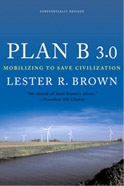
Lester Brown, Plan B 3.0L Mobilizing to Save Civilization. This one’s been on my reading list for a while, will read it soon. It has a much broader remit than the others: Brown wants to solve world poverty, cure disease, feed the world, and solve the climate crisis. I’m looking forward to this one. And it’s also available as a free download.

Okay, so what’s the challenge? Model the set of solutions in each of these books so that it’s possible to compare and contrast their solutions, compare their assumptions, and easily identify areas of agreement and disagreement. I’ve no idea yet how to do this, but a related challenge would be to come up with compelling visualizations that explain to a much broader audience what these solutions look like, and why it’s perfectly feasible. Something like this (my current favourite graphic):

Graph of cost/benefit of climate mitigation strategies

Graph of cost/benefit of climate mitigation strategies

Modularizing Climate Models

March 31st, 2009 steve 1 comment

One of the things that came up in our weekly brainstorming session today was the question of whether climate models can be made more modular, to permit distributed development, and distributed execution. Carolyn has already blogged about some of these ideas. Here’s a little bit of history for this topic.

First, a very old (well, 1989) paper by Kalnay et al,  on Data Interchange Formats, in which they float the idea of “plug compatibility” for climate model components. For a long time, this idea seems to have been accepted as the long term goal for the architecture for climate models. But no-one appears to have come close. In 1996, David Randall wrote an interesting introspective on how university teams can (or can’t) participate in climate model building, in which he speculates that plug compatibility might not be achievable in practice because of the complexity of the physical processes being simulated, and the complex interactions between them. He also points out that all climate models (up to that point) had each been developed at a single site, and he talks a bit about why this appears to be necessarily so.

Fast forward to a paper by Dickinson et al in 2002, which summarizes the results of a series of workshops on how to develop a better software infrastructure for model sharing, and talks about some prototype software frameworks. Then, a paper by Larson et al in 2004, introducing a common component architecture for earth system models, and a bit about the Earth System Modeling Framework being developed at NCAR. And finally, Drake et al.’s Overview of the Community Climate System Model, which appears to use these frameworks very successfully.

Now, admittedly I haven’t looked closely at the CCSM. But I have looked closely at the Met Office’s Unified Model and the Canadian CCCma, and neither of them get anywhere close to the ideal of modularity. In both cases, the developers have to invest months of effort to ‘naturalize’ code contributed from other labs, in the manner described in Randall’s paper.

So, here’s the mystery. Has the CCSM really achieved the modularity that others are only dreaming of? And if so how? The key test would be how much effort it takes to ‘plug in’ a module developed elsewhere…

Great women in climate science

March 23rd, 2009 steve 1 comment

In honour of Ada Lovelace day, I decided to write a post today about Prof Julia Slingo, the new chief scientist at the UK Met Office. News of Julia’s appointment came out in the summer last year during my visit to the Met Office, coincidentally on the same day that I met her, at a workshop on the HiGEM project (where, incidentally, I saw some very cool simulations of ocean temperatures). Julia’s role at the meeting was to represent the sponsor (NERC – the UK equivalent of Canada’s NSERC), but what impressed me about her talk was both her detailed knowledge of the project, and the way she nurtured it – she’ll make a great chief scientist.

Julia’s research has focussed on tropical variability, particularly improving our understanding of the monsoons, but she’s also played a key role in earth system modeling, and especially in the exploration of high resolution models. But best of all, she’s just published a very readable account of the challenges in developing the next generation of climate models. Highly recommended for a good introduction to the state of the art in climate modeling.

A Requirements Modeling Challenge

March 21st, 2009 steve 1 comment

Here’s a challenge for the requirements modelling experts. I’ve phrased it as an exam question for my graduate course on requirements engineering (the course is on hiatus, which is lucky, because it would be a long exam…):

Q: The governments of all the nations on a small blue planet want to fix a problem with the way their reliance on fossil fuels is altering the planet’s climate. Draw a goal model (using any appropriate goal modeling notation) showing the key stakeholders, their interdependencies, and their goals. Be sure to show how the set of solutions they are considering contribute to satisfying their goals. The attached documents may be useful in answering this question: (a) A outline of the top level goals; (b) A description of the available solutions, characterized as a set of Stabilization Wedges; (c) A domain expert’s view of the feasbility of the solutions.

Update: Someone’s done the initial identification of actors already.

understanding the science

March 16th, 2009 steve No comments

I originally wrote this as a response to a post on RealClimate on hypothesis testing

I think one of the major challenges with public understanding of climate change is that most people have no idea of what climate scientists actually do. In the study I did last summer of the software development practices at the Hadley Centre, my original goal was to look just at the “software engineering” of climate simulation models -i.e. how the code is developed and tested. But the more time I spend with climate scientists, the more I’m fascinated by the kind of science they do, and the role of computational models within it.

The most striking observation I have is that climate scientists have a deep understanding of the fact that climate models are only approximations of earth system processes, and that most of their effort is devoted to improving our understanding of these processes (“All models are wrong, but some are useful” – George Box). They also intuitively understand the core ideas from general systems theory – that you can get good models of system-level processes even when many of the sub-systems are poorly understood, as long as you’re smart about choices of which approximations to use. The computational models have an interesting status in this endeavour: they seem to be used primarily for hypothesis testing, rather than for forecasting. A large part of the time, climate scientists are “tinkering” with the models, probing their weaknesses, measuring uncertainty, identifying which components contribute to errors, looking for ways to improve them, etc. But the public generally only sees the bit where the models are used to make long term IPCC-style predictions.

I never saw a scientist doing a single run of a model and comparing it against observations. The simplest use of models is to construct a “controlled experiment” by making a small change to the model (e.g. a potential improvement to how it implements some piece of the physics), comparing this against a control run (typically the previous run without the latest change), and comparing both runs against the observational data. In other words, there is a 3-way comparison: old model vs. new model vs. observational data, where it is explicitly acknowledged that there may be errors in any of the three. I also see more and more effort put into “ensembles” of various kinds: model intercomparison projects, perturbed physics ensembles, varied initial conditions, and so on. In this respect, the science seems to have changed (matured) a lot in the last few years, but that’s hard for me to verify.

It’s a pretty sophisticated science. I would suggest that the general public might be much better served by good explanations of how this science works, rather than with explanations of the physics and mathematics of climate systems.

Going to the EGU General Assembly

March 9th, 2009 steve No comments

Next month, I’ll be attending the European Geosciences Union’s General Assembly, in Austria. It will be my first trip to a major geosciences conference, and I’m looking forward to rubbing shoulders with thousands of geoscientists.

My colleague, Tim, will be presenting a poster in the Climate Prediction: Models, Diagnostics, and Uncertainty Analysis session on the Thursday, and I’ll be presenting a talk on the last day in the session on Earth System Modeling: Strategies and Software. My talk is entitled Are Earth System model software engineering practices fit for purpose? A case study.

While I’m there, I’ll also be taking in the Ensembles workshop that Tim is organising, and attending some parts of the Seamless Assessment session, to catch up with more colleagues from the Hadley Centre. Sometime soon I’ll write a blog post on what ensembles and seamless assessment are all about (for now, it will just have to sound mysterious…)

The rest of the time, I plan to talk to as many climate modellers as a I can from other centres, as part of my quest for comparison studies for the one we did at the Hadley Centre.