Update (Aug 15, 2013): After a discussion on Twitter with Gavin Schmidt, I realised I did the calculation wrong. The reason is interesting: I’d confused radiative forcing with the current energy imbalance at the top of the atmosphere. A rookie mistake, but it shows that climate science can be tricky to understand, and it *really* helps to be able to talk to experts when you’re learning it… [I’ve marked the edits in green]
I’ve been meaning to do this calculation for ages, and finally had an excuse today, as I need it for the first year course I’m teaching on climate change. The question is: how much energy are we currently adding to the earth system due to all those greenhouse gases we’ve added to the atmosphere?
In the literature, the key concept is anthropogenic forcing, by which is meant the extent to which human activities are affecting the energy balance of the earth. When the Earth’s climate is stable, it’s because the planet is in radiative balance, meaning the incoming radiation from the sun and the outgoing radiation from the earth back into space are equal. A planet that’s in radiative balance will generally stay at the same (average) temperature because it’s not gaining or losing energy. If we force it out of balance, then the global average temperature will change.
Physicists express radiative forcing in watts per square meter (W/m2), meaning the number of extra watts of power that the earth is receiving, for each square meter of the earth’s surface. Figure 2.4 from the last IPCC report summarizes the various radiative forcings from different sources. The numbers show best estimates of the overall change from 1750 to 2005 (note the whiskers, which express uncertainty – some of these values are known much better than others):
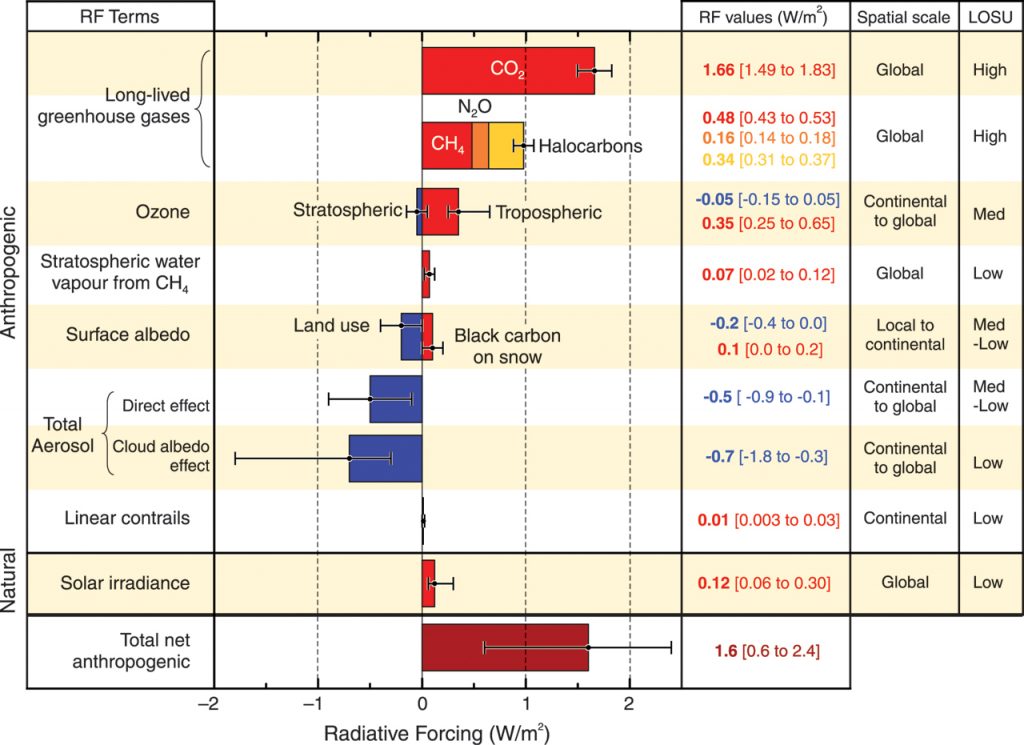
If you add up the radiative forcing from greenhouse gases, you get a little over 2.5 W/m2. Of course, you also have to subtract the negative forcings from clouds and aerosols (tiny particles of pollution, such as sulpur dioxide), as these have a cooling effect because they block some of the incoming radiation from the sun. So we can look at the forcing that’s just due to greenhouse gases (about 2.5 W/m2), or we can look at the total net anthropogenic forcing that takes into account all the different effects (which is about 1.6 W/m2).
Over the period covered by the chart, 1750-2005, the earth warmed somewhat in response to this radiative forcing. The total incoming energy has increased by about +1.6W/m2, but the total outgoing energy lost to space has also risen – a warmer planet loses energy faster. The current imbalance between incoming and outgoing energy at the top of the atmosphere is therefore smaller than the total change in forcing over time. Hansen et. al. give an estimate of the energy imbalance of 0.58 ± 0.15 W/m2 for the period from 2005-2010.
The problem I have with these numbers is that they don’t mean much to most people. Some people try to explain it by asking people to imagine adding a 2 watt light bulb (the kind you get in Christmas lights) over each square meter of the planet, which is on continuously day and night. But I don’t think this really helps much, as most people (including me) do not have a good intuition for how many square meters the surface of Earth has, and anyway, we tend to think of a Christmas tree light bulb as using a trivially small amount of power. According to wikipedia, the Earth’s surface is 510 million square kilometers, which is 510 trillion square meters.
So, do the maths, that gives us a change in incoming energy of about 1,200 trillion watts (1.2 petawatts) for just the anthropogenic greenhouse gases, or about 0.8 petawatts overall when we subtract the cooling effect of changes in clouds and aerosols. But some of this extra energy is being lost back into space. From the current energy imbalance, the planet is gaining 0.3 petawatts at the moment.
But how big is a petawatt? A petawatt is 1015 watts. Wikipedia tells us that the average total global power consumption of the human world in 2010 was about 16 terawatts (1 petawatt = 1000 terawatts). So, human energy consumption is dwarfed by the extra energy currently being absorbed by the planet due to climate change: the planet is currently gaining about 18 watts of extra power for each 1 watt of power humans actually use.
Note: Before anyone complains, I’ve deliberately conflated energy and power above, because the difference doesn’t really matter for my main point. Power is work per unit of time, and is measured in watts; Energy is better expressed in joules, calories, or kilowatt hours (kWh). To be technically correct, I should say that the earth is getting about 300 terawatt hours of energy per hour due to anthropogenic climate change, and humans use about 16 terawatt hours of energy per hour. The ratio is still approximately 18.
Out of interest, you can also convert it to calories. 1kWh is about 0.8 million calories. So, we’re force-feeding the earth about 2 x 10¹⁷ (200,000,000,000,000,000) calories every hour. Yikes.
