Nature news runs some very readable articles on climate science, but is unfortunately behind a paywall. Which is a shame because they really should be widely read. Here’s a couple of recent beauties:

The Real Holes in Climate Science, (published 21 Jan 2010) points out that climate change denialists keep repeating long debunked myths about things they believe undermine the science. Meanwhile, in the serious scientific literature, there are some important open questions over real uncertainties in the science (h/t to AH). These are discussed openly in the IPCC reports (see for example, the 59 robust findings and 55 uncertainties listed in section 6 of the Technical Summary for WG1). None of these uncertainties pose a serious challenge to our basic understanding of climate change, but they do prevent absolute certainty about any particular projection. Not only that, many of these uncertainties suggest a strong application of the precautionary principle, because many of them suggest the potential for the IPCC to be underestimating the seriousness of climate change. The Nature News article identifies the following as particularly relevant:

  • Regional predictions. While the global models do a good job of simulating global trends in temperature, they often do poorly on fine-grained regional projections. Geographic features, such as mountain ridges, which mark the boundary of different climatic zones, occur at scales much smaller than the typical grids in GCMs, which means the GCMs get these zonal boundaries wrong, especially when coarse-grain predictions are downscaled.
  • Precipitation. As the IPCC report made clear, many of the models disagree even on the sign of the change in rainfall over much of the globe, especially for winter projections. The differences are due to uncertainties over convection processes. Worryingly, studies of recent trends (published after the IPCC report was compiled)  indicate the models are underestimating precipitation changes, such as the drying of the subtropics.
  • Aerosols. Estimates of the effect on climate from airborne particles (mainly from industrial pollution) vary by an order of magnitude. Some aerosols (e.g. suphates) induce a cooling effect by reflecting sunlight, while others (e.g. black carbon) produce a warming effect by absorbing sunlight. The extent to which these aerosols are masking the warming we’re already ‘owed’ from increased greenhouse gases is hard to determine.
  • Temperature reconstructions prior to the 20th century. The Nature News article discusses at length the issues in the tree ring data used as one of the proxies for reconstructing past temperature records, prior to the instrumental data from the last 150 years. The question of what causes the tree ring data to diverge from instrumental records in recent decades is obviously an interesting question, but to me it seems to be of marginal importance to climate science.

The Climate Machine, (published  24 Feb 2010) describes the Hadley Centre’s HadGEM-2 as an example of the current generation of earth system models, and discusses the challenges of capturing more and more earth systems into the models (h/t to JH). The article quotes many of the modelers I’ve been interviewing about their software development processes. Of particular interest is the discussion about the growing complexity of these models, once other earth systems processes are added: clouds, trees, tundra, land ice, and … pandas (the inclusion of pandas in the models is an in-joke in the modeling community) . There is likely to be a limit to the growth of this complexity, simply because the task of managing the contributions of a growing (and diversifying) group of experts gets harder and harder. The article also points out that one interesting result is likely to be an increase in some uncertainty ranges from these models in the next IPCC report, due to the additional variability introduced from these additional earth system processes.

I would post copies of the full articles, but I’m bound to get takedown emails from Macmillan publishing. But I guess they’re unlikely to object if I respond to emails requesting copies from me for research and education purposes…

I’ve just ordered the book “A Vast Machine: Computer Models, Climate Data, and the Politics of Global Warming” by Paul Edwards. It’s out next month, and I’m looking forward to reading it. I found out about the book a couple of weeks ago, while idly browsing Paul’s website while on the phone with him. What I didn’t realise, until today, is that Spencer Weart’s wonderful account of the history of general circulation models (an absolute must read!), which I’ve dipped into many times, is based originally on Paul’s work. Small world, huh?

On March 30, David Mackay, author of Sustainable Energy without the Hot Air, will be giving the J Tuzo Wilson lecture in the dept of Physics (Details of the time/location here). Here’s the abstract for his talk:

How easy is it get off our fossil fuel habit? What do the fundamental limits of physics say about sustainable energy? Could a typical “developed” country live on its own renewables? The technical potential of renewables is often said to be “huge” -but we need to know how this “huge” resource compares with another  “huge”: our huge power consumption. The public discussion of energy policy needs numbers, not adjectives. In this talk I will express power consumption and sustainable production in a single set of personal, human-friendly units. Getting off fossil fuels is not going to be easy, but it is possible.

The book itself is brilliant (and freely available online). But David’s visit is even more relevant, because it will give us a chance to show him a tool our group has been developing to facilitate and share the kinds of calculations that David does so well in the book.

We started from the question of how to take “back of the envelope” calculations and make them explicitly shareable over the web. And not just shareable, but to turn them into structured objects that can be discussed, updated, linked to evidence and so on (in much the same way that wikipedia entries are). Actually, the idea started with Jono’s calculations for the carbon footprint of “paper vs. screen”. When he first showed me his results, we got into a discussion of how other people might validate his calculations, and customize them for different contexts (e.g. for different hardware setups, different parts of the world with different energy mixes, etc). He came up with a graphical layout for the calculations, and we speculated how we would apply version control to this, make it a live calculator (so that changes in the input assumptions propagate like they would in a spreadsheet), and give each node it’s own URL, so that it can be attached to discussions, sources of evidence, etc. We brainstormed a long list of other features we’d want in such a tool, and we’re now busy creating a first prototype.

What kind of tool is it? My short description is that it is a crowd-sourced carbon calculator. Because I find existing carbon calculators to be very frustrating, because I can’t play with the assumptions in the calculations. Effectively, they are closed-source.

At the time we came up with these ideas, we were also working on modeling the analysis in David Mackay’s book (JP shows some preliminary results, here and here), to see if we could come up with a way of comparing his results with other books that also attempt to layout solutions to climate change. We created a domain model (as a UML class diagram), which was big and ugly, and a strategic actor goal model (using i*), which helped to identify key stakeholders, but didn’t capture the main content of Mackay’s analysis. So we tried modeling a chapter of the book as a calculation in Jonathan’s style, and it worked remarkably well. So we realized we needed to actually build the tool. And the rest, as they say, is history. Or at least will be, once we have a demo-able prototype…

Stephen Schneider‘s book, Science as a Contact Sport, makes fascinating reading, as he really gets his teeth into the disinformation campaign against climate science. However, the book was written before the denialist industry really cranked things up in the last few months, and now he’s angrier than ever, as is clear in this report yesterday about threats of violence against climate scientists (h/t to LG). By coincidence, I spoke to Schneider by phone yesterday – we were interviewing him as part of our analysis of the use of models such as C-ROADS in tools for online discussion, such as the collaboratorium. He’s very interested in such tools, partly because they have the potential to create a new generation of much more well-informed people (he noted that many of the people participating in the discussions in the collaboratorium are students), and partly because we need to find a much better way to get the science into the hands of the policymakers.

One of the things he said stuck out, in particular because it answers the question posed by Andrew Weaver at the end of the article above. Weaver says “good scientists are saying to themselves, ‘Why would I want to participate in the IPCC?'”. Steve Schneider told me he has a simple response to this – scientists have to keep doing the assessments and writing the reports, because you never know when they will be needed. When we get another climate shock (like Katrina, or the heatwaves in Europe in 2003), the media will suddenly look for the latest assessment report, and we have to have them ready. At that moment, all the effort is worthwhile. He pointed out this happened for the crisis over the ozone hole; when the media finally took notice, the scientific assessments were ready to hand, and it mattered. That’s why it’s important to keep at it.

I’m proposing a new graduate course for our department, to be offered next January (after I return from sabbatical). For the course calendar, I’m required to describe it in fewer than 150 words. Here’s what I have so far:

Climate Change Informatics

This introductory course will explore the contribution of computer science to the challenge of climate change, including: the role of computational models in understanding earth systems, the numerical methods at the heart of these models, and the software engineering techniques by which they are built, tested and validated; challenges in management of earth system data, such as curation, provenance, meta-data description, openness and reproducibility; tools for communication of climate science to broader audiences, such as simulations, games, educational software, collective intelligence tools, and the challenges of establishing reputation and trustworthiness for web-based information sources; decision-support tools for policymaking and carbon accounting, including the challenges of data collection, visualization, and trade-off analysis; the design of green IT, such as power-aware computing, smart controllers and the development of the smart grid.

Here’s the rationale:

This is an elective course. The aim is to bring a broad range of computer science graduate students together, to explore how their skills and knowledge in various areas of computer science can be applied to a societal grand challenge problem. The course will equip the students with a basic understanding of the challenges in tackling climate change, and will draw a strong link between the students’ disciplinary background and a series of inter-disciplinary research questions. The course crosscuts most areas of computer science.

And my suggested assessment modes:

  • Class participation: 10%
  • Term Paper 1 (essay/literature review): 40%
  • Term Paper 2 (software design or implementation): 40%
  • Oral Presentation or demo: 10%

Comments are most welcome – the proposal has to get through various committees before the final approval by the school of graduate studies. There’s plenty of room to tweak it in that time.

I like playing with data. One of my favourite tools is Gapminder, which allows you to plot graphs with any of a large number of country-by-country indicators, and even animate the graphs to see how they change over time. For example, looking at their CO2 emissions data, I could plot CO2 emissions against population (notice the yellow and red dots at the top: the US and China respectively – both with similar total annual emissions, but the US much worse on emissions per person). Press the ‘play’ button to see everyone’s emissions grow year-by-year, and play around with different indicators.

Gapminder looks good, but it’s lacking a narrative – these various graphs are only really interesting when used to tell a story. You get some sense of how to add narrative with the videos of presentations based on Gapminder, for example, this gapcast, which creates a narrative around the CO2 emissions data for the US and China.

But narrative on its own isn’t enough. We also need a way to challenge such narratives. For example, the gapcast above makes it clear that China’s gross annual emissions caught up with the US in the last couple of years, largely because of China’s reliance on coal as a cheap source of electricity. But what it doesn’t tell you is that a significant chunk (one fifth) of China’s emissions are due to carbon outsourcing: creation of goods and services exported to the west. In other words, one fifth of China’s emissions really ought to be counted as belonging to the US and Europe, because it’s our desire for cheap stuff that leads to all that coal being burnt. Without this information, the Gapminder graphs are misleading.

The only tool I’ve come across so far for challenging narratives in this way is: the blog. Many of my favourite blog posts are written as reactions (challenges) to someone else’s narrative. Which leads me to suggest that the primary value of a blog isn’t so much the contents per se, but the way each post creates new links between existing chunks of information, and adds commentary to those links. Now if only I had a tool for visualizing those links, so I could get an overview of who’s commenting on what, without having to read through thousands of blog posts…

09. March 2010 · 1 comment · Categories: advocacy

I blogged a couple of weeks ago about Skeptical Science, and in particular, the new iPhone app. Now there’s another site: Truth Fights Back, which is funded by US senator Kerry, and therefore has a strong US-centric approach, but I won’t hold that against the site, as both the design and content are excellent. Maybe the climate science community did need a swift kick in the pants to get its act together on communicating with the public.

(h/t to MT)

A few more late additions to my posts last month on climate science resources for kids:

  • NASA’s Climate Kids is a lively set of tools for younger kids, with games, videos (the ‘Climate Tales’ videos are wonderfully offbeat), and even information on future careers to help the planet.
  • Climate4Classrooms, put together by the British Council, includes a set of learning modules for kids ages 11+. Looks like a very nice set of resources.
  • And my kids came back from a school book fair last week with the DK Eyewitness book Climate Change, which is easily the best kids book I’ve seen yet (we have several other books in this series, and they’re all excellent). It’s a visual feast with photos and graphics, but it doesn’t skimp on the science, nor the policy implications, nor the available clean energy technologies – in fact it seems to cover everything! The parts that caught my eye (and are done very well) include a page on climate models, and a page entitled “What scares the scientists”, on climate tipping points.
08. March 2010 · 3 comments · Categories: blogging

Over the weekend, this blog quietly celebrated its first birthday. It was a nice moment to reflect on Serendipity’s first few words, back in March 2009:

Oh, and of course, Serendipity got a few birthday presents: a new “popular posts” page (see the menu bar at the top), a great new look on the iPhone, a new page navigation bar, and a live blogroll.

This week I’m visiting NCAR, in Colorado.

As it’s my first visit, I’m still blown away by the beauty of the place – both the location and the building itself (which was designed by I M Pei, the architect better known for the Louvre pyramid). I’m hoping to get some time today to visit the hiking trails around the facility.

Anyway, I gave my talk yesterday, and have had many interesting chats with the scientists and the software engineering team working on the Community Climate System Model (CCSM).

My plan is to do a detailed comparison of the software development practices at NCAR with what I saw in my Hadley study. There seem to be more similarities than differences, but three differences that have struck me so far are:

  • the much greater use of multi-site development (which I expected – it is a community model, after all);
  • the fact that each part of the coupled model (ocean, atmosphere, land, sea ice,…) has a distinct stand-alone identity, each with its own release cycle, which means there are some interesting challenges negotiating the (sometimes) conflicting needs for the stand-alone models, versus the CCSM coupled model;
  • a much longer release cycle – years between official releases, compared to the Hadley’ Centre’s four month release cycle.

We speculated that the length of the release cycles might be largely to do with the major uses of the model. At the Hadley Centre, the climate and weather forecasting models are unified in a single code base. The weather forecasters need regular model improvements to meet annual targets for forecast improvements, and also need to make sure they are using a stable, robust model version (never a pre-release experimental one). Hence a short release cycle makes sense. At NCAR, the main driver for official releases is the IPCC assessment process, which operates on a 5-year cycle. Hence, carefully maintained official releases are only needed every few years. Meanwhile, scientists who want a more up-to-date model can play with unreleased experimental versions at their own risk, if they choose. Creating and supporting an official release takes a large software engineering overhead, and the resources just aren’t available to do it very often, in part because funding agencies much prefer to fund the science, rather than the software infrastructure needed to support that science. The lack of resources for software support seems to be a consistent problem across all the modeling centres I’ve visited so far.

03. March 2010 · 2 comments · Categories: politics

Someone recently challenged me to debate the existence of climate change. Debates are extremely useful for discussing matters that require value judgements. But pointless for establishing what is true of the physical world – for that you need the scientific process. In a complex field like climate change, the best approach is a systematic assessment of the scientific literature.

Debates are won or lost on the rhetorical skills of the debaters. If we were to debate the science of climate change, the set up is somewhat stacked against scientists. Scientists are obliged to stick to the evidence, deal honestly with the uncertainties, and attempt to show how the many different lines of evidence give us confidence in our understanding of climate systems. Scientists eschew rhetoric. Those who want to attack the science need only throw enough talking points around to sow doubt in the minds of the audience. They have at their disposal rhetorical tricks like the gish gallop. The entire exercise is pointless.

Now, if someone wants to debate, say the ethics of leaving subsequent generations to clean up our polluting ways, I’m all on it. That’s a matter of value judgement. If anyone wants to debate the existence or seriousness of anthropogenic climate change, I’d give the same response as I would if they wanted to debate the existence or strength of gravity.

Update: Joe Romm explains it in much more depth.

I’ve been hearing about Wolfram Alpha a lot lately, and I finally got a chance to watch a demo screencast today, and I have to say, it looks really cool. It’s a combination of a search engine, a set of computational widgets, and a large, curated knowledge base. Exactly the kind of thing we need for playing with climate datasets, and giving a larger audience a glimpse into how climate science is done. The only thing I can see missing (and maybe it’s there, and I just didn’t look hard enough) is the idea of a narrative thread – I want to be able to create a narrated trail through a set of computational widgets to tell a story about how we build up a particular scientific conclusion from a multitude of sources of evidence…

[Update 19 May 2010: They’ve added some climate datasets to Wolfram Alpha]

Last week, I ran a workshop for high school kids from across Toronto on “What can computer models tell us about climate change?“. I already posted some of the material I used: the history of our knowledge about climate change. Jorge, Jon and Val ran another workshop after mine, entitled “Climate change and the call to action: How you can make a difference“. They have already blogged their reflections: See Jon’s summary of the workshop plan, and reflections on how to do it better next time, and the need for better metaphors. I think both workshops could have done with being longer, for more discussion and reflection (we were scheduled only 75 minutes for each). But I enjoyed both workshops a lot, as I find it very useful for my own thinking to consider how to talk about climate change with kids, in this case mainly from grade 10 (≈15 years old).

The main idea I wanted to get across in my workshop was the role of computer models: what they are, and how we can use them to test out hypotheses about how the climate works. I really wanted to do some live experiments, but of course, this is a little hard when a typical climate simulation run takes weeks of processing time on a supercomputer. There are some tools that high school kids could play with in the classroom, but none of them are particularly easy to use, and of course, they all sacrifice resolution for ability to run on a desktop machine. Here are some that I’ve played with:

  • EdGCM – This is the most powerful of the bunch. It’s a full General Circulation Model (GCM), based on the NASA’s models, and does support many different types of experiment. The license isn’t cheap (personally, I think it ought to be free and open source, but I guess they need a rich sponsor for that), but I’ve been playing with the free 30-day license. A full century of simulation tied up my laptop for 24 hours, but I kinda liked that, as it’s a bit like how you have to wait for results on a full scale model too (it even got hot, and I had to think about how to cool it, again just like a real supercomputer…). I do like the way that the documentation guides you through the process of creating an experiment, and the idea of then ‘publishing’ the results of your experiment to a community website.
  • JCM – This is (as far as I can tell) a box model, that allows you to experiment with outcomes of various emissions scenarios, based on the IPCC projections, which means it’s simple enough to give interactive outputs. It’s free and open source, but a little cumbersome to use – the interface doesn’t offer enough guidance for novice users. It might work well in a workshop, with lots of structured guidance for how to use it, but I’m not convinced such a simplistic model offers much value over just showing some of the IPCC graphs and talking about them.
  • Climate Interactive (and the C-Roads model). C-ROADS is also a box model, but with the emissions of different countries/regions separated out, to allow exploration of the choices in international climate negotiations. I’ve played a little with C-ROADS, and found it frustrating because it ignores all the physics, and after all, my main goal in playing with climate models with kids is to explore how climate processes work, rather than the much narrower task of analyzing policy choices. It also seems to be hard to tell the difference between various different policy choices – even when I try to run it with  extreme choices (cease all emissions next year vs. business as usual), the outputs are all of a similar shape (“it gets steadily warmer”). This may well be the correct output, but the overall message is a little unfortunate: whatever policy path we choose, the results look pretty similar. Showing the results of different policies as a set of graphs showing the warming response doesn’t seem very insightful; it would be better to explore different regional impacts, but for that we’re back to needing a full GCM.
  • CCCSN – the Canadian Climate Change Scenarios Network. This isn’t a model at all, but rather a front end to the IPCC climate simulation dataset. The web tool allows you to get the results from a number of experiments that were run for the IPCC assessments, selecting which model you want, which scenario you want, which output variables you want (temperature, precipitation, etc), and allows you to extract just a particular region, or the full global data. I think this is more useful than C-ROADS, because once you download the data, you can graph it in various ways, and explore how different regions are affected.
  • Some Online models collected by David Archer, which I haven’t played with much, but which include some box models, some 1-dimensional models, and the outputs of NCAR’s GCM (which I think is the one of the datasets included in CCCSN). Not much explanation is provided here though – you have to know what you’re doing…
  • John Sterman’s Bathtub simulation. Again, a box model (actually, a stocks-and-flows dynamics model), but this one is intended more to educate people about the basic systems dynamics principles, rather than to explore policy choices. So I already like it better than C-ROADS, except that I think the user interface could do with a serious make-over, and there’s way too much explanatory text – there must be a way to do this with more hands on and less exposition. It also suffers from a problem similar t0 C-ROADS: it allows you to control emissions pathways, and explore the result on atmospheric concentrations and hence temperature. But the problem is, we can’t control emissions directly – we have to put in place a set of policies and deploy alternative energy technologies to indirectly affect emissions. So either we’d want to run the model backwards (to ask what emissions pathway we’d have to follow to keep below a specific temperature threshold), or we’d want as inputs the things we can affect – technology deployments, government investment, cap and trade policies, energy efficiency strategies, etc.

None of these support the full range of experiments I’d like to explore in a kids’ workshop, but I think EdGCM is an excellent start, and access to the IPCC datasets via the CCCSN site might be handy. But I don’t like the models that focus just on how different emissions pathways affect global temperature change, because I don’t think these offer any useful learning opportunities about the science and about how scientists work.

I’m giving a talk today to a group of high school students. Most of the talk focusses on climate models, and the kinds of experiments you can do with them. But I thought I’d start with a little bit of history, to demonstrate some key points in the development of our understanding of climate change. Here’s some of the slides I put together (drawing heavily on Spencer Weart’s the Discovery of Global Warming for inspiration). Comments on these slides are welcome.

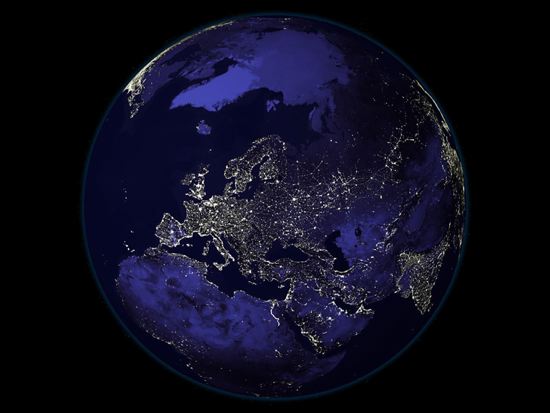
I plan to start with this image:

Spaceship Earth

…and ask some general questions like:

  • What do you think of when you see this image?
  • Where did all that energy come from?
  • Where does all that energy go? (remember, energy cannot be created or destroy, only transformed…)
  • What happens when you add up the energy needs of 6 billion people?
  • and, introducing the spaceship earth metaphor: Who’s driving this spaceship, and are the life support systems working properly?…

For millions of years, the planet had a natural control system that kept the climate relatively stable. We appear to have broken it. Now we’ve got to figure out how to control it ourselves, before we do irreversible damage. We’re not about to crash this spaceship, but we could damage its life support systems if we don’t figure out how to control it properly.

I then show some graphs showing temperature changes through pre-history, together with graphs of the recent temperature rise. As a prelude to a little history. Here’s my history slides:

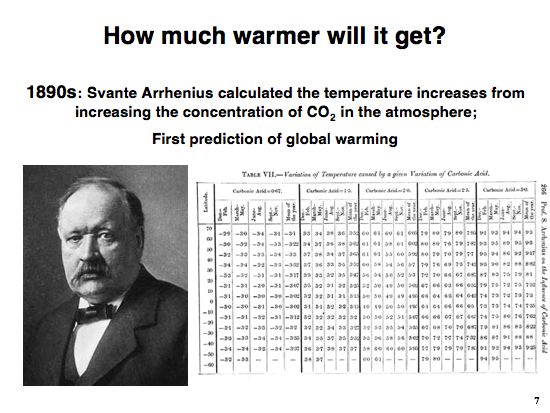
John TyndallSvante ArrheniusVilhelm BjerknesRoger RevelleCharles KeelingJule Charney

In the last year, there were three major attempts to assess the current state of the science of climate change, as an update to the 2007 IPCC reports (which are already looking a little dated). They have very similar names, so I thought it might be useful to disambiguate them:

  • The Copenhagen Synthesis Report was put together at the University of Copenhagen to summarize a conference on “Climate change: Global Risks, Challenges and Decisions” that was held in Copenhagen in March 2009. The report has some great summaries of the research presented at the conference, and puts it all together to identify six key messages:
    1. Observations show that many key climate indicators are changing near the upper boundary of the IPCC range of projections;
    2. We have a lot more evidence now on how vulnerable societies and ecosystems are to temperature rises;
    3. Rapid mitigation strategies are needed because we now know that weaker targets for 2020 will make it much more likely we will cross tipping points and make it much harder to meet long term targets;
    4. There are serious equity issues because the impacts of climate change will be felt by those least able to afford to protect themselves;
    5. Action on climate change will have many useful benefits, including improvements in health, revitalization of ecosystems, and job growth in the sustainable energy sector;
    6. Many societal barriers need to be overcome, including existing social and economic policies that subsidize fossil fuel production and consumption, weak institutions and lack of political leadership.
  • The Copenhagen Prognosis was released in December 2009, put together as a joint publication of the Stockholm Environment Institute and the Potsdam Institute for Climate Impact Research. It focuses on the evidence behind the key issues for an international climate treaty, especially the target of limiting warming to 2°C, and the political actions necessary to do this. The key messages of the report are:
    1. The 2ºC limit is a scientifically meaningful one, because of the evidence about the damage caused by rises above this level;
    2. Even rises below 2°C will have devastating impacts on vulnerable communities and ecosystems (and for this reason, 80 nations have endorsed the idea of setting a global target to be “as far below 1.5ºC as possible”);
    3. Analysis of potential tipping points shows that currently discussed political targets will be unable to protect the world from devastating climate impacts and self-amplifying warming;
    4. Global greenhouse gas emissions must decline very rapidly after 2015, and reach net zero emissions by mid-century, if we want a good (75%) chance of staying below 2ºC of warming;
    5. The challenge is great, but not impossible – such a reduction in greenhouse gases appears to be technically feasible, economically affordable, and possibly even profitable (but only if we start quickly);
    6. The challenge will be especially hard for developing countries, who will need serious assistance from developed countries to make the necessary transitions;
    7. This will require unprecedented levels of North-South cooperation;
    8. Equitable allocation of carbon dioxide budgets suggest that industrialized nations must reach zero net emissions (or even negative emissions) in the 2020-2030 timeframe;
    9. Securing a safe climate for generations to come is now in the hands of just one generation, which means we need a new ethical paradigm for addressing this;
    10. The challenge isn’t only about reducing emissions – it will require a shift to sustainable management of land, water and biodiversity throughout the world’s ecosystems;
    11. The achieve the transformation, we’ll need all of: new policy instruments, new institutions for policy development and enforcement, a global climate fund, feed-in tariff systems, market incentives, technological innovations,
  • The Copenhagen Diagnosis was also released in December 2009. It was put together by 26 leading climate scientists, coordinated by the University of New South Wales, and intended as an update to the IPCC Working Group I report on the physical science basis. The report concentrates on how knowledge of the physical science has changed the IPCC assessment report, pointing out:
    1. Greenhouse gas emissions have surged, with emissions in 2008 40% higher than in 1990;
    2. Temperatures have increased at a rate of 0.19°C per decade over the past 25 years, in line with model forecasts;
    3. Satellite and ice measurements show the Greenland and Antarctic ice sheets are losing mass at an increasing rate, and mountain glacier melting is accelerating;
    4. Arctic sea ice has declined much more rapidly than the models predicted: in 2007-2009 the area of arctic sea ice was 40% lower than the IPCC projections.
    5. Satellite measurements show sea level rise to be 3.4mm/year over the last 15 years, which is about 80% above IPCC projections. This rise matches the observed loss of ice.
    6. Revised projections now suggest sea level rise will be double what the IPCC 2007 assessment reported by 2100, putting it at least 1 meter for unmitigated emissions, with an upper estimate of 2 meters; furthermore, sea levels will continue to rise for centuries, even after global temperatures have stabilized.
    7. Irreversible damage is likely to occur to continental ice sheets, the amazon rainforest, the West African Monsoon, etc, due to reaching tipping points; many of these tipping points will be crossed before we realize it.
    8. If global warming is to be limited to 2ºC above pre-industrial levels, global emissions need to peak between 2015 and 2020, and then decline rapidly, eventually reaching a decarbonized society with net zero emissions.