
(via Wolfgang) Here’s the job title I’d like: Lectureship in Computing for the Future of the Planet at the University of Cambridge. Pity they’re only looking for junior faculty. Now, if they’re already hiring for such a position, that means my new research initiative at U of T already has some catching up to do.
Here’s the intro to a draft proposal I’m working on to set up a new research initiative in climate change informatics at U of T (see also: possible participants and ideas for a research agenda). Comments welcome.
Climate change is likely to be the defining issue of the 21st Century. The impacts of a climate change include a dramatic reduction of food production and water supplies, more extreme weather events, the spread of disease, sea level rise, ocean acidification, and mass extinctions. We are faced with the twin challenges of mitigation (avoiding the worst climate change effects by rapidly transitioning the world to a low-carbon economy) and adaptation (re-engineering the infrastructure of modern society so that we can survive and flourish on a hotter planet)
These challenges are global in nature, and pervade all aspects of society. To address them, researchers, engineers, policymakers, and educators from many different disciplines need to come to the table and ask what they can contribute. There are both short-term challenges (such as how to deploy, as rapidly as possible, existing technology to produce renewable energy; how to design government policies and international treaties to bring greenhouse gas emissions under control) and long-term challenges (such as how to complete the transition to a global carbon-neutral society by the latter half of this century).
For Ontario, climate change is both a challenge and an opportunity. The challenge comes in understanding the impacts and adapting to rapid changes in public health, agriculture, management of water and energy resources, transportation, urban planning, and so on. The opportunity is the creation of green jobs through the rapid development of new alternative energy sources and energy conservation measures. Indeed, it is the opportunity to become a world leader in low-carbon technologies.
While many of these challenges and opportunities are already well understood, the role of digital media as both a critical enabling technology and a growing service industry is less well understood. Digital media is critical to effective decision making on climate change issues at all levels. For governmental planning, simulations and visualizations are essential tools for designing and communicating policy choices. For corporations large and small, effective data gathering and business intelligence tools are needed to enable a transition to low-carbon energy solutions. For communities, social networking and web 2.0 technologies are the key tools in bringing people together and enabling coordinated action, and tracking the effectiveness of that action.
Research on climate change has generally clustered around a number of research questions, each studied in isolation. In the physical sciences, the focus is on the physical processes in the atmosphere and biosphere that lead to climate change. In geography and environmental sciences, there is a strong focus on impacts and adaptation. In economics there is a focus on the trade-offs around various policy instruments. In various fields of engineering there is a push for development and deployment of new low-carbon technologies.
Yet climate change is a systemic problem, and effective action requires an inter-disciplinary approach and a clear understanding of how these various spheres of activity interact. We need the appropriate digital infrastructure for these diverse disciplines to share data and results. We need to understand better how social and psychological processes (human behaviour, peer pressure, the media, etc) interact with political processes (policymaking, leadership, voting patterns, etc), and how both are affected by our level of understanding of the physical processes of climate change. And we need to understand how information about all these processes can be factored into effective decision-making.
To address this challenge, we propose the creation of a major new initiative on Climate Change Informatics at the University of Toronto. This will build on existing work across the university on digital media and climate change, and act as a focus for inter-disciplinary research. We will investigate the use of digital media to bridge the gaps between scientific disciplines, policymakers, the media, and public opinion.
Climate change is likely to be the defining issue of the 21st Century. The impacts of a climate change include a dramatic reduction of food production and water supplies, more extreme weather events, the spread of disease, sea level rise, ocean acidification, and mass extinctions. We are faced with the twin challenges of mitigation (avoiding the worst climate change effects by rapidly transitioning the world to a low-carbon economy) and adaptation (re-engineering the infrastructure of modern society so that we can survive and flourish on a hotter planet)
These challenges are global in nature, and pervade all aspects of society. To address them, researchers, engineers, policymakers, and educators from many different disciplines need to come to the table and ask what they can contribute. There are both short-term challenges (such as how to deploy, as rapidly as possible, existing technology to produce renewable energy; how to design government policies and international treaties to bring greenhouse gas emissions under control) and long-term challenges (such as how to complete the transition to a global carbon-neutral society by the latter half of this century).
For Ontario, climate change is both a challenge and an opportunity. The challenge comes in understanding the impacts and adapting to rapid changes in public health, agriculture, management of water and energy resources, transportation, urban planning, and so on. The opportunity is the creation of green jobs through the rapid development of new alternative energy sources and energy conservation measures. Indeed, it is the opportunity to become a world leader in low-carbon technologies.
While many of these challenges and opportunities are already well understood, the role of digital media as both a critical enabling technology and a growing service industry is less well understood. Digital media is critical to effective decision making on climate change issues at all levels. For governmental planning, simulations and visualizations are essential tools for designing and communicating policy choices. For corporations large and small, effective data gathering and business intelligence tools are needed to enable a transition to low-carbon energy solutions. For communities, social networking and web 2.0 technologies are the key tools in bringing people together and enabling coordinated action, and tracking the effectiveness of that action.
Research on climate change has generally clustered around a number of research questions, each studied in isolation. In the physical sciences, the focus is on the physical processes in the atmosphere and biosphere that lead to climate change. In geography and environmental sciences, there is a strong focus on impacts and adaptation. In economics there is a focus on the trade-offs around various policy instruments. In various fields of engineering there is a push for development and deployment of new low-carbon technologies.
Yet climate change is a systemic problem, and effective action requires an inter-disciplinary approach and a clear understanding of how these various spheres of activity interact. We need the appropriate digital infrastructure for these diverse disciplines to share data and results. We need to understand better how social and psychological processes (human behaviour, peer pressure, the media, etc) interact with political processes (policymaking, leadership, voting patterns, etc), and how both are affected by our level of understanding of the physical processes of climate change. And we need to understand how information about all these processes can be factored into effective decision-making.
To address this challenge, we propose the creation of a major new initiative on Climate Change Informatics at the University of Toronto. This will build on existing work across the university on digital media and climate change, and act as a focus for inter-disciplinary research. We will investigate the use of digital media to bridge the gaps between scientific disciplines, policymakers, the media, and public opinion.
Survey studies are hard to do well. I’ve been involved in some myself, and have helped many colleagues to design them, and we nearly always end up with problems when it comes to the data analysis. They are a powerful way of answering base-rate questions (i.e. the frequency or severity of some phenomena) or for exploring subjective opinion (which is, of course, what opinion polls do). But most people who design surveys don’t seem to know what they are doing. My checklist for determining if a survey is the right way to approach a particular research question includes the following:
- Is it clear exactly what population you are interested in?
- Is there a way to get a representative sample of that population?
- Do you have resources to obtain a large enough sample?
- Is it clear what variables need to be measured?
- Is it clear how to measure them?
Most research surveys have serious problems getting enough people to respond to ensure the results really are representative, and the people who do respond are likely to be a self-selecting group with particularly strong opinions about the topic. Professional opinion pollsters put a lot of work into adjustments for sampling bias, and still often get it wrong. Researchers rarely have the resources to do this (and almost never repeat a survey, so never have the data to do such adjustments anyway). There are also plenty of ways to screw up on the phrasing of the questions and answer modes, such that you can never be sure people have all understood the questions in the same way, and that the available response modes aren’t biasing their responses. (Kitchenham has a good how-to guide)
ClimateSight recently blogged about a fascinating, unpublished survey of whether climate scientists think the IPCC AR4 is an accurate representation our current understanding of climate science. The authors themselves blog about their efforts to get the survey published here, here and here. Although they acknowledge some weaknesses to do with sampling size and representativeness, they basically think the survey itself is sound. Unfortunately, it’s not. As I commented on ClimateSight’s post, methodologically, this survey is a disaster. Here’s why:
The core problem with the paper is the design of the question and response modes. At the heart of their design is a 7-point Likert scale to measure agreement with the conclusions of the IPCC AR4. But this doesn’t work as a design for many reasons:
1) The IPCC AR4 is a massive document, which a huge number of different observations. Any climate scientist will be able to point to bits that are done better and bits that are done worse. Asking about agreement with it, without spelling out which of its many conclusions you’re asking about is hopeless. When people say they agree or disagree with it, you have no idea which of its many conclusions they are reacting to.
2) The response mode used in the study has a built in bias. If the intent is to measure the degree to which scientists think the IPCC accurately reflects, say, the scale of the global warming problem (whatever that means), then central position on the 7-point scale should be “the IPCC got it right”. In the study, this is point 5 on the scale, which immediately introduces a bias because there are twice as many available response modes available in to the left of this position (“IPCC overstates the problem”) than there are to the right (“IPCC understates the problem”). In other words, the scale itself is biased towards one particular pole.
3) The study authors gave detailed descriptive labels to each position on the scale. Although it’s generally regarded as a good idea to give clear labels to each point on a Likert scale, the idea is that this should help users to understand that the intervals on the scale are to be interpreted as roughly equivalent. The labels need to be very simple. The set of labels in this study end up conflating a whole bunch of different ideas, each of which should be tested with a different question and a separate scale. For example, the labels in include ideas such as:
- fabrication of the science,
- false hypotheses,
- natural variation,
- validity of models,
- politically motivated scares,
- divertion of attention,
- uncertainties,
- scientists who know what they’re doing,
- urgency of action,
- damage to the environment,
…and so on. Conflating all of these onto a single scale makes analysis impossible, because you don’t know which of the many ideas associated with each response mode each respondent is agreeing or disagreeing with. A good survey instrument would ask about only one of these issues at once.
4) Point 5 on the scale (the one interpreted as agreeing with the IPCC) includes the phrase “the lead scientists know what they are doing”. Yet the survey is sent out to select group that includes many such lead scientists and their immediate colleagues. This form of wording immediately biases this group towards this response, regardless of what they think about the overall IPCC findings. Again, asking specifically about different findings in the IPCC report is much more likely to find out what they really think; this study is likely to mask the range of opinions.
5) And finally, as other people have pointed out, the sampling method is very suspect. Although the authors acknowledge that they didn’t do random sampling, and that this limits the kinds of analysis they can do, it also means that any quantitative summary of the responses is likely to be invalid. There’s plenty of reason to suspect that significant clusters of opinion chose not to participate because they saw the questionnaire (especially given some of the wording) as suspect. Given the context for this questionnaire, within a public discourse where everything gets distorted sooner or later, many climate scientists would quite rationally refuse to participate in any such study. Which means really we have no idea if the distribution shown in the study represents the general opinion of any particular group of scientists at all.
So, it’s not surprising no-one wants to publish it. Not because of any concerns for the impact of its findings, but simply because it’s not a valid scientific study. The only conclusions that can be drawn from this study are existence ones:
- there exist some people who think the IPCC underestimated (some unspecified aspect of) climate change;
- there exist some people who think the IPCC overestimated (some unspecified aspect of) climate change and
- there exist some people who think the IPCC scientists know what they are doing.
The results really say nothing about the relative sizes of these three groups, nor even whether the three groups overlap!
Now, the original research question is very interesting, and worth pursuing. Anyone want to work on a proper scientific survey to answer it?
This week, Ontario’s new Feed-in Tariff (FIT) program kicks in. The program sets specific prices that the province will pay to people who develop their own renewable power sources and sell the energy back to the grid. The key idea is that it sets up a guaranteed return on investment for people to build renewable capacity, and at a premium price, too.
The prices are set at different levels for different types of power generation and for different sizes of installations, with each price point designed to make it attractive for people to invest (with presumably some weighting in favour of the power mix the province would like to aim for). For example, a homeowner who puts solar panels on the roof will be paid 80c per kilowatt hour ($0.80/kWh), with the price guaranteed for 20 years. That’s for installations lower than 10kW; the price goes down for bigger installations (e.g. for 44c/kWh for rooftop solar larger than 500kW).
Current electricity prices in Ontario are around $0.08/Kwh, so the province is paying 10 times the current market rate for small-scale solar generation. Which makes is a pretty major subsidy. However, the entire program is intended to be revenue neutral. The creation of a large network of small suppliers may prevent the province having to build so many new power stations (the province recently turned down bids of $26 billion for new nuclear plants), and allow it phase out the existing coal plants within the next few years.
So what does this mean for the homeowner? A typical household solar installation will be well below 10kW. I grabbed a few ballpark figures from the web. A small household solar installation might generate about 12kWh per day, i.e. about $10 per day, or about $3,500 per year at the FiT rate; while the average household consumption is about 12,000kWh per year, or about $1,000 at current market prices. So the panels will pay for themselves within a few years, and then become a source of revenue!
The idea of a Feed-in Tariff program isn’t new – they’ve worked well in Europe for a number of years, and indeed the province of Ontario has had one in place since 2006. However the old program was criticised for setting rates too low, especially for small-scale generation; the new program increases the rates dramatically – for example the new small scale solar rate is twice the old rate.
Full details of the new program are at the Ontario Power Authority’s site.
I’m teaching our introductory software engineering course this term, for which the students will be working on a significant software development project over the term. The main aim of the course is to get the students thinking about and using good software development practices and tools, and we organise the term project as an agile development effort, with a number of small iterations during the term. The students have to figure out for themselves what to build at each iteration.
For a project, I’ve challenged the students to design new uses for the Canadian Climate Change Senarios Network. This service makes available the data on possible future climate change scenarios from the IPCC datasets, for a variety of end users. The current site allows users to run basic queries over the data set, and have the results returned either as raw data, or in a variety of visualizations. The main emphasis is on regional scenarios for Canada, so the service offers some basic downscaling, and ability to couple the scenarios with other regional data sources, such as data from weather monitoring stations in the region. However, to use the current service, you need to know quite a bit about the nature of the data: it asks you which models you’re interested in; which years you want data for (assumes you know something about 30-year averages); which scenarios you want (assumes you know something about the standard IPCC scenarios); which region you want (in latitude and longitude); and which variables you want (assumes you know something about what these variables measure). The current design reflects the needs of the primary user group for which the service was developed – (expert) researchers working on climate impacts and adaptation.
The challenge for the students on my course is to extend the service for new user groups. For example, farmers who want to know something about likely effects of climate change on growing seasons, rainfall and heat stress in their local area. High school students studying climate and weather. Politicians who want to understand what the latest science tells us about the impacts of climate change on the constituencies they represent. Activists who want to present a simple clear message to policymakers about the need for policy changes. etc.
I have around 60 students on the course, working in teams of 4. I’m hoping that the various teams will come up with a variety of ideas for how to make this dataset useful to new user groups, and I’ve challenged them to be imaginative. But more suggestions are always welcome…
This post by Paul Gilding sums up my experience very well:
Some days my head hurts, as I shift between what feels like two parallel universes in the climate change debate. First I have these conversations with world-class scientists who calmly lay out the scientific view of the various risks posed by climate change and their relative scale and likelihoods. They tell me the science says it is almost certain the impacts will be serious and destabilising for our society and our economy. The science also describes a lower level of risk – which they find hard to quantify but generally say between 10% and 50% – that the impacts of climate change will be catastrophic, perhaps even civilisation threatening. This could include widespread famine, war and economic collapse. Not certain, but a reasonable possibility.
It is very clear when you listen to these scientists and read their peer-reviewed reports that, on any calm and rational analysis, we should be preparing for a carbon reduction war. Yes, a war – with all that implies about focus, effort and sacrifice. The threat posed is, after all, a “clear and present danger” and the response should be strong, global and immediate. This should be a ‘whatever it takes’ moment.
Then I shift into the parallel universe.
I spend time in corporate boardrooms and listen to the analysis of business executives who explain how we mustn’t damage the economy by “over-reacting”….
Go read the rest.
Next week is Toronto Design Week, which includes the Green Building Festival on Wednesday and Thursday. They have cheap student passes at $50, but register quickly if you’re interested.
The Global Campaign for Climate Action is an umbrella organisation, based in Montreal, which aims to coordinate many diverse environmentalist and science groups (including Greenpeace, WWF, Union of Concerned Scientists, Oxfam, 350.org, and many others) to focus attention on the need for an ambitious, fair and binding climate treaty at the Copenhagen talks in December. Their campaign leading up to the Copenhagen meeting is called TckTckTck, and it promises a bold series of actions over the next few months.
The first of these is next week: Global Wake Up Call (which nicely fits with the “sleepwalking into disaster” idea), and ties in with the premier of The Age of Stupid on Sept 21. The idea is to coordinate the sound of bells and telephones ringing around the world at 12:18pm on Monday, as the wake up call. There’s quite a few in Toronto – including one at Dundas Square. I’ve no idea if this flashmob style protesting works, but I guess there’s one way to find out. Anyone fancy a walk down to Dundas Square on Monday lunchtime?
Update: The Age of Stupid is being screened at the Royal Theatre on Monday night, 7pm.
Here’s an interesting competition (with cash prizes), organized by the Usability Professionals’ Association, to develop a new concept or product, with user-centred design principles, that aims to cut energy consumption or reduce pollution.
And here’s another: A Video Game Creation Contest to create a playable video game that uses earth observations to help address environmental problems.
I’ve just been browsing the sessions for the AGU Fall Meeting, to be held in San Francisco in December. Abstracts are due by September 3. The following sessions caught my attention:
- ED12: Using Web 2.0 Technologies to Facilitate Science Communications. (We could submit an abstract describing some of the tools we’ve been building);
- GC03: Methodologies of Climate Model Confirmation and Interpretation (A great place for Jon to present the results of his study on how climate scientists come to trust their code)
- IN06: The Management and Dissemination of Earth and Space Science Models (Another chance for me to talk about the findings from my Hadley study)
- IN07: Earth Science Software Reuse: Experiences and Challenges (lots of things I could say, but probably not enough material for a real abstract)
- IN11: Challenges in Achieving Earth System Model Interoperability (One for Carolyn’s work)
- IN13: Emerging Issues in e-Science: Collaboration, Provenance, and the Ethics of Data (I’d want to hang out at this one and hear what people have to say; might be a good place for Alicia to present her work too)
- IN17: Data and Informatics for Environmental Decision Making (ditto)
Plus some sessions that sound generally interesting:
- A44: Towards a Policy-Relevant, Open and Transparent Global Greenhouse Gas Monitoring and Information System (GHGIS) (Sounds like a fascinating requirements analysis project)
- ED07: Climate Change Adaptation and Mitigation Education (relevant to the stuff Jon and I were talking about earlier this year on climate models as educational tools)
- IN12: Semantic eScience (because I’m a sucker for social epistemology)
I’ve been tasked with identifying people and initiatives across campus that are involved in Digital Media and Climate Change/Environment. It’s part of a push by the University for greater funding for digital media research. And as everyone seems to interpret the term digital media differently, I’m going to give it the broadest possible interpretation: if it involves doing things with computers (either as a primary research tool or as an object of study), it counts as digital media. Here’s my list of faculty across the University who are doing relevant research. Feel free to suggest more people, or to rearrange my categories…
Understanding Climate Change through Earth Systems Modeling
- William Gough, Sharon Cowling, Danny Harvey, Scott Munro, Jing Chen, John Desloges, Geography;
- Dick Peltier, Ted Shepherd, Dylan Jones, Paul Kushner, Kent Moore, Physics
- Jonathan Abbatt, Chemistry
- Greg Evans, Chemical Engineering
- Steve Easterbrook, Computer Science
- John Caspersen, Sean Thomas, Forestry
- John Coleman, Cell & Systems Biology
- George Arhonditsis, Ecological Modeling Lab, UTSC
- Ulrich Wortmann, Geology
Impacts of Climate Change and Adaptation
- Brad Bass and Monirul Mirza at the Centre for the Environment
- Marie-Josee Fortin, Arthur Weis, Ecology and Evolutionary Biology
- Miriam Diamond, Virginia MacLaren, Dept of Geography
- the Education Alliance for a Sustainable Toronto (EAST)
Earth Systems Management (as in: how we manage forests, water supplies, land use, etc)
- David Martell, Mike Wotton, (FireLab) and Shashi Kant in the Faculty of Forestry
- Barry Adams, Brent Sleep, Phil Byer, Bryan Karney (Water/hydrology), Civil Engineering
- Tenley Conway, (land use and urbanization) Dept of Geography
Sustainable design and energy management (e.g. architectural design, urban planning, etc)
- Beth Savan, Sarah Wakefield at the UofT Sustainability Office (e.g. the St George Campus Greenhouse Gas Inventory)
- Tom Bessai, John Danahy, Ted Kesik, Faculty of Architecture
- Danny Harvey, Dept of Geography
- Matt Ratto, iSchool
Sustainable Transportation Systems
- Eric Miller (modeling) A. S. Shalaby, (simulations) Heather MacLean (lifecycle analysis), Civil Engineering
Geographical Information Systems (GIS) and Environmental Informatics
- Don Boyes, Vincent Robinson,Department of Geography
Policy and Decision Making
- Ingrid Stefanovic at the Centre for the Environment
- Anthony Wensley, Rotman
- Steven Bernstein, Munk Centre
- Greg Jamieson, Mechanical and Industrial Engineering
- Eric Yu, Faculty of Information
- The Cities Centre
For sociologists, a strong call to action in the report of an NSF sponsored workshop on Sociological Perspectives on Global Climate Change. Like the APA report I wrote about earlier, it’s a call to action, covering the key research challenges for the field, and addressing the barriers that might prevent researchers participating in such research. Among the recommendations are better data collection on organisational and community behaviour relevant to climate change, and better inter-disciplinary links:
“…social scientists are seldom consulted except as an afterthought in natural science and engineering research projects […and…] social scientists tend not to seek out collaborations with natural scientists and engineers and often are uninformed about major research programs on climate change. The result is that the research of each community does not tend to be informed by the insights and resources available from the others. This is true not only between the social sciences and the natural sciences, but among the social sciences themselves. For instance, sociological research projects seldom incorporate spatial processes, behavioral analyses, or economic models.
For a short summary, read the article “The Wisdom of Crowds” in this week’s Nature Reports, and indeed, the editorial that goes with it.
…is a section heading on page 23 of this new report, “Psychology and Global Climate Change: Addressing a Multi-faceted Phenomenon and Set of Challenges” from the APA on how the field of psychology can contribute to the climate crisis. It’s a very good report, covering many of the core issues in the psychology of climate change, and laying out a research agenda for the field. Let me just quote the final paragraph of the report:
“a psychological perspective is crucial to understanding the probable effects of climate change, to reducing the human drivers of climate change, and to enabling effective social adaptation. By summarizing the relevant psychological research, we hope not only to enhance recognition of the important role of psychology by both psychologists and non-psychologists, but also to encourage psychologists to be more aware of the relevance of global climate change to our professional interests and enable them to make more of the contributions the discipline can offer.”
Or, if you’re short of time, just read the press release.
Now, where’s the equivalent task force for the computer science community?
I’ve spent some time pondering why so many people seem unable or unwilling to understand the seriousness of climate change. Only half of all Americans understand that warming is happening because of our use of fossil fuels. And clearly many people still believe the science is equivocal. Having spent many hours arguing with denialists, I’ve come to the conclusion that they don’t approach climate change in a scientific way (even those who are trained as scientists), even though they often appear to engage in scientific discourse. Rather than assessing all the evidence and trying to understand the big picture, climate denialists start from their preferred conclusion and work backwards, selecting only the evidence that supports the conclusion.
But why? Why do so many people approach global warming in this manner? Previously I speculated that the Dunning-Kruger effect might explain some of this. This effect occurs when people at the lower end of the ability scale vastly overestimate their own competence. Combine this with the observation that few people really understand the basic system dynamics, for example that concentrations of greenhouse gases in the atmosphere will continue to rise even if emissions are reduced, as long as the level of emissions (burning fossil fuels) exceeds the removal processes (e.g. sequestration by the oceans). The Dunning-Kruger effect suggests that people whose reasoning is based on faulty mental models are unlikely to realise it.
While incorrect mental models and overconfidence might explain some of the problem that people have in accepting the scale and urgency of the problem, it doesn’t really explain the argumentation style of climate denialists, particularly the way in which they latch onto anything that appears to be a weakness or an error in the science, while ignoring the vast majority of the evidence in the published literature.
However, a series of studies by Kahan, Braman and colleagues explain this behaviour very well. In investigating a key question in social epistemology, Kahan and Braman set out to study why strong political disagreements seem to persist in many areas of public policy, even in the face of clear evidence about the efficacy of certain policy choices. These studies reveal a process they term cultural cognition, by which people filter (scientific) evidence according to how well it fits their cultural orientation. The studies explore this phenomenon for contentious issues such as the death penalty, gun control and environmental protection, as well as issues that one might expect would be less contentious, such as immunization and nanotechology. It turns out that not only do people care about how well various public policies cohere with their existing cultural worldviews, but their beliefs about the empirical evidence are also derived from these cultural worldviews.
For example, in a large scale survey, they tested people’s attitudes to the perception of risks from global warming, gun ownership, nanotechnology and immunization. They assessed how well these perceptions correlate with a number of characteristics, including gender, education, income, political affiliation, and so on. While political party affiliation correlates well with attitudes on some of these issues, there was a generally stronger correlation across the board with the two dimensions of cultural values identified by Douglas and Wildavsky: ‘group’ and ‘grid’. The group dimension assesses whether people are more oriented towards individual needs (‘individualist’) or the needs of the group (‘communitarian’); and the grid dimension assesses whether people tend to believe societal roles should be well defined and differentiated (‘hierarchical’) or those who believe in more equality and less rigidity (‘egalitarian’).
The most interesting part of the study, for me, is a an experiment on how perceptions change depending on how the risk of global warming is presented. About 500 subjects were given one of two different newspaper articles to read, both of which summarized the findings of a scientific report about the threat of climate change. In one version, the scientists were described as calling for anti-pollution regulations, while in the other, they were calling for investment in more nuclear power. Both these were compared with a control group who saw neither version of the report. Here are the results (adapted from Kahan et al, with a couple of corrections supplied by the authors):

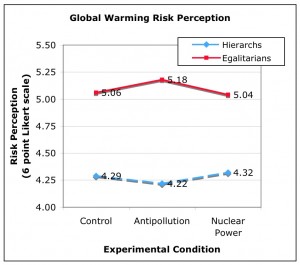
In all cases, the mean risk assessment of the subjects correlates with their position on these dimensions: individualists and hierarchs are much less worried about global warming than communitarians and egalitarians. But more interestingly, the two different newspaper articles affect these perceptions in different ways. For the article that described scientists as calling for anti-pollution measures, people had quite opposite reactions: for communitarians and egalitarians, it increased their perception of the risk from global warming, but for individualists and hierarchs, it decreased their perception of the risk. When the same facts about the science are presented in an article that calls for more nuclear power, there is almost no effect. In other words, people assessed the facts in the report about climate change according to how well the policy prescription fits with their existing worldview.
There are some interesting consequences of this phenomenon. For example, Kahan and Braman argue that there is really no war over ideology in the US, just lots of people with well-established cultural worldviews, who simply decide what facts (scientific evidence) to believe based on these views. The culture war is therefore really a war over facts, not ideology.
The studies also suggest that certain political strategies are doomed to failure. For example, a common strategy when trying to resolve contentious political policy issues is to attempt to detach the policy question from political ideologies, and focus on the available evidence about the consequences of the policy. Kahan and Braman’s studies show this won’t work, because different cultural worldviews prevent people from agreeing what the consequences of a particular policy will be (no matter what empirical evidence is available). Instead, they argue that policymakers must find ways of framing policy so that affirm the values of diverse cultural worldviews simultaneously.
As an example, for gun control, they suggest offering a bounty (e.g. a tax rebate) for people who register handguns. Both pro- and anti- gun control groups might view this as beneficial to them, even though they disagree on the nature of the problem. For climate change, the equivalent policy prescriptions include tradeable emissions permits (which appeal to individualists and hierarchists), and more nuclear power (which egalitarians and hierarchists tend to view as less risky when presented as a solution to global warming).
Update: There’s a very good opinion piece by Kahan in the January 21, 2010 issue of Nature.
The recording of my Software Engineering for the Planet talk is now available online. Having watched it, I’m not terribly happy with it – it’s too slow, too long, and I make a few technical mistakes. But hey, it’s there. For anyone already familiar with the climate science, I would recommend starting around 50:00 (slide 45) when I get to part 2 – what should we do?
[Update: A shorter (7 minute) version of the talk is now available]
The slides are also available as a pdf with my speaking notes (part 1 and part 2), along with the talk that Spencer gave in the original presentation at ICSE. I’d recommend these pdfs rather than the video of me droning on….
Having given the talk three times now, I have some reflections on how I’d do it differently. First, I’d dramatically cut down the first part on the climate science, and spend longer on the second half – what software researchers and software engineers can do to help. I also need to handle skeptics in the audience better. There’s always one or two, and they ask questions based on typical skeptic talking points. I’ve attempted each time to answer these questions patiently and honestly, but it slows me down and takes me off-track. I probably need to just hold such questions to the end.
Mistakes? There are a few obvious ones:
- On slide 11, I present a synoptic view of the earth’s temperature record going back 500 million years (it’s this graph from wikipedia). I use it to put current climate change into perspective, but also also to make the point that small changes in the earth’s temperature can be dramatic – in particular, the graph indicates that the difference between the last ice age and the current inter-glacial is about 2°C average global temperature. I’m now no longer sure this is correct. Most textbooks say it was around 8°C colder in the last ice age, but these appear to be based on an assumption that temperature readings taken from ice cores at the poles represent global averages. The temperature change at the poles is always much greater than the global average, but it’s hard to compute a precise estimate of global average temperature from polar records. Hansen’s reconstructions seem to suggest 3°C-4°C. So the 2°C rise shown on the wikipedia chart is almost certainly an underestimate. But I’m still trying to find a good peer-reviewed account of this question.
- On slide 22, I talk about Arrhenius’s initial calculation of climate sensitivity (to doubling of CO2) back in the 1880’s. His figure was 4ºC-5ºC, whereas the IPCC’s current estimates are 2ºC-4.5ºC. And I need to pronounce his name correctly.
What’s next? I need to turn the talk into a paper…